President Mas response to PP Catalonia leader Alícia Sánchez Camacho. September 26, 2013, Parliament of Catalonia. Original transcript in Catalan. (pages 26-28)
(The video from this section can be viewed in this article on VilaWeb (in the original Catalan). Even if you don't understand it, his tone is pretty clear.)
Now let's get to the last bit, shall we? which is what you said. And now you all are going to say no to us about one more thing, which is to be able to resolve this conflict that we have through a specific referendum. That, Mrs. Sánchez-Camacho, won't be possible either? I ask you this: are you all, who you represent, disposed, are disposed to finding a legal way, which can be negotiated, so that in Catalonia this very serious conflict can be resolved? Which was not invented by the Government, Mrs. S-C, this is not a conflict that was invented by the Government or, if you will allow me the personal reference, by me. And you all don't understand what is really happening—what is really happening—means that therefore it's impossible to find a good solution.
At this point, I am tired of trying to explain in Madrid that what is happening in Catalonia is not a minor thing, that there are many people who have made a mental switch with respect to the Spanish State, they have made a mental switch, and the thought is of disconnecting from the State. And the moment that these mental shifts take place is when great changes occur in society, and that is what is happening in Catalonia.
You all can keep saying that whatever you want about what happened on September 11, say whatever you want, go ahead and say that the majority of the country wasn't there, but you must accept one thing: if the majority of the country wasn't there, why don't we resolve the question of whether the majority of the country is in favor of one thing or another by voting? Why don't we resolve it by voting, if you all have doubts about where the majority of the country stands?
Yesterday, I explained the whole sequence of events, of three or four years, or five or six, and I'll tell you one last thing: don't look at what happened on the street if you don't want to, you all don't want to look at the street because you don't like what is happening, you don't like seeing 1.6 million people holding hands asking for the independence of Catalonia, you don't like it, I understand that—I understand it—but what I don't understand is something else: what I don't understand is how you're not able to read the results of the elections of November 25 that occurred 10 months ago. I don't understand why that is so hard for you to be able to read.
Because that [election] result was very clear, that result gives a very clear majority in favor of the right to decide and to have a referendum—very clear. And you can't suppose that what you and your party represents should be imposed on this wide majority that is next to you. You can't suppose that that which you all defend—legitimately—should take precedence over everything else, because that is not normal, it's not normal.
So, stop talking about the silent majority, instead resolve it another way: by voting. A clear referendum. We have given you many methods for doing so, many. There are five legal methods. The only thing that's necessary is political will. And one second thing: a lot of courage in Madrid by those who would suggest it, a lot of courage, lots of courage, I recognize that, they'll have to have a lot of courage. But watch out, because if you don't have the courage to deal with it now, you'll have to deal with it later under different conditions. They'll be peaceful, obviously, and they'll be democratic, obviously, because it couldn't be any other way coming from the Catalan people, it will be democratic and it will peaceful, but it will be.
All of the cards are on the table, I haven't hidden anything, and I told you "I am prepared to get to—in order to hold a referendum—to the last possible legal tool that a president has, which is the convocation of elections." I'm not hiding anything, all my cards are on the table. And our attitude is absolutely constructive, because with regard to this majority of the people of Catalonia, it's there, Mrs. S-C, it's there. What's happened has happened, and it's there, this majority is there, and it's very large.
Keeping that in mind, the only way to resolve these conflicts in a democracy is by voting. It's what other countries do. When you vote, you either lose or win. Listen, those who now say independence, may go to vote and then lose, or maybe they will win, but that is the risk of a referendum.
But, Mrs. S-C, that is the risk of a referendum. Tell us one thing: what is the risk of not having a referendum? Have you asked yourselves that? Change your perspective, change it for one second, I only ask you to take a single moment in this regard, the way the country is feeling right now is not the obsession of the president or of the Government, change your perspective for just a second. Study the costs of not having the referendum, and compare that with the costs—if there are any—of having a referendum. That is how this must be resolved, democratically, there is a majority of the country that wants to radically change the status quo in Catalonia, that wants to go to the extreme that Catalonia become a state, an independent state. That could happen, it could happen and many people are in favor if it.
The only way to resolve if that is what will happen or not, is for this referendum to take place, because that is the current that will not change, Mrs. S-C. Not only that, the more negative the position of the institutions of the State against the referendum are, the more it will grow. Because in all democratic and normal civilized countries, when they have problems like these, they resolve these issues by consulting the people. Ignoring the problem will not resolve it, the problem will continue being there. Therefore, grab the bull by the horns, if you'll allow me this expression, an expression translated from Spanish that perhaps you'll like, grabbing the bull by the horns, and understand that beyond speeches about silent majorities and all that, there is a very big problem here, and that problem can be resolved, can be resolved democratically, and you'll have to accept the consequences of the march of time and of the majority will of the people that consider themselves to be a people, who consider themselves to be a nation, who consider themselves to be a society of their own.
And in our house, in this Parliament, it is an expression, this people that we're referring to, as I said yesterday, is a mixed people, of quite mixed origins, of languages, of origins of all types, of beliefs, not to mention ideologies, etc. it's a very mixed people, very mixed. And you end end up saying "You are dividing the Catalans." No, Mrs. S-C, do you know what unites Catalans at this moment when there is conflict? And this one cannot be avoided, conflict exists, but that's OK, it's not a violent conflict, it can be a perfectly civilized conflict, it must be a normal conflict, we're in the 21st century, we're in the European Union, we have agreed to a multitude of international agreements about human rights, about whatever you all want. One basic inspiration of the European Union that you made reference to is democracy. Conflict exists, but conflict doesn't mean that this conflict has to get out of hand if we don't make it bigger than it is. Conflict means that we have to face it, and then what unites Catalans, Mrs. S-C, I believe.
Showing posts with label President Mas. Show all posts
Showing posts with label President Mas. Show all posts
Thursday, September 26, 2013


General Policy Debate, September 25, 2013, Catalan Parliament
Opening remarks by President Mas:
I shall begin this General Policy Debate, the first of this 10th legislature, by covering the four major themes currently affecting our country and that, depending on their evolution, will outline the future of Catalonia both in the short and in the long term. I'd like to point out, from the very start, that the four major topics that I will mention should not be seen as discrete compartments, but rather intersecting and overlapping interdependent issues.
Concretely, I'm referring to:
Let's dig in, then, to these four areas that I propose to you.
September, 2005: approval in this Parliament and by a wide majority, of the proposal for a new Statute of Autonomy.
End of 2005: confirmation that the president of the Government of Spain, J.L. Rodríguez Zapatero, had for a long time retreated from and had no intention of fulfilling his famous and public commitment to “support the Statute that comes out of the Parliament”.
January, 2006: Moncloa Pact in order to unblock the whittled down Statute that was more dead than alive.
June, 2006: Referendum in Catalonia to approve the Statute previously approved in the General Spanish Congress. The Yes vote won 74%, with a turnout close to 50%. The new Statute goes into effect. As always, there begin to be ways in which the State does not follow the agreements. Once again, the bar is lowered below where it had been lowered to before.
June, 2010: Ruling of the Constitutional Court, on the suits from the Partido Popular and the Spanish Ombudsman, that eliminates essential portions of the Spanish Congress-approved Statute—that is, approved by the body which represents the sovereignty of the Spanish people—and by the Catalan people in a referendum. An unnecessary, disproportionate, humiliating ruling that puts an end to 100 years of Catalanist action based on faith in a constructive and loyal understanding with the Spanish State.
Miquel Roca, one of the fathers of the Constitution, writes then that "the common project of 78 has been exhausted. The Constitutional Court has buried it. Spain has a problem."
July 10, 2010: Massive demonstration in Barcelona under the slogan "We are a nation, we decide". The then-President of the Generalitat, José Montilla, attends.
July, 2012: the Parliament of Catalonia approves, also with a wide majority, the proposal for a fiscal pact in line with economic agreement.
National Day, September 11, 2012: One million and a half people, in the most well-attended demonstration ever held in Catalonia, take to the streets of the capital of Catalonia in the most civic fashion, behind the placard, "Catalonia, New State of Europe". Nine days later, on September 20 of last year, [Spanish] President Mariano Rajoy closes the door on any negotiation on the fiscal pact. With this refusal made clear, I decided to dissolve the Parliament and convoke elections for November 25, 2012.
November 25, 2012: The highest turnout of all the Parliamentary elections since 1980. The result is well known, and determines the current composition of this chamber. Those elections were held in order to obtain the legitimacy for beginning the road that we are following today: the right to decide, the referendum, national transition, and Catalonia's own State. From those elections on, no one can talk about silent majorities when referring to the political future of Catalonia: 70% turnout at the polls is a loud majority. Very loud, and at the same time very calm.
Seeing the description that I have laid out, can anyone really be surprised that we've gotten to this point? We are here because the Constitutional Court ruling erected a wall between the majority of the Catalan population and the Spanish State, and at the same time gives solid evidence that the famous "fitting" of Catalonia in the State is not possible in the terms that the multicultural, diverse, and varied forces of Catalanism historically and until very recently were determined to find. Put another way, fitting Catalonia into Spain is only possible if Catalonia renounces its collective project, if it gives up being a political subject. If we accept being an object, fitting together would be possible. If we want to be a subject, with our own personality and identity, with the ability to offer the 7.5 million Catalans their own project, that is not subordinate, then fitting together is not possible, despite our repeated attempts over a very long period. More than one hundred years.
But that's not the only story. Meanwhile, Catalan society has not conformed, has not lowered its head, is not crossing its arms in resignation. The country is alive, very much alive. And it is reacting. It is mobilizing. It is tired of a relationship with the State in which it sees no future, under the current conditions. I may be wrong, but I'll give you my perception: Catalonia feels real affection toward Spain, Catalonia loves Spain, but it no longer trusts the Spanish State.
This country that is alive and hopeful for a different and better future, that wants to be the protagonist of its own destiny, is the one that came out last September 11th, democratically, peacefully, massively, civically, and even joyously, despite the difficulties of its current situation, and forms the Catalan Way toward Independence, a great expression of its faith in its own collective future, and impresses the world with its vitality, its enormous capacity for mobilizing itself, and even for its good manners.
This time, even the State, usually arrogant and cavalier about Catalan national questions, almost as often condescending as it ignorant, had no other option than to realize it has a problem. A big problem.
How is this situation that we are experiencing being translated in this chamber of our Parliament?
Over a range of variations, that go from Constitutional reform to the configuration of an independent state, one thing remains clear: 107 of the 135 members of this Parliament had electoral platforms that included proposals that approved different systems for changing the current relationship between Catalonia and the rest of the Spanish State.
The right to decide and the will to hold a referendum are therefore the desire of a wide spectrum, and indeed a wide majority, of this Parliament. They are today and they will be tomorrow. While it is true that the views on the referendum are varied and diverse, it's also true that practically 80% of the Parliament is very clear that we cannot maintain the current status quo.
We are facing a new political centrality in Catalonia, a new era. Very different from previous eras. I myself, at one moment, even spoke of the twilight zone. And now we are here, and in addition, we know that that there is no turning back possible. In these last few months, clear steps have been made in the direction of the path that the people of Catalonia traced for us in the elections 10 months ago.
On January 23, the Parliament of Catalonia approved in plenary session a historic declaration of sovereignty and of the right to decide of the people of Catalonia, in which the beginning of the "process to realize the exercising of the right to decide so that the citizens of Catalonia can decide their collective political future" was solemnly demonstrated, together with the principles of sovereignty (that is, that the people of Catalonia are a political subject), democratic legitimacy, transparency, dialogue, social cohesion, Europeanism, legality, the central role of the Parliament, and participation.
Incredibly, the Spanish Government took the Declaration of Sovereignty before the Constitutional Court, which declared its suspension. Regardless of the final decision that it will end up making, what's absurd and difficult to understand is that they are trying to cancel a political position, which expresses the will of the people of Catalonia to exercise their right to decide by strictly democratic means. How can they invalidate a democratic expression of will? Does it mean that a wide majority of Catalans must stop expressing our will or saying what we think? Can you invalidate a declaration that expresses a peaceful and democratic thought?
Later, on March 13, the Parliament approved by an even wider majority a resolution in which it pressed the Government to "initiate a dialogue with the Government of the State in order to make possible the celebration of a referendum of the citizens of Catalonia in order to decide on their future."
In this way, then, the Parliament was giving form to the legislature's national objectives: political positioning in favor of initiating the process for the referendum and a mandate for the Government to open dialogue and negotiate with the Spanish government.
In that same direction, last July 1, the Parliament constituted the Study Committee on the Right to Decide, thanks to a proposal by 5 of the 7 political parties in this chamber.
At the same time, we have worked toward another of the elements that is fundamental, in our opinion: the process has to have support from as wide a part of the political spectrum as possible, as well as important support from society, and that this support continue to grow. The wider the better, since that is what will make this incontestable. To this end, on June 26, the National Pact for the Right to Decide was instituted, with a goal of involving the civil society, the most representative institutions of the country, the local community, and the political powers that are in favor of having a referendum, regardless of their final position at the moment of the referendum.
Last week, President Rigol publicly presented the proposal of the Declaration of the Right to Decide, along with the objective in the next few months, that all of those signed up for the Pact can subscribe to it, thereby expressing the unequivocal cross-cultural and cross-organization determination that exists around this process. For its part, the Government constituted in April the National Transition Advisory Committee, made up of 14 people of important and recognized prestige throughout the university and professional worlds, which is charged with analyzing and foreseeing the major decisions that the Government will have to make, and the structures of State that Catalonia will have to have, as it becomes a new state. It's clear that we are embarking on a new era in which we have never worked so deeply or with so much detail. It's also evident that this is a process that we have to be capable of carrying out well, with rigor, seriousness and careful steps. Therefore, the work that this advisory council is doing will be useful for creating a clear road map of the decisions and elements to keep in mind for the future. In that sense, the first report presented by the Council last July 25 addresses the referendum on Catalonia's political future and rigorously lays out the legal paths that would allow it to be held. Indeed there are numerous and varied legal frameworks for holding a referendum, but the political will must be there in order to take advantage of them.
I would be remiss if I didn't remind you that this Chamber is processing at this very moment a proposal for a referendum law, and the goal is for it to be approved during this year 2013. It's important to point out that this law that develops the powers granted to us by the Statute of Autonomy, particularly in Article 122, is quite relevant, since it could be one of the legal paths possible for celebrating the referendum.
Finally, following the resolution approved by this Parliament in the month of March that I mentioned earlier, last July 26 I wrote a letter to the president of the Spanish government to express to him in a solemn manner the feeling, will, and desire of a very large majority of the people of Catalonia. Further, I encouraged him to begin a dialogue and negotations for celebrating a referendum in an agreed fashion, under the legal frameworks that we establish. Beyond the letter, this desire of dialogue had also been expressed in other earlier meetings with President Rajoy.
President Rajoy responded on September 14 to the letter that I sent him. His answer focused on what he understands as an offer of open paths of dialogue and respect within a judicial framework. The Government that I preside, and I myself are, and have been, in favor of the maximum possible dialogue between institutions and we have offered up to 5 possible legal paths for holding a referendum.
We will take advantage of any sliver of possibility of dialogue with the institutions of the State. At the same time, there is a crucial question that even today has not been answered and which conditions any process of dialogue: Does the Spanish State accept holding a referendum in Catalonia to know the will of the Catalan people about the political future of their country? If it accepts this democratic principle, and responds to the common will of the Catalan people, then we will have to negotiate and agree on the legal framework to make it possible. However, if the Spanish State does not accept this principle, then what is there to negotiate about?
For the Government of Catalonia's part, the road map is clearly defined. As a reminder, we'd like to point out the following points:
First. The referendum must be celebrated in 2014, as was agreed in our legislative pact. We will work tirelessly to make it so.
Second. Before the end of the year, we will specify the date, the content of the referendum, and the legal frameworks that will be used, keeping in mind that there are five possibilities. My wish is that this triple agreement be achieved among all of the political formations who are in favor of the right to decide.
Third. We want to celebrate a referendum in agreement with the State, or at the least, in a framework of tolerance, and therefore, without judicial conflict.
Fourth. If, despite our unequivocal desire for dialogue and agreement, no negotiations with the State are possible, I am prepared to use, as President, all of the democratic and legal tools at my disposal in order to help the people of Catalonia be able to freely decide its future as a country, including convoking elections. It's not the method I prefer, nor is it the best. Nevertheless, I am prepared to get to that point, as a last resource, if there is an attempt to silence the Catalan people's voice and block their ability to vote.
Although the political process in which Catalonia is immersed is immensely and profoundly crucial and far reaching, and captures a huge amount of interest and media attention, it is not by any measure the only topic of importance that our country is living through and that the Government is taking care of. If the political process progresses it's because it has the potential to strengthen our collective well-being for a good time to come.
We'll enter, then, the second theme of this presentation.
[I have not translated the rest of the speech.]
__________
*"dret a decidir" [right to decide] is a phrase in Catalan which is generally an abbreviation of "right to decide Catalonia's political future" and which in English is more often given as "right to self-determination". Since the pharse "right to self-determination" exists in Catalan as well, I have chosen to translate "right to decide" more literally.
*"consulta" [referendum] While there is technically a legal difference between "consulta" and "referendum" in Catalan (and Spanish) and President Mas uses "consulta" in his speech, there is no English word that captures the meaning of "consulta". (A consultation is something you get at the doctor's office.) It might be translated as "non-binding referendum", but that is wordy, and more explicit than perhaps is desired or necessary. I have chosen to translate it simply as "referendum" since in the end, that's what it is: asking the people what they think.
I shall begin this General Policy Debate, the first of this 10th legislature, by covering the four major themes currently affecting our country and that, depending on their evolution, will outline the future of Catalonia both in the short and in the long term. I'd like to point out, from the very start, that the four major topics that I will mention should not be seen as discrete compartments, but rather intersecting and overlapping interdependent issues.
Concretely, I'm referring to:
- the political process begun in Catalonia, based on the right to decide* and the concept of a national transition.
- the situation and perspectives of the finances of the Catalan government [la Generalitat], and therefore the viability of most public policy in Catalonia.
- the behavior of the economy, employment, and our model of well-being
- the restoration of confidence between institutions and the populace, democratic regeneration and quality.
Let's dig in, then, to these four areas that I propose to you.
1. The Political Process
Let's go over a quick synopsis of the events of the last few years that explain why we are where we are and how we got here.September, 2005: approval in this Parliament and by a wide majority, of the proposal for a new Statute of Autonomy.
End of 2005: confirmation that the president of the Government of Spain, J.L. Rodríguez Zapatero, had for a long time retreated from and had no intention of fulfilling his famous and public commitment to “support the Statute that comes out of the Parliament”.
January, 2006: Moncloa Pact in order to unblock the whittled down Statute that was more dead than alive.
June, 2006: Referendum in Catalonia to approve the Statute previously approved in the General Spanish Congress. The Yes vote won 74%, with a turnout close to 50%. The new Statute goes into effect. As always, there begin to be ways in which the State does not follow the agreements. Once again, the bar is lowered below where it had been lowered to before.
June, 2010: Ruling of the Constitutional Court, on the suits from the Partido Popular and the Spanish Ombudsman, that eliminates essential portions of the Spanish Congress-approved Statute—that is, approved by the body which represents the sovereignty of the Spanish people—and by the Catalan people in a referendum. An unnecessary, disproportionate, humiliating ruling that puts an end to 100 years of Catalanist action based on faith in a constructive and loyal understanding with the Spanish State.
Miquel Roca, one of the fathers of the Constitution, writes then that "the common project of 78 has been exhausted. The Constitutional Court has buried it. Spain has a problem."
July 10, 2010: Massive demonstration in Barcelona under the slogan "We are a nation, we decide". The then-President of the Generalitat, José Montilla, attends.
July, 2012: the Parliament of Catalonia approves, also with a wide majority, the proposal for a fiscal pact in line with economic agreement.
National Day, September 11, 2012: One million and a half people, in the most well-attended demonstration ever held in Catalonia, take to the streets of the capital of Catalonia in the most civic fashion, behind the placard, "Catalonia, New State of Europe". Nine days later, on September 20 of last year, [Spanish] President Mariano Rajoy closes the door on any negotiation on the fiscal pact. With this refusal made clear, I decided to dissolve the Parliament and convoke elections for November 25, 2012.
November 25, 2012: The highest turnout of all the Parliamentary elections since 1980. The result is well known, and determines the current composition of this chamber. Those elections were held in order to obtain the legitimacy for beginning the road that we are following today: the right to decide, the referendum, national transition, and Catalonia's own State. From those elections on, no one can talk about silent majorities when referring to the political future of Catalonia: 70% turnout at the polls is a loud majority. Very loud, and at the same time very calm.
Seeing the description that I have laid out, can anyone really be surprised that we've gotten to this point? We are here because the Constitutional Court ruling erected a wall between the majority of the Catalan population and the Spanish State, and at the same time gives solid evidence that the famous "fitting" of Catalonia in the State is not possible in the terms that the multicultural, diverse, and varied forces of Catalanism historically and until very recently were determined to find. Put another way, fitting Catalonia into Spain is only possible if Catalonia renounces its collective project, if it gives up being a political subject. If we accept being an object, fitting together would be possible. If we want to be a subject, with our own personality and identity, with the ability to offer the 7.5 million Catalans their own project, that is not subordinate, then fitting together is not possible, despite our repeated attempts over a very long period. More than one hundred years.
But that's not the only story. Meanwhile, Catalan society has not conformed, has not lowered its head, is not crossing its arms in resignation. The country is alive, very much alive. And it is reacting. It is mobilizing. It is tired of a relationship with the State in which it sees no future, under the current conditions. I may be wrong, but I'll give you my perception: Catalonia feels real affection toward Spain, Catalonia loves Spain, but it no longer trusts the Spanish State.
This country that is alive and hopeful for a different and better future, that wants to be the protagonist of its own destiny, is the one that came out last September 11th, democratically, peacefully, massively, civically, and even joyously, despite the difficulties of its current situation, and forms the Catalan Way toward Independence, a great expression of its faith in its own collective future, and impresses the world with its vitality, its enormous capacity for mobilizing itself, and even for its good manners.
This time, even the State, usually arrogant and cavalier about Catalan national questions, almost as often condescending as it ignorant, had no other option than to realize it has a problem. A big problem.
How is this situation that we are experiencing being translated in this chamber of our Parliament?
Over a range of variations, that go from Constitutional reform to the configuration of an independent state, one thing remains clear: 107 of the 135 members of this Parliament had electoral platforms that included proposals that approved different systems for changing the current relationship between Catalonia and the rest of the Spanish State.
The right to decide and the will to hold a referendum are therefore the desire of a wide spectrum, and indeed a wide majority, of this Parliament. They are today and they will be tomorrow. While it is true that the views on the referendum are varied and diverse, it's also true that practically 80% of the Parliament is very clear that we cannot maintain the current status quo.
We are facing a new political centrality in Catalonia, a new era. Very different from previous eras. I myself, at one moment, even spoke of the twilight zone. And now we are here, and in addition, we know that that there is no turning back possible. In these last few months, clear steps have been made in the direction of the path that the people of Catalonia traced for us in the elections 10 months ago.
On January 23, the Parliament of Catalonia approved in plenary session a historic declaration of sovereignty and of the right to decide of the people of Catalonia, in which the beginning of the "process to realize the exercising of the right to decide so that the citizens of Catalonia can decide their collective political future" was solemnly demonstrated, together with the principles of sovereignty (that is, that the people of Catalonia are a political subject), democratic legitimacy, transparency, dialogue, social cohesion, Europeanism, legality, the central role of the Parliament, and participation.
Incredibly, the Spanish Government took the Declaration of Sovereignty before the Constitutional Court, which declared its suspension. Regardless of the final decision that it will end up making, what's absurd and difficult to understand is that they are trying to cancel a political position, which expresses the will of the people of Catalonia to exercise their right to decide by strictly democratic means. How can they invalidate a democratic expression of will? Does it mean that a wide majority of Catalans must stop expressing our will or saying what we think? Can you invalidate a declaration that expresses a peaceful and democratic thought?
Later, on March 13, the Parliament approved by an even wider majority a resolution in which it pressed the Government to "initiate a dialogue with the Government of the State in order to make possible the celebration of a referendum of the citizens of Catalonia in order to decide on their future."
In this way, then, the Parliament was giving form to the legislature's national objectives: political positioning in favor of initiating the process for the referendum and a mandate for the Government to open dialogue and negotiate with the Spanish government.
In that same direction, last July 1, the Parliament constituted the Study Committee on the Right to Decide, thanks to a proposal by 5 of the 7 political parties in this chamber.
At the same time, we have worked toward another of the elements that is fundamental, in our opinion: the process has to have support from as wide a part of the political spectrum as possible, as well as important support from society, and that this support continue to grow. The wider the better, since that is what will make this incontestable. To this end, on June 26, the National Pact for the Right to Decide was instituted, with a goal of involving the civil society, the most representative institutions of the country, the local community, and the political powers that are in favor of having a referendum, regardless of their final position at the moment of the referendum.
Last week, President Rigol publicly presented the proposal of the Declaration of the Right to Decide, along with the objective in the next few months, that all of those signed up for the Pact can subscribe to it, thereby expressing the unequivocal cross-cultural and cross-organization determination that exists around this process. For its part, the Government constituted in April the National Transition Advisory Committee, made up of 14 people of important and recognized prestige throughout the university and professional worlds, which is charged with analyzing and foreseeing the major decisions that the Government will have to make, and the structures of State that Catalonia will have to have, as it becomes a new state. It's clear that we are embarking on a new era in which we have never worked so deeply or with so much detail. It's also evident that this is a process that we have to be capable of carrying out well, with rigor, seriousness and careful steps. Therefore, the work that this advisory council is doing will be useful for creating a clear road map of the decisions and elements to keep in mind for the future. In that sense, the first report presented by the Council last July 25 addresses the referendum on Catalonia's political future and rigorously lays out the legal paths that would allow it to be held. Indeed there are numerous and varied legal frameworks for holding a referendum, but the political will must be there in order to take advantage of them.
I would be remiss if I didn't remind you that this Chamber is processing at this very moment a proposal for a referendum law, and the goal is for it to be approved during this year 2013. It's important to point out that this law that develops the powers granted to us by the Statute of Autonomy, particularly in Article 122, is quite relevant, since it could be one of the legal paths possible for celebrating the referendum.
Finally, following the resolution approved by this Parliament in the month of March that I mentioned earlier, last July 26 I wrote a letter to the president of the Spanish government to express to him in a solemn manner the feeling, will, and desire of a very large majority of the people of Catalonia. Further, I encouraged him to begin a dialogue and negotations for celebrating a referendum in an agreed fashion, under the legal frameworks that we establish. Beyond the letter, this desire of dialogue had also been expressed in other earlier meetings with President Rajoy.
President Rajoy responded on September 14 to the letter that I sent him. His answer focused on what he understands as an offer of open paths of dialogue and respect within a judicial framework. The Government that I preside, and I myself are, and have been, in favor of the maximum possible dialogue between institutions and we have offered up to 5 possible legal paths for holding a referendum.
We will take advantage of any sliver of possibility of dialogue with the institutions of the State. At the same time, there is a crucial question that even today has not been answered and which conditions any process of dialogue: Does the Spanish State accept holding a referendum in Catalonia to know the will of the Catalan people about the political future of their country? If it accepts this democratic principle, and responds to the common will of the Catalan people, then we will have to negotiate and agree on the legal framework to make it possible. However, if the Spanish State does not accept this principle, then what is there to negotiate about?
For the Government of Catalonia's part, the road map is clearly defined. As a reminder, we'd like to point out the following points:
First. The referendum must be celebrated in 2014, as was agreed in our legislative pact. We will work tirelessly to make it so.
Second. Before the end of the year, we will specify the date, the content of the referendum, and the legal frameworks that will be used, keeping in mind that there are five possibilities. My wish is that this triple agreement be achieved among all of the political formations who are in favor of the right to decide.
Third. We want to celebrate a referendum in agreement with the State, or at the least, in a framework of tolerance, and therefore, without judicial conflict.
Fourth. If, despite our unequivocal desire for dialogue and agreement, no negotiations with the State are possible, I am prepared to use, as President, all of the democratic and legal tools at my disposal in order to help the people of Catalonia be able to freely decide its future as a country, including convoking elections. It's not the method I prefer, nor is it the best. Nevertheless, I am prepared to get to that point, as a last resource, if there is an attempt to silence the Catalan people's voice and block their ability to vote.
Although the political process in which Catalonia is immersed is immensely and profoundly crucial and far reaching, and captures a huge amount of interest and media attention, it is not by any measure the only topic of importance that our country is living through and that the Government is taking care of. If the political process progresses it's because it has the potential to strengthen our collective well-being for a good time to come.
We'll enter, then, the second theme of this presentation.
[I have not translated the rest of the speech.]
__________
*"dret a decidir" [right to decide] is a phrase in Catalan which is generally an abbreviation of "right to decide Catalonia's political future" and which in English is more often given as "right to self-determination". Since the pharse "right to self-determination" exists in Catalan as well, I have chosen to translate "right to decide" more literally.
*"consulta" [referendum] While there is technically a legal difference between "consulta" and "referendum" in Catalan (and Spanish) and President Mas uses "consulta" in his speech, there is no English word that captures the meaning of "consulta". (A consultation is something you get at the doctor's office.) It might be translated as "non-binding referendum", but that is wordy, and more explicit than perhaps is desired or necessary. I have chosen to translate it simply as "referendum" since in the end, that's what it is: asking the people what they think.
Tuesday, September 10, 2013
Address of the President of the Generalitat in honor of the celebration of the National Day of Catalonia, 2013
Address of the President of the Generalitat in honor of the celebration of the National Day of Catalonia, 2013
Fellow Catalans:
Once again, we celebrate Catalonia’s National Day, the Diada. The Diada allows us to commemorate our national character, and to recognize the values that best identify us as a people. Our tenacity, our commitment, and our ability to recover in the face of difficulty are the best examples of our will to survive, as well as undeniable proof of our will to exist. A will that has helped construct this country generation after generation from people of all origins and from all walks of life.
Yesterday we inaugurated the Born Cultural Centre, a space that allows us to contemplate the history and artifacts of the Barcelona of 1714. A space that shows us just how far some were willing to go to annihilate a country and its institutions, rights, language, and culture. A space that is the clearest proof that not even the negation of all of its freedoms can finish off a people that is steadfast in its will to exist and constant in its efforts to do so. In a moment like the present, we must keep the lessons from history foremost in our minds. As the classics remind us, a drop of water does not perforate a stone by force, but through perseverance.
What made the Catalan men and women of 300 years ago—defeated, vanquished, with their liberties stripped away—refuse to give up who they were so that now we can be who we are? Only their belief, as we continue to hold today, that with their abilities, with their strength, and with their laws, they could live better and hope for a more prosperous and just future. And these beliefs gave them the ability to resist and the moral fortitude to begin to recover, and with the passage of time, reconstruct our country and keep the flame of our own identity and our own progress alive.
Tomorrow marks the first anniversary of the massive demonstration that filled the streets of Barcelona last year, that demonstrated the firmness of our collective will and our unshakable longing to decide our future democratically, peacefully, and freely. Tomorrow, there will be a new manifestation of our patriotism, of our civic feeling, and of our commitment. It will be evident in all of the institutional events that will take place throughout our country. And it will be apparent when hundreds of thousands of our citizens join hands to express once again their desire for freedom, peace, democracy, and social justice.
Like last year, I have decided that my role as President precludes my involvement in person. Nevertheless, my commitment today is not only just as solid as it was a year ago, but it is even more clearly explicit: the people of Catalonia must be consulted next year on their political future. My commitment is so firm about the Catalan people’s right to self-determination that, as I have made evident in recent days, I am ready to use all the democratic and legal tools at my disposal in order to help the citizens of Catalonia be able to vote on their future as a country.
In the same way that my commitment is unwavering it is also my will that the process be carried forward thoughtfully: that we do it right. Because it is only by doing things properly that we’ll be able to achieve our objectives.
Our road map is drawn: the right to self-determination, a referendum, the national transition, and the formation of the State. Together with our road map we also have the “Catalan Way” [in English in the original], a way of doing things which reflects our way of being and includes democracy, dialog, legality, civility, a peaceful spirit, and wide majorities. And respect for minority viewpoints, because any project for a country must serve the entire country, that is, all 7.5 million Catalan men, women, and children. We must not waver a single millimeter from our road map, but we must also remain committed to the Catalan Way of doing things. We must carry out a national transition, but we must do it right. And doing it right is everyone’s responsibility.
Although the exercise of self-determination is the most important objective of the present legislative session, and the one that will affect the public the most, there are other challenges, objectives, and goals that are on the same level: to lift the country up economically, to redress social issues, and to improve the democratic system. That is, to go from recession to wealth creation, from unemployment to work, from weakening the state of well-being to strengthening it, from the threat of public policies to their guarantee, from the deterioration of the public’s confidence in our institutions to a climate of transparency and mutual respect.
The right to self-determination, prosperity, social justice, and a robust democracy are, each and every one, the foundational walls of the house that we want to build. If any one of these walls cracks, the whole house is affected. But if they are all strong and sturdy, the whole house is more solid.
Even if we don’t have the sufficient tools, even if the tools we have are dramatically lacking, we will continue to work to reinforce these foundational walls. With the modesty of knowing that we have made mistakes and the determination to convert those mistakes into learning opportunities.
Catalonia is working to leave recession, unemployment and poverty behind. To stop the budget cuts and stabilize public financing. To increase school performance and to be able to properly care for the sick and the most vulnerable. Our National Day is also about that: building a country that is more socially just, economically sound, culturally advanced and democratically exemplary.
The closer we are to this multifaceted spirit of our Diada, the closer we are to the city of ideals envisioned by the poet.
And beyond all that, there is our search and conquest of freedom. Salvador Espriu, the 100th anniversary of whose birth we celebrate this year, told us “build your new house in the plot that is labeled with the name of liberty”. And to Spain he proclaimed, “Listen, Sepharad, people cannot be if they are not free.” Three centuries later, the desire for freedom continues to ring from north to south, from east to west. And it rings louder than ever.
Long live Catalonia.
Sunday, March 17, 2013
Catalan President orders cabinet to open "all lines of communication" possible with Spanish government
Originally published on Vilaweb, March 17, 2013
The President of the Catalan Government, Artur Mas, met with his cabinet yesterday in the Pedralbes Palace in Barcelona after having called off the economic and social policy summit. The purpose of the unusual meeting was to make a plan to confront the "national state of emergency" and the president's directives were clear: an "educational campaign" must be undertaken to help the citizenry understand the devastating economic reality of the country, all lines of communication with the Spanish government must be reopened, and a calendar of political action based on social policy initiatives must be laid out.
According to some media sources reporting today, including La Vanguardia and Catalunya Ràdio, the meeting lasted for more than four hours and its principal objectives were to analyze the economic and political situation. The president was clear with his councillors and indicated to them that they must open "all possible lines of communication" with the Spanish government, and pointed to recent agreements with the Ministries of Agriculture and Public Works as examples to follow. Finally, he suggested the promotion in the second half of the year of a calendar of political and legislative action centered basically on social policy initiatives to fight against the ill effects of the crisis on the most disadvantaged. The referendum on sovereignty was only mentioned in passing, when Mas remarked on the inviolability of two goals: the maintenance of the welfare state and the right to self-determination.
President Mas also criticized the opposition parties, who he accused of avoiding getting their hands dirty in the current difficult situation and instead of taking advantage of the discontent that the budget cuts generate. Among the measures that Mas proposed to the councillors was a concerted effort to educate the citizenry on the perilous economic situation that the country finds itself in, by explaining the fiscal deficit that Catalonia suffers and the monstrous debt that the Catalan government is carrying.
Saturday, March 16, 2013
This Week in Catalonia, 10-16 March 2013
European Court of Justice rules that Spain's mortgage law doesn't offer sufficient consumer protection
On Thursday, in the "El perquè de tot plegat" segment of the El món a RAC1 radio program, Jordi Basté interviewed Dionisio Moreno and his client Mohamed Aziz. It is a phenomenal story, deserving of much, much more attention than it's getting, and anyone who can understand Catalan should listen. But it is not just about Catalonia, it affects mortgage law in all of Spain and is a brilliant tale of the little guy doggedly turning over every stone until they bring the big guy to justice.Moreno is the Catalan lawyer that just convinced the European Court of Justice (ECJ) that Spain's mortgage law—which dates from 1909—doesn't conform to EU consumer protections law. Once a mortgage begins foreclosure proceedings, the consumer loses immediate recourse, and there is nothing a judge can do to halt foreclosure or eviction. The consumer can sue after the fact, but by then they're already on the street. The ECJ ruling said that:
A system of levying execution, in reliance on notarial documents, on mortgaged or pledged property, in which the possible grounds of objection to enforcement are limited is incompatible with Directive 93/13/EEC on unfair terms in consumer contracts where the consumer cannot obtain effective legal protection, either in the enforcement proceedings themselves or in separate judicial proceedings for the assertion of the rights conferred in Directive 93/13/EC, by the court being able to order the provisional suspension of enforcement.
This is a watershed for mortgage rights in Spain. It gives a judge the power to block an eviction even after foreclosure proceedings have begun.
I was struck also by the fact that Dionisio Moreno got involved with the case because Aziz was a friend of Moreno's father. Moreno has done all the legal work pro bono, and has stated that he paid for many of the expenses out of his own pocket, including the trip to Luxembourg to defend the case before the European Court of Justice.
At one point, he describes meeting the bank lawyers at the trial in Barcelona, after his client had already been evicted. The Bank lawyer says "What are you doing here? Isn't your client already out?" The fact that Moreno continued working on the case even after the eviction is a key part of the puzzle. And the fact that the bank lawyers completely underestimated him is another. They just expected him to give up.
As Jordi Basté says, Dionisio Moreno is the Erin Brockovich of the Spanish mortgage crisis. Someone should make a movie. And meanwhile, someone should set up a legal fund for his expenses.
There are a fair number of good articles in La Vanguardia on the case (in Spanish):
European Justice system considers Spanish mortgage law abusive and illegal
I want everyone who's going through the eviction trauma to benefit
Dionisio Moreno: "I am broke, but I am rich with sentiment"
And here's a very interesting profile of the ECJ Adovcate General, Juliane Kokott, who is presiding the case
Spain uses “Mediterranean Corridor” name to get EU support for trains to and through Madrid
On March 11, the Spanish Minister of Public Works signed an agreement in Brussels to promote the “Mediterranean Corridor” railway. Spain has assiduously and inexplicably refused to fund or support the connection of Barcelona and Valencia with the rest of Europe, despite the fact that 1) it has built more highspeed rail lines in Spain than any other country in the world except China, and 2) Valencia and Barcelona are the two economic powerhouses on the Mediterranean.When pushed by the European Parliament, Spain reluctantly agreed to build rail lines along the Mediterranean Corridor while at the same time insisting on a "Central Corridor" which would go straight under the Pyrenees Mountains and require huge infastructure investments as well as maintenance costs to climb and descend the differences in altitude.
So people were more than just a bit worried when the press release gave an itinerary of Almería-Valencia/Madrid-Zaragoza/Barcelona-Marsella-Lyon-Turín-Milán-Verona-Padua/Venecia-Trieste/Koper-Liubliana-Budapest-Zahony.
If you're any good at geography, you'll note right away that Between Valencia and Barcelona, if you pass through Madrid and Zaragoza, you've gone some 1000 km out of your way, and you won't be seeing views of the coastline along the trip.
The Public Works minister then sent out a "clarifying note" that said the itinerary was the same as always—not that of the "Mediterranean Corridor" railway, but instead of the "Corridor Number 6".
According to Germà Bel, expert in infrastructures and investments in Catalonia and Spain, it's all a name game, and even a call to political correctness. If Spain calls the branch that goes from Algeciras through Madrid part of the "Mediterranean Corridor" then they can get money from the EU to build it—which they're already doing. He says
This line (Algeciras-Bobadilla-Madrid-Zaragoza-Barcelona) has always been the priority. Right now it has four tracks (two conventional and two high speed) almost the entire way except for the piece they're finishing up between Algeciras and Bobadilla. And they may (??) make a new normal gauge track for cargo. Meanwhile, from Alacant to Tarragona there are two conventional tracks and they'll make a third for cargo... Three total for the most used land corridor in the south of Europe.
From Almeria to Valencia? All things come to those who wait. Perhaps in a few decades.
From Algecires to Almeria? It's not on the table and it won't be done.
This—in practice—is the agreement that was signed in October of 2010 (where they said that from Algecires to Almeria would be a good plan. There wouldn't be so much confusion if they called the Mediterranean Corridor by its true name, and what they're actually prioritizing: the Madridian Corridor.
In short, there's no telling what Spain's Public Works Ministry means by "Mediterranean Corridor", since it includes a huge chunk of track that goes through Madrid. Buyer beware.
Note also that no high speed connection is planned for linking Valencia and Barcelona, the two major Mediterranean ports. Talk about cutting off your nose to spite your face.
Discrediting the Catalan police in order to call in the Spanish police
I'm not sure I can even begin to unravel the bizarre twists and turns of the spying scandal that's developing in Catalonia. It's important though, because it now seems to be being used to discredit the Catalan local police force (Mossos d'Esquadra) and bring in the Spanish Police (Policía Nacional).A quick overview. 2.5 years ago (!) the head of the PP in Catalonia, Alícia Sánchez-Camacho had lunch with the ex-girlfriend of the son of the man who had been President of Catalonia for 23 years, Jordi Pujol. Supposedly the conversation (whose contents have now been protected by judicial order) included allegations from the ex that the son (Jordi Pujol Ferrusola) had smuggled suitcases of 500 euro notes to Andorra. Sánchez-Camacho did not begin any legal proceedings at the time.
I can't remember if the ex-girlfriend publicized her claims at the time, but it all came to light a few weeks ago when it was revealed that a detective agency—Método 3—had recorded the conversation, by putting a microphone in a vase of flowers on the table in the restaurant where they ate. There are some that say Sánchez-Camacho was in on the recording, since in Spain it's legal to record a conversation only if the conversation takes place in public and one of the conversants knows the recording is being made. To my knowledge she has denied it.
Over the weekend, the Barcelona-based conservative daily, La Vanguardia reported that the Spanish Police said that it had seen that the head of the Catalan Police, Manel Prat, (a political appointee from the CiU party) had parked his car in front of the residence of Francisco Marco, Director of Método 3 (detective agency) and picked up a woman there. Further, this was only a few hours before Marco was arrested.
Alícia Sánchez Camacho then held a press conference and said that because of this information, she no longer could depend on the police protection provided to her by the Mossos d'Esquadra and that she had asked the Spanish Police to step in. She further stated that she would only accept the protection of the Mossos in the future if their director, Manel Prat, resigned.
The woman who had met with Manel Prat turned out to be Mayka Navarro, a journalist with El Periódico (Barcelona newspaper). She denied that she had gotten into Prat's car in front of Marco's house, saying that she did meet with him that day but that they met 1.5 km away, on the way to grab a bite to eat.
Prat confirmed her story and added that Sánchez-Camacho had asked for the Spanish Police to step in three weeks ago, without telling the Mossos. There was even an incident where the two police forces were guarding her at the same time, which could have had disastrous consequences, given that both were armed.
Besides sounding like a soap opera, what's really going on here? I listened to a journalist on El Món a RAC1, Esperanza Garcia, saying "don't you think it's a little suspicious" that Navarro met with Marco just a few minutes before meeting with Prat, and just a few minutes before he was arrested." Well, I don't know, it sounds rather like what a news reporter should be doing. Even La Vanguardia's director, Pepe Antich, said as much.
It does seem like a concerted effort to make Prat look bad. Further, it looks like an excuse for Sánchez-Camacho to invite the Spanish Police to do a job that doesn't belong to them, and to make it look like Catalonia can't handle its own affairs, and that it needs the Spanish Police to solve things.
Swiss banks deny Spanish newspaper's report—published mid-electoral-campaign—that President Mas had money there
Meanwhile, the Spanish Minister of the Interior held a press conference today in which he said he didn't know who wrote the Police Report that was published right in the middle of Catalonia's elections in November, a report published by El Mundo newspaper which said that the candidate for the presidency had millions of euros squirreled away in Swiss bank accounts.The Swiss banks in question have denied that President Mas, former President Pujol, or Pujol's son had any accounts, deposits, safety deposit boxes, etc. in their bank.
My goodness. It's just one week.
Monday, November 26, 2012
Who won in Catalonia?
I drove down to New York yesterday to watch the Catalan election returns with more than 100 Catalan expats in the Socarrat paella bar. The croquetas were delicious, if a bit expensive.
The first reactions were incredulity, combined with sadness. As the night wore on, the results improved, and so did the mood. But it certainly wasn't the jubilant party that some (yes me!) had hoped for.
So what happened? And perhaps first, what were they voting for? The Catalan President Artur Mas had called early elections after three important events: the massively attended march for Catalan Independence on September 11th, the definitive "no" received from Spanish President Rajoy shortly thereafter to an improved financial deal for Catalonia, and the lingering effects of the "whittling away" of Catalonia's 2nd Statute of Autonomy, at the hands of the rightist, unionist PP, despite it having duly passed by referendum, in the Catalan Parliament, and even in the Spanish Parliament.
Mas didn't have to call elections. But, and this is very important, he knew that the international community (or Spain) would never accept a push for independence from a party that had run on a platform that didn't include independence. The fact that Mas called early elections, despite the risk, shows that he was putting the legitimacy of independence ahead of his party's security. This should not be overlooked. And although I was frustrated by Mas’ vocabulary—he steadfastly refused to use the word independence—I was impressed with the democracy reflected in his speeches, and for the clear awareness that there is no future for Catalonia within Spain, that Catalonia must have its own state.
But CiU is a complicated coalition. They have been the majority force in Catalonia almost since the transition to democracy, and many saw their recent conversion as politically motivated. They said derisively that Mas was following the people, riding the wave, which frankly, I'm not so sure is such a bad thing. However, the disastrous decision to show the president in a Moses-like pose on the campaign posters played right into the hands of those who claimed the new-found independentism was just a front to solidfy Mas' personal power.
At the same time, CiU's coalition refused to jettison the extremely divisive Josep Antoni Duran i Lleida, who constantly and pointedly reminded anxious voters that he believed Catalonia didn't make sense without Spain, or Spain without Catalonia and that CiU's platform did not include the word "independence". Duran completely torpedoed Mas' credibility and should be held accountable for much of CiU's failure to convince voters of their desire for “their own state” or however they wanted to word it.
CiU paid dearly for these mistakes. From 62 seats, they fell to 50. (No poll had predicted such results, hence the incredulity. They need Nate Silver badly.) But 50 seats is still 2.5 times as many as the 2nd power, and more than all the unionist parties combined. All is not lost.
Let's talk about that second power: ERC, the “Republican Left”. Republican in the sense of a Catalan Republic, not Mitt Romney! This is the traditional independentist party, the same party that declared the Catalan Republic in 1931, and whose democratically elected president was handed over by Franco to the Nazis, who promptly executed him.
But it is also the ERC who lost huge amounts of credibility and political capital during the seven years that they put independence aside in an effort to advance a more leftist social program together with the Socialists and Greens. This so called "tripartit" or "threeparty" put Socialists in the Presidency of the Catalan Government (Generalitat) for the first time since the transition, and ERC bet on gaining prestige and experience in office, rather than furthering independence.
Unfortunately for them, the Catalan Socialists were wed (or chained, depending on how you look at it) to the very centralist Spanish Socialists, and the Greens have always been more interested in social policy than independence, stubbornly refusing to see how the latter determines the former. The terrible ruling of Spain's Constitutional Court, in which the new Catalan Statute of Autonomy was further destroyed, was evidence that ERC's bet had failed miserably, evidenced by their electoral results in 2006 and 2010.
So CiU returned to power in 2010 on a platform of fiscal discipline at home and fiscal pact with Madrid. They found the coffers empty and no one willing to take the blame, certainly not the Catalan Left coalition of Socialists, Greens and ERC. And then, thanks to pressure from the banking crisis and Brussels, the Spanish President began to turn the screws, refusing to deliver billions of dollars in funds already budgeted to Catalonia. CiU, whose economic policies are much closer to the Spanish President's PP party than to that of the Catalan left, may have been surprised to find that the PP had left them high and dry. CiU for many years has secured crumbs from the Spanish table thanks to its alliances with the PP. Now that the table was more bare, the PP turned its back on CiU, preferring to spend its decreasing funds elsewhere, for example in Andalusia and Galicia.
So CiU bet on the “fiscal pact”: a demand that Spain fix the desperately unfair system of taxation in which Catalonia transfers almost 9% of its GDP to fund toll-free rolls, high speed trains, and brand new hospitals and schools in Spain, while going without at home. (That 9%, or some 20 billion US dollars, are above and beyond what Catalans pay in taxes and get back in services and infrastructure.) At the same time, CiU pledged to clean up the fiscal situation, by implementing the budget cuts demanded by the central government. An almost impossible combination, which was not helped by the fact that any concessions that Spain's PP had extracted from Brussels were not shared with Catalonia, adding to CiU's frustration with its former partner.
The Greens and Socialists pounced, blaming CiU for unraveling the social safety net. I was particularly perplexed when at the end of 2011, and Spain had reneged on delivering already-budgeted funds to Catalonia, thus forcing CiU to delay payments and make further cuts, that the left's criticism was not to Spain but to CiU. In my opinion, they took political potshots instead of responsibility.
After the massive September 11th march, and Rajoy's definitive "no" to the fiscal pact, Mas chose sovereignty. He didn't have to, and I think deserves some credit for doing so. And Esquerra (ERC), to their credit, has been fair. While they have demanded improved social policy and more prioritized budget cuts, they have not attacked Mas personally. And they were rewarded in the polls, rising to 21 seats, and the second force in the Parliament. Much of their rise is thanks to Oriol Junqueras, their new leader, who is intelligent, focused, and willing to negotiate.
The rest of the results were for me, less hopeful, or more ambiguous. I expected the Catalan Socialists, who campaigned on the impossible platform of “federalism”—rejected even by their own Spanish Socialist partners, to fall farther than the 8 seats they lost (to 20). The Catalan wing of the People's Party, the same rightist party in power in Madrid gained one seat, and Ciutadans, a pro-unionist party gained six, thanks to its vicious fear campaign: they scurrilously claimed that an independent Catalonia would require people to Catalanize their names, that university degrees would no longer be recognized, and probably most damaging: that Catalonia would be "expelled" from Europe, as if that were even possible.
The Catalan Greens gained three, capitalizing on people's continued mistrust of CiU on independence, and especially over anger over budget cuts. And they blamed CiU for the police violence that occurred during the general strike on November 14, right in the middle of the electoral period. It frustrates me that they took no responsibility for their own role in financial woes, and that their attacks on Mas have been so personal and so virulent. The leader of the Greens, Joan Herrera, feels more opportunist to me than any other party leader.
And finally, a new party has emerged, and another has disappeared. The CUP, which is a grassroots, leftist and pro-independence movement (not party) won 3 seats, while Solidaritat, a purely pro-independence party, lost their three. I don't know the first group well enough to talk about them. I will miss Solidarity's focus and dedication, if not their sharp tongues.
In the end, I think that instead of focusing on CiU's decline, we should recognize independence's rise. In the previous parliament, there were 14 MP's who were on the record in favor of independence. In the new Parliament, there are 74, not counting an additional 20 or so MPs from the Greens and Socialists who are at least in favor of the right to self-determination. President Mas has said he will forge ahead with the referendum for Catalan independence, and Oriol Junqueras, has repeatedly said he would support Mas in such an endeavor. Junqueras' role will be crucial and complicated, as ERC and CiU are now wholly dependent on each other, for both independence and sound fiscal policy. The intelligence and attitude of both leaders gives me hope they will find a way on both issues.
Friday, September 28, 2012
The question from Europe: What will be in CiU's platform? by Ramon Tremosa
Ramon Tremosa is a Member of the European Parliament for CiU. The original version of this post can be found on Mr. Tremosa's blog. It is reproduced (and translated) here with permission.
September 27, 2012 will be a day to remember in the history of Catalonia because 84 Members of Parliament, with the President of the Generalitat as their leader, voted in favor of exercising their right to self-determination in the next legislature. Only 21 voted against. This vote, approved by almost 2/3 of the members (CiU, ICV, ERC, SI, Maragall i Laporta) and with the abstention of 26 representatives of the Socialist Party of Catalonia, was the culmination of two exciting September weeks, that began with a massive demonstration and led to today.
On the international scene, and especially in Europe, the media has given quite a different portrait of the events going on in Catalonia than has the press in Madrid, describing the early elections of November 25 as a "de facto referendum on independence" (Financial Times). Spain's loss of prestige thanks to the incompetence and arrogance of its governments, including the total financial bailout that Madrid to this day is refusing to ask for out of some sense of pride, generates shock and amazement in EU institutions and threatens to drag the euro farther down into the pits.
In this context, the path that Catalonia started out on today with early elections has as an objective to build strong majority support for sovereignty around the right to self-determination, with a broad majority of the homegrown Catalan parties which have no ties to central parties, which would be basically unanswerable in the context of a democratic Europe. The unionist parties would be well advised to present the benefits of the union (if there still are any) instead of hurling threats or manipulating reality. President Mas has grasped that in Catalonia there is already a majority in favor of a break-up, in great measure led by orderly people (as Josep Ramoneda has described, it's a break-up, not a revolt or revolution). Europe is already asking what the Catalan parties, especially CiU, plan to put in their electoral platforms, despite the fact that President Mas has been particularly clear during these historic days of debates.
1. September 25, 2012 will be remembered in Catalan history books because President Artur Mas called for early elections in the Parliament, saying "the moment has come for Catalonia to exercise its right to self-determination in the next legislature". On September 26, 2012, President Artur Mas said, also in the same Parliament, that the "referendum will be held even if it violated Spanish law" denying almost simultaneously what Duran Lleida was saying on a state radio show.
2. All of these things were said and done in Parliament: the European institutions have told me that we can organize the best civic and peaceful demonstrations in the world for the most noble of causes, as is the freedom of Catalonia, but what the EU is waiting for are "votes and acts of Parliament". In fact, the "Catalan dossier" will only be opened in European institutions from the moment the Parliament of Catalonia votes as it did last July, in which a proposal for the economic financing plan which demanded fiscal sovereignty (which is 2/3 of a country's total sovereignty) received 82 votes in favor and only 23 against.
3. In fact, in Brussels, they'e not asking "What are you Catalans doing?" but rather "When are you going to do it?" Since the outdated, politicized and discredited Spanish Constitutional Court amputated a Statute that had been voted on favorably by the people, and by both the Spanish and Catalan parliaments, many European MPs and high-level civil servants of the European Commission have seen that the Spanish Democracy doesn't even reach the level of "budget democracy". In this sense, the answer from Mas to Rajoy (who had said, "Take your fiscal pact to Congress and see how many votes it gets") that he relayed in the Parliament was one of great dignity: "Now it won't be the Spanish Congress who votes (as they did on the Ibarretxe Plan), but it will be the Catalan people who vote."
4. The most insistent question, however, that I get is "What will Ciu put in its platform for the upcoming elections?" The electoral platform is seen in most democratic countries like a sacred compact that must be fulfilled no matter what: this is what provides a "democratic mandate" like the one that makes the British government accept the Scottish Referendum. I answer that if CDC aims to be a serious and respected party in the European context, it must be predictable, consistent, and coherent, just as the Northern European parties are. That means the platform has to include the phrase "sovereign state", just as it was agreed in March of this year in its last congress in Reus.
Further, I also have to explain what I hear Josep Rull repeating in every interview I have heard him give lately: "if the State bars Catalonia's way again, the only option left will be a unilateral declaration of sovereignty by the Catalan Parliament", the thought of which terrifies the Spanish, given the precedent created by Kosovo.
5. In the EU, I haven't seen anyone question the SNP's democratic mandate, since they won the elections with such a proposal in their platform and thus are now required to hold a referendum. On the same principle, Daniel Cohn-Bendit, the leader of the European Greens, told La Vanguardia on September 26 that the EU would accept Catalonia's independence if it was passed by a clear majority after following scrupulously transparent and democatic procedures. Amen.
Thursday, September 27, 2012
US and German Diplomatic Personnel Attend Catalan Parliamentary Debate
Originally published on September 27, 2012 in Vilaweb.
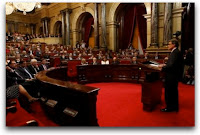 The German Consul in Barcelona, an assistant at the US Consulate in Barcelona, and a Member of the Quebec Assembly attended the Catalan President's presentation Tuesday
To wit, from within the gallery of the Catalan Parliament itself, Mas' speech was listened to by the General Consul of Germany in Barcelona, Bernhard Brasack, and by an assistant to the US Consulate in Barcelona. There was also a Member of the Quebec Assembly, Alain Therrien, in the role of parliamentary advisor to the Quebec's Minister of International Relations.

The political events happening in Catalonia are being closely followed by international news organizations and also by governments from all over the world. This was clearly demonstrated during the General Policy Debate this week in the Catalan Parliament, where there were more accredited international media than ever before, as well as the presence of representatives from certain countries during President Artur Mas' Opening remarks on Tuesday.
To wit, from within the gallery of the Catalan Parliament itself, Mas' speech was listened to by the General Consul of Germany in Barcelona, Bernhard Brasack, and by an assistant to the US Consulate in Barcelona. There was also a Member of the Quebec Assembly, Alain Therrien, in the role of parliamentary advisor to the Quebec's Minister of International Relations.
Broad representation by international media
With respect to international news media who requested accreditation for their professionals in order to attend the general policy debate, the Parliament's Press Office mentioned Al Jazeera, France Press, Associated Press, Reuters, the newspapers La Presse from Quebec, Volkskrant from the Netherlands, Sud Ouest, Proceso from Mexico, the French radio station Europe 1, the Getty Images agency, Deutsche Welle, The Times, and the Wall Street Journal.Friday, September 21, 2012
Full Transcript of Catalan President Mas' Q&A session after Press Conference, September 20
I posted the transcript (in both English and Catalan) of President Mas' Press Conference after his meeting with President Rajoy yesterday. Today, I offer you the transcript of the Question and Answer session that followed his presentation, in both its original Catalan and Spanish (at the end), and my translation into English. Please spread this far and wide. As gratified I am that international news sources are finally covering what's going on in Catalonia, I still think it's crucial to hear exactly what is being said. To that end, my translations of political speech will continue to be as literal as possible. Once again, my thanks to the Catalan Government Press Office for providing me with a copy of the original transcript.
Q: I seemed to understand that you are sorry that the meeting didn't go well because it affects the common future and you made a reference that you maintain the fiscal goals. Do you think following the path toward fiscal sovereignty is compatible with a future within Spain?
President Mas: I will repeat what I think I said, I think that it's not exactly the way you interpreted it. Not just I, but a very significant portion of the Catalan population, believed that the fiscal pact would be a big improvement for Catalonia, a leap forward for self-governance, and a possible reduction in our fiscal deficit, and at the same time, together with all of that, a possibility of reaching an agreement with the state, and thus, within the framework of the state, even within the Constitution itself, and the rules in place, that a fiscal pact could have been created that gave Catalonia a unique fiscal situation, in line with fiscal sovereignty, that would allow us to collect taxes, give us the key to the strongbox, that would transfer the state tributary agency to Catalonia, as is done with other agencies; that the Catalan Parliament could control the level of taxes much more than it can presently, that this fiscal pact would open doors that over time would significantly reduce our fiscal deficit with the rest of the Spanish state. Not at this moment when there's no money, there's only debt, but at the moment when the economy begins to improve. That is what the Catalan Parliament voted in July. That is what will not happen. And if that cannot happen, Catalonia cannot give up on its ideas for the future, it cannot give up simply because it is impossible to negotiate with the Spanish Government, it can't give up on building its future, and it cannot give up its wish of self-government; it cannot, it would be a self-immolation of Catalonia, and even a betrayal of the people of Catalonia if the Catalan people are willing to go down this path to build its self-government. And that definitely does enter into the debate on sovereignty. What I told you before is that this very important debate should take place next week and over the next few weeks, it's not a debate that should be rushed, that must be undertaken today, each moment has its own codes of conduct. Today we are at a "no", there is no room for discussion of the fiscal pact and next week we will be in the Catalan General Policy Debate and making decisions. And in the next few weeks we will see where these decisions will take us.
Q: Is an immediate call for early elections on the table, among the decisions you will make next week? And what is the message that you will bring to those elections? Will you bring a message of independence? How can you do that with the current Constitution?
Let me tell you two things, one I've already mentioned and that I'll repeat. There are questions which don't have an answer today. I'm not going to answer you today about whether there will soon be elections in Catalonia or not. These decisions and many others must be made in the next few days or weeks. Today is not the moment for announcing them because, for one thing, they have not been made yet. Don't speculate so much. There are decisions that are mine to make alone, in my capacities as Catalan President, and I can assure you that right now, I have not made any, everything is still on the table. I want to appear before the Parliament next week and within the solemnity of the General Policy Debate be able to have a thorough debate on the situation in which we find ourselves as a country, as Catalonia.
The topic of whether the Constitution is a framework in which we can move forward or not, we always had believed it was. I believe that Spain is committing a mistake and that the Constitution is almost always reinterpreted with a centralist slant, and that is a grave error, since the Constitution was created in 1978, three years after Franco's death. [Catalan] President Taradellas had just returned to Catalonia and three years later, in 1981, there was sable rattling and the Guardia Civil's invasion of Congress. The Constitution was created in that context, but in such a way that it could be reinterpreted, so that in better times, and with less noise, things could be done that were not possible in the 70s. But thirty years have gone by and instead of re-reading the Constitution in a more open, more friendly way in line with a pluri-national State, which the Spanish one definitely is, because there are peoples here who feel like a nation and that can't be changed with a Constitution, or with declarations from the highest ranks. You can't change that, it's a feeling, a will, a project with a history, an identity, it's all that together, and that can't be changed by a Constitution, by declarations, by applying pressure, or by making people afraid. Not even dictators have been able to change that feeling, go figure how other situations might affect it. They don't ever want to read the Constitution in a more open way than they could have 35 years ago? Constitutions adapt and even if they don't, they still don't overrule the will of the people, and if Catalonia at a given time, perhaps in the next months or years, in a peaceful, democratic way with the support of the majority, wants to envision a path and a project for the future, well, the Constitution can't simply be positioned as an unsurmountable obstacle. It doesn't work like that anywhere.
Q: Did you leave Moncloa [President Rajoy's Office] with the feeling that the legislative session was over and do you think that, besides in the Parliament, the people should be given the chance to voice their opinion, via elections or a referendum?
It's obvious that once you get to the conclusion that the fiscal pact has no possibilities for negotiation, which is what was said to me very clearly, it's obvious that this is a significant turning point in the legislative session, the opposite cannot be said, that would be going against common sense. This was the principal matter to be discussed, together with restarting the economy and protecting the welfare of the people. The fiscal pact, which in addition, is tied to the two other topics, has no way forward. Let me make it clear, it was not my intention today that they would say yes to everything I asked. What I wanted today was to see if there was any room to move forward or to discuss it. But there's not, there is no possibility, and it's obvious that this is a crucial turning point in this legislative session. How can it be resolved? I ask you not to speculate because you may well be wrong. You could certainly speculate a lot, but I think it's more normal, more correct in a mature democracy that Catalonia tries to be, that if we have a crucial turning point in a legislative session, and in three days we have scheduled a General Policy Debate, which is the most serious one of the year, the most normal option is to have that debate in the Catalan Parliament. And that's what we will do.
Q: You said that besides the definitive No to the fiscal pact, in the meeting, you also discussed the possibility of revising the system for financing the autonomous communities in 2013. I would like to ask you if that was offered on the side, as an ellipsis, in small print, or with more formality. How important was it? And secondly, I wanted to ask if you offered any opinion to the Spanish President about the King's letter.
I can't give you an idea of the size of the offer of revising the financing system because while today Mr. Rajoy was in a position of saying 'no' to what I suggested, without any gray areas, he also said: this is 'no' but we should discuss the other matters at some point. But revising the financing system next year will have to be discussed, because according to the law, the old system expires after five years. Therefore, no matter what, it will have to be discussed. I think that at this point, I have the feeling that they don't have anything figured out yet. I think that it's more a general offer and one in the traditional line of that every year that the financing system must be revised, all of the autonomous communities of the common system get together, there are 15 of us, and we talk it over with the Government and from there, we more or less adapt the old system and some more things, which sometimes is positive, and sometimes not so much. This is the Autonomous Community financing system movie we've been watching for the last 30 years. We in Catalonia were hoping to move beyond that. And they offered us the same old, same old. For that reason, at the beginning, I told you that when they offered us the same old thing, we, as civilized people, will go to the bargaining table, we will listen, but we know that that does not solve Catalonia's problems, and that's that. It does not change anything substantial or fundamental, which is what we intended, and what we intend in Catalonia.
The King's letter didn't come up in the conversation. We didn't spend 30 seconds on it.
Q: Have you calculated the financial consequences of your discourse? You have recognized that the markets and European partners are keeping a close watch on the Spanish situation. Have you taken that all into account? Secondly, how do you see the King's letter? How can progress be made toward more sovereignty for Catalonia within the confines of the Constitution?
If there is not a more open reading of the Constitution, it's obvious that within the confines of the Constitution, you have to read it in the sense that we propose. For example. I am of the belief that what we have proposed for the fiscal pact does not require a change in the Constitution but rather of the LOFCA law, which is a law that derives from the Constitution but can be made in one way or another. In no section of the Constitution does it say that Catalonia can't have a bilateral financing system with the State. What it does say is that autonomous financing systems must incorporate a quota of 'solidarity' with the other territories. But that the Catalan Government cannot manage its own Tributary Agency the way it manages the police, that is not in the Constitution. What is more, in one article, it says that almost everything is transferable to the autonomous communities, if desired, and thus so is a Tributary Agency. You can't make the Constitution into an unsurmountable obstacle, it makes for an impossible future. And if you can't change anything, or reinterpret anything, in the end it becomes impossible to move forward. For some, for other parts of the State it won't be like this, but for a territory like Catalonia, that has real aspirations of self-government, and that in addition, considers and feels itself to be a nation, this feeling, will, project and hope cannot be canceled out by a constitutional text.
My opinion on the King's letter was expressed by our government spokesperson a few days ago. We don't think it pertains to us. If he's talking about pipe dreams, it could also be considered a pipe dream that, without touching the Constitution or ever re-interpreting it in any way, there is any hope of fitting Catalonia into the rest of the State. And I don't say that as a reply to the King's letter, because we don't think it's about us. We have not proposed any pipe dreams, we have proposed a project called the fiscal pact, and it was approved by 70& of the Parliament, and we have defended it where necessary. It is a project widely backed by Catalan society, voters from all parties believe in it. That cannot be considered a pipe dream, the way we see it, the King cannot allude to it as a pipe dream, and thus we feel he cannot be talking about us.
Q: With respect to the calm and constructive debate that you are asking be held within the General Policy Debate, you said last week that a definitive No from Spain or the state to the fiscal pact would open the door to freedom for Catalonia. I would like to know if you plan to position the debate in this direction, since today you haven't even mentioned the "state structures" that you talked about the other day.
No, today I did not. Not because I mean to contradict myself. I did it for a very simple reason that I think you all have already understood. Today I didn't come to give my response on what we will do in Catalonia. Today I came to explain the importance, what it means that the fiscal pact cannot move forward, once that is clear and officially communicated, and that is no minor matter. What I have to say in that sense I will say next week in the Parliament and in the next few weeks in general. I think that makes it clear, it's not what you wanted to hear, but it is the limit to what I will say that I have self-imposed out of respect for the Parliament. The Parliament chose me as President, and if we were four months away from the General Policy Debate, maybe I would do it differently, but since it's three days away, I believe I need to go to the Catalan Parliament and explain things just as I see them, as the Government sees them, and from there, listen to the parties and make decisions.
Q: In this process of reflection that begins now, are you planning on meeting with Catalan business leaders who have asked that you try everything possible to move the fiscal pact forward?
Q: Did the President of the Government say if his definitive No was agreed upon with Rubalcaba?
He did not say, and I didn't ask him. I understood it that way, and in addition, if you listen to Rubalcaba's statements, it's clear that the answer from the Socialist Party is also "no", no matter what the Catalan Socialists may say. The response from Spanish Socialism is "no", with the same intensity with which the PP or the President of the Government has answered.
Q: Do you believe that this definitive "no" will dampen or encourage this wave of independence by the Catalan population?
It's not an exact science. My intuition is that, if all the people in Catalonia who are trying to find arguments that support whether there is a way to progress within a state or constitutional framework see that there is not, and not because of a lack of will to negotiate on our part, which exists, but because on the other side of the table there is neither the will nor the interest in opening a negotiation, well, these people in Catalonia who are betting on finding arguments, well, I don't know what conclusion they'll end up with, but they will get to this: that Catalonia, as a result of these "no"s cannot be left with no project at all. That is for sure. And therefore, Catalonia, in the short term will have to formulate a project with the most ample majority possible, but it must formulate a project. Because the evidence shows that it's practically impossible to progress within the state framework, in accordance with Catalan aspirations. We had the Statute of 2006, which ended up whittled down and vilified by the Constitutional Court. That was not a neutral act, and it left in Catalonia a feeling of lack of understanding, and frustration, surely anger as well. And that feeling remains, but now it's larger. And any attempt that Catalonia tries to make about important matters that it is concerned about, in the end go nowhere, not even to negotiation, and that might make even people who up to now were reluctant change their mind and say, "the only thing that I can't permit as a Catalan citizen, whether I think this way or that way, is that Catalonia ends up without a plan, because having no plan means having no future, to be adrift, directionless. That is the only thing that we cannot allow."
Q: Will you try to keep the bridges open within the Spanish state or with the Spanish state? You have been insistent that you would not make any rash decisions but I suppose there's a range within which you move and I would like to know if the bet on a break with Spain goes beyond that range.
I don't know what decision will be made about it all, even by Catalan society and the Catalan political parties, but as a general reference, at least in Catalonia, I will explain it this way, I believe that one must not talk in terms of complete break-ups, because I believe that would be an error, because within the European framework, there are no total break-ups, there can't be, they wouldn't make sense.
Q: Have you thought about the creation of a new State? Did he ask you for an explanation about what you were asking for?
He did not. The truth is he told me straight out, "I'm not going to ask you what you plan to do because it's not my place to do so" and he's quite right. It's one thing that he cannot ask of me. Therefore, he acted properly in that sense, saying that it was not up to him what we were going to do, or about the decisions we would make. As president of the Spanish Government, it makes sense that he ask that since we are in very complicated place with the rest of the State, and that we should all try to help calm and normalize the State's situation. That is what is up to him as President of the Government. We, in these last months, while he has been in office, on many occasions have had this mentality, and with the previous government as well. We have had this mentality more than the state parties in opposition, who only think about changing the Spanish government. I didn't tell him that, but I tell you all now.
Q: You said that you were not thinking in terms of break-up and that you didn't plan on separating from the EU. Could you be more specific about whether you plan to separate from Spain?
I know that the debate is about breaking-up, about separation and this is the regular debate, but please understand that I must use slightly different terminology. Whatever decision Catalonia makes in the coming days, weeks, and months, whatever decision must be within the framework that we are a country and a society that wants to be part of Europe and part of the euro. From there, what that means in terms of our relationship with Spain will be seen. That's what is wide open and that I'm not going to talk about today. In whichever case, whatever decision that is made, whatever the Catalan project will be, I will defend that it should be a European project, part of the European Union, and the Euro.
Q: Did the President of the Government ask you not to convoke elections? Are you planning on not breaking with Europe but yes with Spain? Do you see the two options as compatible?
Now, whatever proposal that we don't frame in terms of break-up in which Catalonia evolves into something different than that which it has been up to now must be in terms of a European framework and that framework of the euro, and therefore, in a normal, calm, democratic, and of course, peaceful scenario.
He did not propose that about the elections in those terms at all. He was very respectful about that, as he should be, and I told him that this put us in a complicated position and that we would have to make decisions soon. He explicitly told me that he was not going to ask me which decisions, because it wasn't his place to do so.
Q: With respect to this new era that you are depicting of the relationship between Catalonia and Spain, is it possible that the steps to be taken violate the current judicial and political framework, for example, a unilaterally created treasury agency? Do you believe that we should be prepared in your opinion for steps that might violate the legal order?
Look what's happening in the United Kingdom, where they are giving a grand lesson on what is democracy. The Scots say they want to hold a referendum and I don't know if holding a referendum is within the British rule of law, but the British Government says that if it wants to hold a referendum to decide its future, we have to negotiate some conditions. That's what you do in a democracy. I have to pressupose that if Spain is a democracy—as it is, and we have all contributed to it being so—the norm, the law—no matter how important it is—cannot always be an obstacle that cancels out the feeling, the will, and the projects for the future. That is impossible.
And with that, I have not responded directly, but it's understood what we mean with that.
P.- M’ha semblat entendre que li sabia greu que la reunió no anés bé perquè afectava el futur comú i ha fet una referència que es manté l’objectiu fiscal. Considera compatible seguir el camí cap a la sobirania fiscal dins d’un futur amb Espanya?
Repeteixo el que crec que he dit, crec que no és exactament el que vostè interpreta. El pacte fiscal, no jo, sinó una part molt significativa de la societat catalana, havia entès que era una gran millora per a Catalunya, un salt per a l’autogovern, una possible reducció dels nostres dèficits fiscals i al mateix temps, junt amb això, una possibilitat de fer-ho d’acord amb l’Estat, i per tant dintre del marc de l’Estat, de la mateixa Constitució fins i tot, de les normes que regeixen, es podia fer un pacte fiscal que a Catalunya li donés una singularitat fiscal, en la línia de la sobirania fiscal, que ens permetés recaptar els impostos, la clau de la caixa, que se’ns transferís l’agència tributària estatal a Catalunya, com es fan altres transferències; que el Parlament de Catalunya pogués modificar a l’alça i a la baixa els impostos molt més del que ho pot fer en aquest moment, que aquest pacte fiscal ens portés amb el pas del temps a reduir significativament el nostre dèficit fiscal amb el conjunt de l’Estat espanyol. No en aquest moment en què no hi ha diners, només hi ha deutes, però sí en el moment en què l’economia anés millorant. Això és el que el Parlament de Catalunya va votar al mes de juliol. Això és el que no pot ser. I si això no pot ser, Catalunya no pot renunciar als seus escenaris de futur; no pot renunciar simplement perquè no es pugui negociar amb el Govern espanyol, no pot renunciar a construir el seu futur, i no pot renunciar d’acord amb la seva voluntat d’autogovern; no pot, seria una espècie d’immolació de Catalunya, o fins i tot de traïció al poble de Catalunya si realment el poble català està disposat a anar per aquesta via, d’anar construint el seu autogovern. I això efectivament entra dins del debat de la sobirania. El que jo els deia abans és que aquest debat, transcendent, és el que haurem de tenir la setmana que ve i en les properes setmanes; no és un debat que es pugui fer en calent, que s’hagi de fer avui, cada moment té els seus codis de conducta. Avui estem en un no, no hi ha marge per al pacte fiscal i la setmana que ve estarem en el debat català i en les decisions. I en les properes setmanes veurem aquestes decisions on ens han de portar.
P.- ¿Entre esas decisiones que tomarán la semana que viene está encima de la mesa la convocatoria inmediata de unas elecciones anticipadas? Y ¿con qué mensaje va a ir usted a esas elecciones? ¿Iría con el mensaje de la independencia? ¿Cómo se hace esto con la Constitución vigente?
Le hago una doble reflexión, una ya la he hecho y se la repito. Hay preguntas que hoy no tienen respuesta. Si va a haber elecciones en Catalunya o no en poco tiempo no se lo voy a contestar hoy. Estas decisiones y otras muchas habrá que tomarlas en los próximos días o en las próximas semanas. Hoy no es el momento de anunciarlas porque además no están tomadas. No hagan muchas especulaciones. Hay decisiones que me corresponden solamente por mis facultades como presidente catalán, y les puedo asegurar que hoy por hoy no están tomadas, están todas las decisiones abiertas. Quiero comparecer ante el Parlamento la semana que viene y con la solemnidad del Debate de Política General para poder tener un debate a fondo sobre la situación en la que nos encontramos como país, como Catalunya.
El tema de si la Constitución es un marco donde se pueda avanzar o no, nosotros siempre habíamos creído que sí. Creo que en España se está cometiendo un error y es que la Constitución casi siempre se relee en clave centralista y esto es un inmenso error porque la Constitución se hizo en 1978, hacía tres años que había muerto Franco; el presidente Tarradellas acababa de volver a Catalunya y tres años después, en el 81,
hubo ruido de sables y la Guardia Civil invadió el Congreso. La Constitución se hizo en aquel contexto, pero se hizo de una manera que se podía ir releyendo, para que cuando los tiempos fueran mejores y con menos ruido, se pudieran hacer aquellas cosas que no se podían hacer en los años 70, pero han pasado más de 30 años y en vez de releerla de una forma más abierta, más amable, más en la línea de un Estado plurinacional, que en definitiva es el español, porque hay pueblos que se sienten nación y esto no lo van a cambiar con una Constitución, ni con unas declaraciones por muy alto rango que tengan. Esto no se cambia, es un sentimiento, una voluntad y un proyecto y unas raíces, y una identidad, es todo esto junto, esto no se cambia ni por una Constitución, ni por declaraciones, ni por presiones, ni metiendo miedo; no lo cambiaron ni las dictaduras eso, imagínese entonces como va a cambiar eso otras situaciones. ¿No lo quieren releer nunca en un término algo más abierto que lo que se pudo hacer hace 35 años atrás? Las constituciones se adaptan y si no se adaptan no anulan las voluntades de un pueblo, y si Catalunya en su momento, sea en los próximos meses o años, de una forma pacífica, democrática y muy mayoritaria, quiere emprender un camino y un proyecto de futuro, pues a esto no se puede poner simplemente una Constitución como un pared insalvable; esto no funciona así en ninguna parte.
P.- Surt de la Moncloa amb la sensació que si la legislatura s’ha esgotat i creu que la paraula a banda del Parlament potser se li havia de donar als ciutadans, amb eleccions o referèndum?
És evident que una vegada arribes a la conclusió que el pacte fiscal no té recorregut de negociació, que és el que se m’ha dit d’una manera molt clara, és evident que aquest és un punt d’inflexió significatiu en l’actual legislatura, no es pot dir el contrari, perquè seria atemptar contra el sentit comú. Si el gran tema era aquest, conjuntament amb la reactivació de l’economia i la protecció de l’estat del benestar, si el pacte fiscal, que a més a més va lligat amb aquests dos temes, no té recorregut de negociació. Insisteixo, no és que jo pretengués avui que em diguessin que sí a tot, jo avui volia saber si hi hauria recorregut o no per parlar-ne. Però és que no hi ha recorregut, no hi ha camí, i és evident que això és un punt d’inflexió transcendent en la legislatura. Com s’ha de resoldre? Els demano que no facin especulacions perquè es poden equivocar. Se’n poden fer moltes, però crec que és més normal, i més correcte en una democràcia madura com pretén ser la catalana, que si tenim un punt d’inflexió important en la legislatura i d’aquí a tres dies tenim un Debat de Política General que és el més solemne de l’any, el més normal és que aquest debat el fem al Parlament de Catalunya. I així serà.
P.- Ha dicho que a parte de este no rotundo al pacto fiscal, en la reunión se ha planteado la hipótesis de una revisión del sistema de financiación de las autonomías en el horizonte del 2013. Quisiera preguntarle si ha sido un ofrecimiento al margen, unos puntos suspensivos, en minúsculas, o bien tenían una formalidad mayor. ¿Qué tamaño tenía? En segundo lugar, quería preguntarle si usted le ha transmitido al presidente español alguna opinión respecto a la carta del rey.
No le puedo dibujar la dimensión del ofrecimiento sobre la revisión del sistema de financiación, porque ha salido durante la conversación y creo que como hoy el señor Rajoy estaba en una posición de que lo que yo planteaba era no, sin matices, él mismo ha tenido el impulso de decir: esto es no, pero de lo demás, en su momento, tendremos que hablar. Pero es que de revisar el sistema de financiación el año que viene hay que hablar seguro, porque de acuerdo con la ley, finalizan los 5 años de vigencia del sistema anterior. Por lo tanto, sí o sí toca hablar de esto. Creo que a estas alturas, tengo la sensación que no tienen nada programado. Creo que es más un ofrecimiento sin mayor contenido y que va en la línea tradicional que es que cada vez que hay que revisar el sistema de financiación nos ponemos todas las CCAA del régimen común, que somos 15, nos ponemos a hablar con el Gobierno y a partir de ahí se hace un sistema que más o menos recoge el anterior y alguna cosa más que, a veces es en positivo y, a veces, no tanto. Esa es la película de 30 años de sistemas de financiación autonómicos. Nosotros pretendíamos des de Cataluña superar eso. Y nos ofrecen lo de siempre. Por eso al principio les he dicho que cuando nos ofrezcan lo de siempre, nosotros que somos gente educada, iremos a la mesa, nos sentaremos, escucharemos, sabremos que aquello no resuelve los problemas de fondo de Catalunya y punto y final. Pero eso no cambia nada sustancial ni fundamental, que es lo que se pretendía y se pretende des de Catalunya.
La carta del rey no ha salido en la conversación, no le hemos dedicado ni 30 segundos.
P.- Ha calibrado las consecuencias financieras que este discurso suyo tiene? Usted ha reconocido la vigilancia estrecha de los mercados y los socios europeos a la situación española. ¿Ha calibrado todo esto? En segundo lugar, ¿qué valoración hace usted de la carta del rey? ¿Cómo se puede avanzar dentro de la Constitución hacía más soberanía para Catalunya?
Si no hay una relectura abierta de la Constitución, es evidente que dentro de la Constitución esa relectura hay que hacerla en el sentido que hemos propuesto. Por ejemplo. Yo soy de la tesis que lo que hemos propuesto como pacto fiscal no requiere un cambio de la Constitución sino de una ley que se llama la LOFCA, que es una ley que deriva de la Constitución pero que se puede hacer de una manera u otra. En ninguna parte de la Constitución dice que Catalunya no pueda tener un sistema de financiación bilateral con el Estado. Lo que sí dice es que los sistemas de financiación autonómicos tiene que incorporar una cuota de solidaridad entre los territorios. Pero que el Gobierno catalán no pueda tener la gestión de la agencia tributaria igual como tiene la gestión de la policía, eso no lo dice la Constitución. Es más, en un artículo dice que casi todo es transferible a las comunidades autónomas si se quiere, y por tanto también la Agencia Tributaria. No se puede poner la Constitución como una pared insalvable, porque en el momento en que es una pared insalvable, se hace un camino imposible. Si no se puede tocar nada en el sentido de ni releer nada, se hace un camino imposible, al final. Para algunos, para otros territorios del Estado no será así, pero para un territorio como Catalunya, que tiene aspiraciones de autogobierno reales y, además, que se siente nación, este sentimiento, voluntad, proyecto e ilusión, no lo anula un texto constitucional.
Yo he calibrado perfectamente la situación en la que estamos. Tanto que creo que nos estamos comparando en general con una serenidad muy grande. Pero que el hecho de que España esté en la situación que está, que quiere decir que nos afecta a todos, ¿significa dar la espalda a una opinión pública catalana, que sale a la calle, un millón y medio de persones de forma absolutamente pacifica, sin reventar nada, y eso es una realidad que nos olvidamos de ella, le hemos de dar la espalda? Se imaginan ustedes en España una manifestación de 9 millones de personas de golpe, que es la misma proporción en España que un millón y medio en Catalunya. ¿Se imaginan ustedes eso, se le podría dar la espalda a una manifestación de 9 millones?. Pues nosotros tampoco le podemos dar la espalda porque somos el Gobierno de Catalunya y porque sabemos desde hoy que, además, nuestro proyecto de negociación del pacto fiscal no tiene recorrido. Se nos ha dicho con toda claridad. Claro que hay inestabilidad, la hay en toda Europa, pero porque haya inestabilidad nosotros no nos podemos simplemente sumergir como si no existiéramos. Las dinámicas están abiertas en todas partes, y de debates de soberanía en plena inestabilidad los hay en toda Europa. ¿O no es un debate de soberanía si el BCE tiene que hacer de banco controlador de todo el sistema financiero europeo o no? Y si al final unos se acogen a un fondo y otros a otros también hay problemas de soberanía y no por eso se toman decisiones inmediatas. Problemas de soberanía hay en todo el debate europeo de forma constante. Si no hubiera debates de soberanía, tendríamos los Estados Unidos de Europa en este momento, que es lo que necesitamos. Todo el mundo lo sabe. Pero precisamente porque hay debates de soberanía no tenemos los Estados Unidos de Europa. Y Catalunya en estas condiciones no puede estar callada ni subyugada ni inerte. Tiene que estar viva, y lo está.
Mi valoración sobre la carta del rey la expresó el portavoz de nuestro gobierno hace pocos días. No nos sentimos aludidos. Si se habla de quimeras, también podría ser una quimera pretender que, sin tocar nada de la Constitución ni releerla en ningún sentido, se pueda aspirar a encajar bien Catalunya en el conjunto del Estado. Y no lo digo por respuesta a la carta del rey, pero no nos sentimos aludidos. Nosotros no hemos planteado ninguna quimera, hemos planteado un proyecto que se llama pacto fiscal, votado por el 70% del Parlament, lo hemos defendido dónde lo hemos tenido que defender. Es un proyecto que está ampliamente consensuado en la sociedad catalana, votantes de todos los partidos aspiran a eso. Eso no puede ser nunca una quimera, y como entendemos que el rey no puede aludir a eso como una quimera, no nos damos por aludidos.
P.- Sobre aquest debat serè i constructiu que demana de cara al debat de política general, Vostè va dir la setmana passada que el cop de porta d’Espanya o l’Estat al pacte fiscal obria la porta a la llibertat de Catalunya. M’agradaria saber si aquest debat l’encararà cap a aquest camí, ja que avui ni tan sols ha esmentat l’expressió d’estructures d’estat?
No, avui no ho he fet. No perquè em vulgui contradir amb res, ho he fet per una raó molt senzilla que crec que vostès ja han entès. Avui no he vingut a donar resposta sobre el que farem a Catalunya. He vingut a fer un balanç sobre la transcendència, el que significa que el pacte fiscal no tingui recorregut, una vegada això és evident i oficialment comunicat i a parlar-los que això no és un tema menor. El que hagi de dir en aquest sentit ho diré la setmana que ve al Parlament i en les properes setmanes en general. Crec que amb això ja li responc, no el que a vostè li agradaria sentir, però és el que m’he autoimposat de dir com a màxim, per respecte al Parlament. A mi em va escollir el Parlament com a president i, si estiguéssim a quatre mesos del Debat de Política General, potser ho faria diferent, però a tres dies, crec que he d’anar al Parlament de Catalunya a explicar les coses tal i com les veig, com les veu el Govern i, a partir d’aquí, escoltar els partits i prendre decisions.
P.- En aquest procés de reflexió que ara comença, té previst reunir-se amb l’empresariat català que li ha demanat que esgotés fins al final la via pacte fiscal?
A tothom que a Catalunya m’ha demanat que exhauríssim la via del pacte fiscal els he fet cas, i després he fet cas d’un mandat del Parlament de Catalunya i d’un programa propi amb el qual vam guanyar les eleccions, que es deia pacte fiscal. Els he fet cas perquè he arribat fins al final. Jo avui m’he trobat un dic de contenció, una paret, en aquest tema, en altres no. En altres, el president Rajoy ha estat més obert a parlar-ne, a trobar solucions, però en aquest tema la resposta ha estat clara. Per tant, tots aquells que em demanaven que fes el màxim esforç possible pel pacte fiscal, està fet. No hi ha ningú més amunt del president del Govern espanyol, no puc recórrer a cap altra instància. I com que no hi ha ningú més amunt, i ell em diu el que em diu i, a més, que al costat seu partits polítics espanyols em donaran la mateixa resposta, doncs no perdrem mesos ni anys en una cosa que ja se sap que no té recorregut ni té futur per la via del pacte. Per tant, és evident que, a partir d’aquí, hem de prendre decisions. Però vull deixar molt clar que tota aquella gent que ens ha demanat que féssim el màxim esforç en aquesta línia, l’hem fet fins al darrer segon del darrer minut, però la resposta és la que és. Jo el que no puc fer és substituir el senyor Rajoy, en el sentit que m’hauria agradat que la resposta fos una altra. Per mi aquest no és un dia que jo em sentit gaire content ni satisfet, perquè sé que tot això afegeix problemàtiques de molts tipus, però com que també tinc molta confiança en el que jo represento, que no és un partit polític sinó en aquest moment un país, el poble de Catalunya, estic segur que el poble de Catalunya davant d’aquesta evidència, d’aquesta negativa, sabrà trobar respostes que converteixin aquesta decepció que avui pot ser una decepció, en una il·lusió i un compromís de futur.
P.- ¿El presidente del Gobierno le ha dicho si ese no rotundo ha sido un no consensuado con Rubalcaba?
No me lo ha dicho, tampoco se lo he preguntado. Lo he entendido así y, además, si escucha las declaraciones de Rubalcaba, es muy evidente que la respuesta es no también por parte del partido socialista, digan lo que digan los socialistas catalanes. La respuesta del socialismo español, es que no, con la misma intensidad que lo dice el PP o el presidente del Gobierno.
P. ¿Usted cree que el impacto que va tener este no rotundo en la ciudadanía de Catalunya será el de frenar o dar más alas a esa ola de apoyo a la independencia?
Una ciencia exacta en este sentido no se la puedo avanzar. Mi intuición es que, si toda aquella gente que en Catalunya se quiere ir cargando de razones para ver si hay posibilidades de avanzar en ese marco estatal y constitucional, y después van viendo que no las hay, no porque no haya voluntad de negociar por nuestra parte, que la hay, sino porque en la otra parte de la mesa no hay ni ganas ni interés de abrir una negociación, pues esta gente que en Catalunya hacen esta apuesta de irse cargando de razón, probablemente no sé a qué conclusión final llegarán, pero sí llegarán a una: que Catalunya, como consecuencia de estos nos, no se puede quedar sin proyecto. Eso seguro. Y por tanto, Catalunya en estos próximos tiempos tiene que formular un proyecto lo más mayoritario posible, pero tiene que formular un proyecto. Porque las evidencias son que en ese marco estatal es muy difícil avanzar, de acuerdo con las aspiraciones catalanas. Tuvimos el Estatut de 2006, que acabó cepillado y vilipendiado en el TC. Eso no fue neutral, eso dejó un pósito en Catalunya de una gran incomprensión y de una cierta frustración y seguramente de un cierto cabreo,. Y aquel poso sigue existiendo, pero ahora es mayor. Y si cualquier intento que haga Catalunya de grandes temas que le preocupan al final no tienen recorrido, ni siquiera de negociación, pues incluso la gente que en este sentido era más reticente le puede hacer de cambiar de opinión y puede decir: lo único que no puedo permitir como ciudadano catalán, piense así o de otra manera, es que Catalunya se quede sin proyecto, porque quedarse sin proyecto quiere decir quedarse sin futuro, a la deriva, sin rumbo. Esto es lo único que no nos podemos permitir.
P.- ¿Tratará de que los puentes dentro del Estado español o con el Estado español estén abiertos? Ha sido usted insistente en que no va a tomar una decisión en caliente pero supongo que hay una horquilla dentro de la que usted se mueve y me gustaría saber si la apuesta por la ruptura de España desborda esa horquilla.
Tomemos las decisión que tomemos en los próximos días, meses o semanas creo que no hay que plantearlo en términos de ruptura, porque ruptura es como si hubiera un aislamiento total, y tomemos la decisión que tomemos la vamos a tomar dentro de un marco europeo, y dentro de un marco de una moneda en la cual nosotros creemos, que es el euro. Nosotros no nos vamos a separar de ahí. Y en ese marco europeo y del euro ahora está España entera, está también Catalunya. Y haga lo que haga Catalunya seguirá estando ahí. Y eso no son rupturas, eso son evoluciones, en todo caso. Las cosas, las sociedades evolucionan, e incluso las estructuras de los estados evolucionan. Y solamente mirando el mapa europeo usted verá que ha sido así en los últimos 15 o 20 años. El mapa europeo de hoy no tiene nada que ver con el mapa europeo del año 1190. Y eso no han significado rupturas, al revés. En muchas ocasiones han significado integraciones, ampliaciones, siempre con dialogo, con un espíritu de buscar lo mejor para todos, etc.
No sé qué decisión se tomará del todo, incluso por parte de la sociedad catalana y de los partidos catalanes, pero yo como consejo general, al menos en Catalunya lo explicaré así, creo que no hay que hablar en términos de ruptura total, porque creo que eso seria un error, porque dentro del marco europeo no hay rupturas totales, no las puede haber, no tienen sentido.
P.- Ha fet una reflexió respecte a la creació d’un nou estat? Ell li ha demanat explicacions per la reclamació que ha fet?
No me n’ha demanat. La veritat és que m’ha dit clarament: “jo no et demano el que penses fer perquè no em correspon demanar-t’ho” i té
tota la raó. És una cosa que no me la pot demanar. Per tant, ell mateix ha estat molt correcte en aquest sentit, dient que no li corresponia a ell demanar el que nosaltres havíem de fer, les decisions que havíem de prendre. Ell com a president del Govern espanyol té sentit que demani ja que estem en una situació molt complicada en el conjunt de l’Estat i que intentem tots ajudar de manera que la situació de l’Estat es tranquil·litzi i es normalitzi. Això li correspon demanar-ho com a president del Govern. Nosaltres, en aquests darrers mesos, mentre ell ha governat en moltíssimes ocasions hem tingut aquesta mentalitat i amb el Govern anterior també. Hem tingut més aquesta mentalitat que els partits estatals quan estan a l’oposició i pensen només a canviar el Govern espanyol. Això no li he dit, però els ho dic a vostès.
P.- Usted decía que no se estaba planteando en términos de ruptura y decía que no piensa separarse ahí, de la UE. ¿Me podría concretar si quieren separase de España?
Ya sé que el debate está en términos de ruptura, de separación y este es el debate ordinario, pero entienda que yo tengo que utilizar un lenguaje un poco distinto. Tome la decisión que tome Catalunya en los próximos días, semanas o meses, cualquier decisión tiene que ser en el marco que nosotros somos un país y una sociedad que queremos estar en Europa y en el euro. Después lo que eso significa de relación con España ya se verá. Eso es lo que está abierto y no voy a contestar hoy. En cualquier caso, se tome la decisión que se tome, sea cual sea el proyecto catalán, yo defenderé que tiene que ser un proyecto europeo, de Unión europea y de euro.
P.- ¿El presidente del Gobierno les ha planteado que no convocará elecciones? Usted está plateando que no va a romper con Europa pero sí con España. ¿Lo ve compatible?
Usted ha interpretado eso de mis palabras? Vuelve a insistir en romper. Usted me pregunta por romper y yo le digo que no está en mi vocabulario y usted vuelve a decirlo... Así es muy difícil entenderse porqué responda lo que le responda usted va a poner romper. Y así es muy difícil responder. Qué quiere que le diga? Nosotros no queremos... Cuando nosotros hablamos de proyectos de futuro de Catalunya no hablamos de rupturas; hablamos en algunas ocasiones de estructuras de estado, en otras ocasiones de estado propio, pero no hablamos de rupturas totales; que esto conlleva si se llega a hacer algún tipo de replanteamiento general de todo? Pues es evidente, esto no es cualquier cosa, es un tema de grandísima envergadura. Pero nosotros cuando hacemos eso y lo explicamos lo situamos en ese marco europeo, siempre. Nosotros no nos hemos vuelto locos! Que queramos ser catalanes y también en el futuro no quiere decir que nos hayamos vuelto locos y, por lo tanto, nuestro marco natural es la UE, el euro. Y queremos seguir estando ahí. Y, por tanto, las decisiones que nosotros tomemos deben estar dentro de ese marco. Y eso significa que no se puede mover nada en el futuro? Si resulta que todas las cosas que planteamos es no, no y no, pues se moverán las cosas, eso es seguro. Seguro que de la reflexión que se haga en Catalunya saldrá un proyecto distinto del que hemos tenido hasta ahora, esto es evidente. No podemos seguir muchos años más igual que los últimos 30, porque eso sería darse con la cabeza en la misma pared. Eso no puede ser y ya se entiende, no?
Ahora, cualquier planteamiento que no lo situamos en términos de ruptura en dónde Catalunya evolucione hacia algo distinto de lo que ha sido hasta ahora tiene que ser en ese marco europeo y en ese marco del euro y, por lo tanto, dentro de un escenario de normalidad y tranquilidad democrática y, por supuesto pacífica. No nos lo planteamos de otra forma porque no nos hemos vuelto locos.
Lo de las elecciones no me lo ha planteado en esos términos en absoluto. Con eso ha sido muy respetuoso, como tienen que ser, y yo le he dicho que obviamente esto nos ponía en una situación complicada y que tendríamos que tomar decisiones en los próximos tiempos. Él explícitamente me ha dicho que no me iba a preguntar cuáles, porque no le correspondía.
P.- Respecte a aquesta nova etapa que està dibuixant de relacions entre Catalunya i l’Estat cap la possibilitat que els passos a donar vulnerin en algun moment l’actual marc juridicopolític, com la hisenda pròpia sense acord... Creu que hem d’estar preparats des del seu punt de vista per a passos que puguin vulnerar l’ordenament?
La meva reflexió aniria una mica diferent, perquè la pregunta explícita que vostè formula jo no li puc contestar avui. Això es veurà quan hi hagi aquests plantejaments de futur el màxim de consensuats possibles dintre de la societat catalana. L’única cosa que li puc contestar és que no hi ha cap marc legal que pugui fer-se servir eternament per anul·lar la voluntat majoritària, democràtica i pacífica d’un poble. Òbviament, a les dictadures o a les semidictadures o d’altre tipus de règims es pot anul·lar la voluntat d’un poble de moltes maneres: manu militari, per la força de les armes, per la força de la violència, per la força de l’aniquilació de la identitat. Nosaltres com a catalans ja ho hem viscut en carn pròpia al llarg de la història tot això i no una vegada, sinó una i dues i tres i moltes... Ja sabem què vol dir això. Però ara Espanya no és un estat dictatorial, ni és un estat on imperi la violència, és un estat on impera la llei, l’estat de dret, forma part de l’euro, i en aquestes condicions, si el poble de Catalunya d’una manera molt majoritària, pacífica i democràtica decideix evolucionar cap a un futur diferent arribarà un moment en què no es podrà posar un text legal que digui que anul·len els sentiments que tenim, la voluntat i el projecte. Això no es pot escriure en un text legal. S’hauria de fer complir per altres vies que en una Espanya democràtica no són possibles i en una Espanya europea tampoc són possibles. Aquesta és la grandesa de la democràcia, que es pot parlar de tot i es pot plantejar tot sense por que actuïn de forma violenta i per això tots hem treballat perquè Espanya també fos una democràcia, que és el que és.
Mirin el que està passant al Regne Unit, que estan donant una lliçó en majúscules del que és la democràcia. Els escocesos diuen que volen fer un referèndum i jo no sé si fer un referèndum està dintre de les normes britàniques, però el Govern britànic diu que si vol fer un referèndum per decidir el seu futur cal negociar les condicions. Això és el que s’ha de fer en democràcia. Jo he de pressuposar que si Espanya és una democràcia – com és i tots hi hem contribuït-, la norma, la llei –per molt important que sigui- no podrà ser sempre la paret que anul·la el sentiment, la voluntat i el projecte, això serà impossible.
Amb això no li responc directament, però ja s’entén què volem dir amb això.
Questions to President Mas from the Press Corps, September 20, Catalan Government Delegation, Madrid
Q: I seemed to understand that you are sorry that the meeting didn't go well because it affects the common future and you made a reference that you maintain the fiscal goals. Do you think following the path toward fiscal sovereignty is compatible with a future within Spain?
President Mas: I will repeat what I think I said, I think that it's not exactly the way you interpreted it. Not just I, but a very significant portion of the Catalan population, believed that the fiscal pact would be a big improvement for Catalonia, a leap forward for self-governance, and a possible reduction in our fiscal deficit, and at the same time, together with all of that, a possibility of reaching an agreement with the state, and thus, within the framework of the state, even within the Constitution itself, and the rules in place, that a fiscal pact could have been created that gave Catalonia a unique fiscal situation, in line with fiscal sovereignty, that would allow us to collect taxes, give us the key to the strongbox, that would transfer the state tributary agency to Catalonia, as is done with other agencies; that the Catalan Parliament could control the level of taxes much more than it can presently, that this fiscal pact would open doors that over time would significantly reduce our fiscal deficit with the rest of the Spanish state. Not at this moment when there's no money, there's only debt, but at the moment when the economy begins to improve. That is what the Catalan Parliament voted in July. That is what will not happen. And if that cannot happen, Catalonia cannot give up on its ideas for the future, it cannot give up simply because it is impossible to negotiate with the Spanish Government, it can't give up on building its future, and it cannot give up its wish of self-government; it cannot, it would be a self-immolation of Catalonia, and even a betrayal of the people of Catalonia if the Catalan people are willing to go down this path to build its self-government. And that definitely does enter into the debate on sovereignty. What I told you before is that this very important debate should take place next week and over the next few weeks, it's not a debate that should be rushed, that must be undertaken today, each moment has its own codes of conduct. Today we are at a "no", there is no room for discussion of the fiscal pact and next week we will be in the Catalan General Policy Debate and making decisions. And in the next few weeks we will see where these decisions will take us.
Q: Is an immediate call for early elections on the table, among the decisions you will make next week? And what is the message that you will bring to those elections? Will you bring a message of independence? How can you do that with the current Constitution?
Let me tell you two things, one I've already mentioned and that I'll repeat. There are questions which don't have an answer today. I'm not going to answer you today about whether there will soon be elections in Catalonia or not. These decisions and many others must be made in the next few days or weeks. Today is not the moment for announcing them because, for one thing, they have not been made yet. Don't speculate so much. There are decisions that are mine to make alone, in my capacities as Catalan President, and I can assure you that right now, I have not made any, everything is still on the table. I want to appear before the Parliament next week and within the solemnity of the General Policy Debate be able to have a thorough debate on the situation in which we find ourselves as a country, as Catalonia.
The topic of whether the Constitution is a framework in which we can move forward or not, we always had believed it was. I believe that Spain is committing a mistake and that the Constitution is almost always reinterpreted with a centralist slant, and that is a grave error, since the Constitution was created in 1978, three years after Franco's death. [Catalan] President Taradellas had just returned to Catalonia and three years later, in 1981, there was sable rattling and the Guardia Civil's invasion of Congress. The Constitution was created in that context, but in such a way that it could be reinterpreted, so that in better times, and with less noise, things could be done that were not possible in the 70s. But thirty years have gone by and instead of re-reading the Constitution in a more open, more friendly way in line with a pluri-national State, which the Spanish one definitely is, because there are peoples here who feel like a nation and that can't be changed with a Constitution, or with declarations from the highest ranks. You can't change that, it's a feeling, a will, a project with a history, an identity, it's all that together, and that can't be changed by a Constitution, by declarations, by applying pressure, or by making people afraid. Not even dictators have been able to change that feeling, go figure how other situations might affect it. They don't ever want to read the Constitution in a more open way than they could have 35 years ago? Constitutions adapt and even if they don't, they still don't overrule the will of the people, and if Catalonia at a given time, perhaps in the next months or years, in a peaceful, democratic way with the support of the majority, wants to envision a path and a project for the future, well, the Constitution can't simply be positioned as an unsurmountable obstacle. It doesn't work like that anywhere.
"But thirty years have gone by and instead of re-reading the Constitution in a more open, more friendly way in line with a pluri-national State, which the Spanish one definitely is, because there are peoples here who feel like a nation and that can't be changed with a Constitution, or with declarations from the highest ranks. You can't change that, it's a feeling, a will, a project with a history, an identity, it's all that together, and that can't be changed by a Constitution, by declarations, by applying pressure, or by making people afraid. Not even dictators have been able to change that feeling, go figure how other situations might affect it."
Q: Did you leave Moncloa [President Rajoy's Office] with the feeling that the legislative session was over and do you think that, besides in the Parliament, the people should be given the chance to voice their opinion, via elections or a referendum?
It's obvious that once you get to the conclusion that the fiscal pact has no possibilities for negotiation, which is what was said to me very clearly, it's obvious that this is a significant turning point in the legislative session, the opposite cannot be said, that would be going against common sense. This was the principal matter to be discussed, together with restarting the economy and protecting the welfare of the people. The fiscal pact, which in addition, is tied to the two other topics, has no way forward. Let me make it clear, it was not my intention today that they would say yes to everything I asked. What I wanted today was to see if there was any room to move forward or to discuss it. But there's not, there is no possibility, and it's obvious that this is a crucial turning point in this legislative session. How can it be resolved? I ask you not to speculate because you may well be wrong. You could certainly speculate a lot, but I think it's more normal, more correct in a mature democracy that Catalonia tries to be, that if we have a crucial turning point in a legislative session, and in three days we have scheduled a General Policy Debate, which is the most serious one of the year, the most normal option is to have that debate in the Catalan Parliament. And that's what we will do.
Q: You said that besides the definitive No to the fiscal pact, in the meeting, you also discussed the possibility of revising the system for financing the autonomous communities in 2013. I would like to ask you if that was offered on the side, as an ellipsis, in small print, or with more formality. How important was it? And secondly, I wanted to ask if you offered any opinion to the Spanish President about the King's letter.
I can't give you an idea of the size of the offer of revising the financing system because while today Mr. Rajoy was in a position of saying 'no' to what I suggested, without any gray areas, he also said: this is 'no' but we should discuss the other matters at some point. But revising the financing system next year will have to be discussed, because according to the law, the old system expires after five years. Therefore, no matter what, it will have to be discussed. I think that at this point, I have the feeling that they don't have anything figured out yet. I think that it's more a general offer and one in the traditional line of that every year that the financing system must be revised, all of the autonomous communities of the common system get together, there are 15 of us, and we talk it over with the Government and from there, we more or less adapt the old system and some more things, which sometimes is positive, and sometimes not so much. This is the Autonomous Community financing system movie we've been watching for the last 30 years. We in Catalonia were hoping to move beyond that. And they offered us the same old, same old. For that reason, at the beginning, I told you that when they offered us the same old thing, we, as civilized people, will go to the bargaining table, we will listen, but we know that that does not solve Catalonia's problems, and that's that. It does not change anything substantial or fundamental, which is what we intended, and what we intend in Catalonia.
The King's letter didn't come up in the conversation. We didn't spend 30 seconds on it.
Q: Have you calculated the financial consequences of your discourse? You have recognized that the markets and European partners are keeping a close watch on the Spanish situation. Have you taken that all into account? Secondly, how do you see the King's letter? How can progress be made toward more sovereignty for Catalonia within the confines of the Constitution?
If there is not a more open reading of the Constitution, it's obvious that within the confines of the Constitution, you have to read it in the sense that we propose. For example. I am of the belief that what we have proposed for the fiscal pact does not require a change in the Constitution but rather of the LOFCA law, which is a law that derives from the Constitution but can be made in one way or another. In no section of the Constitution does it say that Catalonia can't have a bilateral financing system with the State. What it does say is that autonomous financing systems must incorporate a quota of 'solidarity' with the other territories. But that the Catalan Government cannot manage its own Tributary Agency the way it manages the police, that is not in the Constitution. What is more, in one article, it says that almost everything is transferable to the autonomous communities, if desired, and thus so is a Tributary Agency. You can't make the Constitution into an unsurmountable obstacle, it makes for an impossible future. And if you can't change anything, or reinterpret anything, in the end it becomes impossible to move forward. For some, for other parts of the State it won't be like this, but for a territory like Catalonia, that has real aspirations of self-government, and that in addition, considers and feels itself to be a nation, this feeling, will, project and hope cannot be canceled out by a constitutional text.
"But, should the fact that Spain is in the situation in which it finds itself, and that affects all of us, mean we turn our backs on Catalan public opinion, in which a million and a half people come out and demonstrate in a perfectly peaceful way, without breaking anything?"
I have taken the current situation in which we find ourselves into account perfectly. So much so that I believe we are acting with complete serenity. But, should the fact that Spain is in the situation in which it finds itself, and that affects all of us, mean we turn our backs on Catalan public opinion, in which a million and a half people come out and demonstrate in a perfectly peaceful way, without breaking anything? Is this a reality that we should just forget and turn our backs on? Imagine if in Spain there was suddenly a demonstration with 9 million people, that is the same proportion as the million and half we had in Catalonia. Can you imagine that you could turn your back on a demonstration of 9 million people? Well we can't turn our backs on them either because we are the Government of Catalonia and we know that from this day forward, in addition, our project of negotiating a fiscal pact can move no further ahead. They told us so quite clearly. Of course there's instability, there is instability all over Europe, but just because there is instability we cannot simply hide our heads and pretend we don't exist. The situation is wide open, and sovereignty debates in the midst of complete instability are happening all over Europe. Or is it not a debate on sovereignty whether the ECB should create a bank that controls the entire European financial system? And if in the end, some take advantage of one fund and others of another, there are also problems of sovereignty and that is no reason to make hasty decisions. There are constantly problems of sovereignty being debated all over Europe. If there weren't sovereignty debates, we would have the United States of Europe already, which is what we need. Everyone knows it. But it's precisely because we have sovereignty debates that we don't have the United States of Europe. And Catalonia in this situation cannot be silenced nor subjugated nor inert. It must be alive, and it will be so.My opinion on the King's letter was expressed by our government spokesperson a few days ago. We don't think it pertains to us. If he's talking about pipe dreams, it could also be considered a pipe dream that, without touching the Constitution or ever re-interpreting it in any way, there is any hope of fitting Catalonia into the rest of the State. And I don't say that as a reply to the King's letter, because we don't think it's about us. We have not proposed any pipe dreams, we have proposed a project called the fiscal pact, and it was approved by 70& of the Parliament, and we have defended it where necessary. It is a project widely backed by Catalan society, voters from all parties believe in it. That cannot be considered a pipe dream, the way we see it, the King cannot allude to it as a pipe dream, and thus we feel he cannot be talking about us.
Q: With respect to the calm and constructive debate that you are asking be held within the General Policy Debate, you said last week that a definitive No from Spain or the state to the fiscal pact would open the door to freedom for Catalonia. I would like to know if you plan to position the debate in this direction, since today you haven't even mentioned the "state structures" that you talked about the other day.
No, today I did not. Not because I mean to contradict myself. I did it for a very simple reason that I think you all have already understood. Today I didn't come to give my response on what we will do in Catalonia. Today I came to explain the importance, what it means that the fiscal pact cannot move forward, once that is clear and officially communicated, and that is no minor matter. What I have to say in that sense I will say next week in the Parliament and in the next few weeks in general. I think that makes it clear, it's not what you wanted to hear, but it is the limit to what I will say that I have self-imposed out of respect for the Parliament. The Parliament chose me as President, and if we were four months away from the General Policy Debate, maybe I would do it differently, but since it's three days away, I believe I need to go to the Catalan Parliament and explain things just as I see them, as the Government sees them, and from there, listen to the parties and make decisions.
Q: In this process of reflection that begins now, are you planning on meeting with Catalan business leaders who have asked that you try everything possible to move the fiscal pact forward?
"For me, today is not a day in which I feel happy or satisfied, because I know that all of this adds many kinds of problems, but I am also very sure about what I represent, and it's not a party right now, but rather a people, the people of Catalonia, and I am sure that the people of Catalonia, when faced with this evidence, this negative evidence, will know how to find the answers that convert this disappointment, that today may be a disappointment, into hope and a commitment for the future."
I have listened to everyone in Catalonia who asked me to bring the fiscal pact as far as possible. Afterward, I paid attention to the mandate from the Catalan Parliament and of our own platform with which we won the elections, which included the fiscal pact. The fact that I listened to them is shown out by how I got to the very end. Today I found myself in front of a brick wall on this topic, on others, not so much. President Rajoy was more disposed to talk about other matters, to find solutions, but on this matter, the answer was clear. Therefore, for all those who asked me to do everything in my power for the fiscal pact, it's done. There is no one higher up than the President of the Spanish Government, I have no recourse to any other body. And since there's no one higher up, and he tells me what he has told me, and in addition, the Spanish political parties at his side would give me the same answer, well, we're not going to waste months or years on something that we already know has no prospects for the future. Therefore, it's obvious that, from here on out, we have to make some decisions. But I want to make it very clear to all of the people who asked us to make the maximum effort on this path, that we tried until the last second of the last minute, but the answer is what it is. What I can't do is take Mr. Rajoy's place, in the sense that I would have liked the answer to be different. For me, today is not a day in which I feel happy or satisfied, because I know that all of this adds many kinds of problems, but I am also very sure about what I represent, and it's not a party right now, but rather a people, the people of Catalonia, and I am sure that the people of Catalonia, when faced with this evidence, this negative evidence, will know how to find the answers that convert this disappointment, that today may be a disappointment, into hope and a commitment for the future.Q: Did the President of the Government say if his definitive No was agreed upon with Rubalcaba?
He did not say, and I didn't ask him. I understood it that way, and in addition, if you listen to Rubalcaba's statements, it's clear that the answer from the Socialist Party is also "no", no matter what the Catalan Socialists may say. The response from Spanish Socialism is "no", with the same intensity with which the PP or the President of the Government has answered.
Q: Do you believe that this definitive "no" will dampen or encourage this wave of independence by the Catalan population?
It's not an exact science. My intuition is that, if all the people in Catalonia who are trying to find arguments that support whether there is a way to progress within a state or constitutional framework see that there is not, and not because of a lack of will to negotiate on our part, which exists, but because on the other side of the table there is neither the will nor the interest in opening a negotiation, well, these people in Catalonia who are betting on finding arguments, well, I don't know what conclusion they'll end up with, but they will get to this: that Catalonia, as a result of these "no"s cannot be left with no project at all. That is for sure. And therefore, Catalonia, in the short term will have to formulate a project with the most ample majority possible, but it must formulate a project. Because the evidence shows that it's practically impossible to progress within the state framework, in accordance with Catalan aspirations. We had the Statute of 2006, which ended up whittled down and vilified by the Constitutional Court. That was not a neutral act, and it left in Catalonia a feeling of lack of understanding, and frustration, surely anger as well. And that feeling remains, but now it's larger. And any attempt that Catalonia tries to make about important matters that it is concerned about, in the end go nowhere, not even to negotiation, and that might make even people who up to now were reluctant change their mind and say, "the only thing that I can't permit as a Catalan citizen, whether I think this way or that way, is that Catalonia ends up without a plan, because having no plan means having no future, to be adrift, directionless. That is the only thing that we cannot allow."
Q: Will you try to keep the bridges open within the Spanish state or with the Spanish state? You have been insistent that you would not make any rash decisions but I suppose there's a range within which you move and I would like to know if the bet on a break with Spain goes beyond that range.
"no matter what decision we make, we are going to make it within a European framework, and within the framework of a currency in which we believe, the euro. We will not separate from that"
No matter what decision we take over the next few days, weeks, or months, I believe you can't think about it in terms of a "break", because a break would mean total isolation, and no matter what decision we make, we are going to make it within a European framework, and within the framework of a currency in which we believe, the euro. We will not separate from that. And within that European framework and the Euro is all of Spain, and also Catalonia. And no matter what Catalonia does, it will continue to be there. And that's not a break, but an evolution, at any rate. Things, societies evolve, and even state structures evolve. Just by looking at a map of Europe you can see that that's the way it's been over the last 15 or 20 years. The map of Europe of today doesn't look anything like that of a European map of 1190. And that hasn't meant break-ups, on the contrary. In many cases, it has meant there have been integrations, extensions, always with dialogue, and with a spirit of finding the best for everyone, etc.I don't know what decision will be made about it all, even by Catalan society and the Catalan political parties, but as a general reference, at least in Catalonia, I will explain it this way, I believe that one must not talk in terms of complete break-ups, because I believe that would be an error, because within the European framework, there are no total break-ups, there can't be, they wouldn't make sense.
Q: Have you thought about the creation of a new State? Did he ask you for an explanation about what you were asking for?
He did not. The truth is he told me straight out, "I'm not going to ask you what you plan to do because it's not my place to do so" and he's quite right. It's one thing that he cannot ask of me. Therefore, he acted properly in that sense, saying that it was not up to him what we were going to do, or about the decisions we would make. As president of the Spanish Government, it makes sense that he ask that since we are in very complicated place with the rest of the State, and that we should all try to help calm and normalize the State's situation. That is what is up to him as President of the Government. We, in these last months, while he has been in office, on many occasions have had this mentality, and with the previous government as well. We have had this mentality more than the state parties in opposition, who only think about changing the Spanish government. I didn't tell him that, but I tell you all now.
Q: You said that you were not thinking in terms of break-up and that you didn't plan on separating from the EU. Could you be more specific about whether you plan to separate from Spain?
I know that the debate is about breaking-up, about separation and this is the regular debate, but please understand that I must use slightly different terminology. Whatever decision Catalonia makes in the coming days, weeks, and months, whatever decision must be within the framework that we are a country and a society that wants to be part of Europe and part of the euro. From there, what that means in terms of our relationship with Spain will be seen. That's what is wide open and that I'm not going to talk about today. In whichever case, whatever decision that is made, whatever the Catalan project will be, I will defend that it should be a European project, part of the European Union, and the Euro.
Q: Did the President of the Government ask you not to convoke elections? Are you planning on not breaking with Europe but yes with Spain? Do you see the two options as compatible?
"If it turns out that whatever we suggest receives a 'no, no, no" then things will shift, that's for sure."
Is that what you got from what I said? You're insisting on "break-up". You ask me about breaking and I tell you that's not in my vocabulary and you keep saying it. That makes it pretty hard to understand each other because no matter what I respond to you, you're going to say "break-up". It makes it very hard to answer. What can I tell you? We don't want... When we are talking about future projects for Catalonia, we don't talk about break-ups; we sometimes talk about state structures, sometimes about our own state, but we don't talk about complete break-ups. Is that part of any conversation if we start rethinking everything? Well, obviously, but that is no slight thing, it is a matter of very great magnitude. But when we do that, and we explain it, it will be within a European framework, always. We haven't gone crazy. That we want to be Catalan and also part of the future does not mean that we've gone crazy, and therefore, our natural framework is the EU and the euro. And we want to continue there. And therefore, the decisions that we make must be within this framework. And does that mean that nothing can shift in the future? If it turns out that whatever we suggest receives a 'no, no, no" then things will shift, that's for sure. It's certain that after the contemplation that will take place in Catalonia, a project will emerge that is different from that which we had up until now, that's obvious. We can't keep going many more years like the last 30 because that would be like bashing our head against the wall. That just cannot be, and that's understood, no?Now, whatever proposal that we don't frame in terms of break-up in which Catalonia evolves into something different than that which it has been up to now must be in terms of a European framework and that framework of the euro, and therefore, in a normal, calm, democratic, and of course, peaceful scenario.
He did not propose that about the elections in those terms at all. He was very respectful about that, as he should be, and I told him that this put us in a complicated position and that we would have to make decisions soon. He explicitly told me that he was not going to ask me which decisions, because it wasn't his place to do so.
Q: With respect to this new era that you are depicting of the relationship between Catalonia and Spain, is it possible that the steps to be taken violate the current judicial and political framework, for example, a unilaterally created treasury agency? Do you believe that we should be prepared in your opinion for steps that might violate the legal order?
"there is no legal framework that can be used to eternally cancel out the majority, democratic, and peaceful will of a people."
My thoughts might take a slightly different tack, because today I cannot answer the exact question you are asking. This will be seen when there are proposals for the future, arrived at by the largest consensus possible within Catalan society. The only thing that I can tell you is that there is no legal framework that can be used to eternally cancel out the majority, democratic, and peaceful will of a people. Obviously, under a dictatorship or semi-dictatorship or some other kind of regime, the will of the people can be abrogated in many ways: military manipulation through the power of weapons, violence, or the annihilation of an identity. We Catalans have already experienced that first hand, not once, but once, twice, three times, many times... We know what that means. But now Spain is not a dictatorship, and it's not a state where violence rules, it is a state where the law rules, where the rule of law is supreme, it's part of the euro, and in those conditions, if the people of Catalonia, in a majority, peaceful, and democratic manner, decide to evolve toward a different future, a time will come when no text will be able to be presented that can cancel out our feelings, our will, and our project for the future. That cannot be expressed in a legal document. You'd have to do it some other way, but in a democratic Spain, that is not possible, and in a European Spain, it's not either. This is the greatness of democracy, that you can talk about anything and you can propose anything without fear of reprisal and it is for that that we all have worked so that Spain would also be a democracy, and that's what it is.Look what's happening in the United Kingdom, where they are giving a grand lesson on what is democracy. The Scots say they want to hold a referendum and I don't know if holding a referendum is within the British rule of law, but the British Government says that if it wants to hold a referendum to decide its future, we have to negotiate some conditions. That's what you do in a democracy. I have to pressupose that if Spain is a democracy—as it is, and we have all contributed to it being so—the norm, the law—no matter how important it is—cannot always be an obstacle that cancels out the feeling, the will, and the projects for the future. That is impossible.
And with that, I have not responded directly, but it's understood what we mean with that.
Original Catalan and Spanish Transcript
P.- M’ha semblat entendre que li sabia greu que la reunió no anés bé perquè afectava el futur comú i ha fet una referència que es manté l’objectiu fiscal. Considera compatible seguir el camí cap a la sobirania fiscal dins d’un futur amb Espanya?
Repeteixo el que crec que he dit, crec que no és exactament el que vostè interpreta. El pacte fiscal, no jo, sinó una part molt significativa de la societat catalana, havia entès que era una gran millora per a Catalunya, un salt per a l’autogovern, una possible reducció dels nostres dèficits fiscals i al mateix temps, junt amb això, una possibilitat de fer-ho d’acord amb l’Estat, i per tant dintre del marc de l’Estat, de la mateixa Constitució fins i tot, de les normes que regeixen, es podia fer un pacte fiscal que a Catalunya li donés una singularitat fiscal, en la línia de la sobirania fiscal, que ens permetés recaptar els impostos, la clau de la caixa, que se’ns transferís l’agència tributària estatal a Catalunya, com es fan altres transferències; que el Parlament de Catalunya pogués modificar a l’alça i a la baixa els impostos molt més del que ho pot fer en aquest moment, que aquest pacte fiscal ens portés amb el pas del temps a reduir significativament el nostre dèficit fiscal amb el conjunt de l’Estat espanyol. No en aquest moment en què no hi ha diners, només hi ha deutes, però sí en el moment en què l’economia anés millorant. Això és el que el Parlament de Catalunya va votar al mes de juliol. Això és el que no pot ser. I si això no pot ser, Catalunya no pot renunciar als seus escenaris de futur; no pot renunciar simplement perquè no es pugui negociar amb el Govern espanyol, no pot renunciar a construir el seu futur, i no pot renunciar d’acord amb la seva voluntat d’autogovern; no pot, seria una espècie d’immolació de Catalunya, o fins i tot de traïció al poble de Catalunya si realment el poble català està disposat a anar per aquesta via, d’anar construint el seu autogovern. I això efectivament entra dins del debat de la sobirania. El que jo els deia abans és que aquest debat, transcendent, és el que haurem de tenir la setmana que ve i en les properes setmanes; no és un debat que es pugui fer en calent, que s’hagi de fer avui, cada moment té els seus codis de conducta. Avui estem en un no, no hi ha marge per al pacte fiscal i la setmana que ve estarem en el debat català i en les decisions. I en les properes setmanes veurem aquestes decisions on ens han de portar.
P.- ¿Entre esas decisiones que tomarán la semana que viene está encima de la mesa la convocatoria inmediata de unas elecciones anticipadas? Y ¿con qué mensaje va a ir usted a esas elecciones? ¿Iría con el mensaje de la independencia? ¿Cómo se hace esto con la Constitución vigente?
Le hago una doble reflexión, una ya la he hecho y se la repito. Hay preguntas que hoy no tienen respuesta. Si va a haber elecciones en Catalunya o no en poco tiempo no se lo voy a contestar hoy. Estas decisiones y otras muchas habrá que tomarlas en los próximos días o en las próximas semanas. Hoy no es el momento de anunciarlas porque además no están tomadas. No hagan muchas especulaciones. Hay decisiones que me corresponden solamente por mis facultades como presidente catalán, y les puedo asegurar que hoy por hoy no están tomadas, están todas las decisiones abiertas. Quiero comparecer ante el Parlamento la semana que viene y con la solemnidad del Debate de Política General para poder tener un debate a fondo sobre la situación en la que nos encontramos como país, como Catalunya.
El tema de si la Constitución es un marco donde se pueda avanzar o no, nosotros siempre habíamos creído que sí. Creo que en España se está cometiendo un error y es que la Constitución casi siempre se relee en clave centralista y esto es un inmenso error porque la Constitución se hizo en 1978, hacía tres años que había muerto Franco; el presidente Tarradellas acababa de volver a Catalunya y tres años después, en el 81,
hubo ruido de sables y la Guardia Civil invadió el Congreso. La Constitución se hizo en aquel contexto, pero se hizo de una manera que se podía ir releyendo, para que cuando los tiempos fueran mejores y con menos ruido, se pudieran hacer aquellas cosas que no se podían hacer en los años 70, pero han pasado más de 30 años y en vez de releerla de una forma más abierta, más amable, más en la línea de un Estado plurinacional, que en definitiva es el español, porque hay pueblos que se sienten nación y esto no lo van a cambiar con una Constitución, ni con unas declaraciones por muy alto rango que tengan. Esto no se cambia, es un sentimiento, una voluntad y un proyecto y unas raíces, y una identidad, es todo esto junto, esto no se cambia ni por una Constitución, ni por declaraciones, ni por presiones, ni metiendo miedo; no lo cambiaron ni las dictaduras eso, imagínese entonces como va a cambiar eso otras situaciones. ¿No lo quieren releer nunca en un término algo más abierto que lo que se pudo hacer hace 35 años atrás? Las constituciones se adaptan y si no se adaptan no anulan las voluntades de un pueblo, y si Catalunya en su momento, sea en los próximos meses o años, de una forma pacífica, democrática y muy mayoritaria, quiere emprender un camino y un proyecto de futuro, pues a esto no se puede poner simplemente una Constitución como un pared insalvable; esto no funciona así en ninguna parte.
P.- Surt de la Moncloa amb la sensació que si la legislatura s’ha esgotat i creu que la paraula a banda del Parlament potser se li havia de donar als ciutadans, amb eleccions o referèndum?
És evident que una vegada arribes a la conclusió que el pacte fiscal no té recorregut de negociació, que és el que se m’ha dit d’una manera molt clara, és evident que aquest és un punt d’inflexió significatiu en l’actual legislatura, no es pot dir el contrari, perquè seria atemptar contra el sentit comú. Si el gran tema era aquest, conjuntament amb la reactivació de l’economia i la protecció de l’estat del benestar, si el pacte fiscal, que a més a més va lligat amb aquests dos temes, no té recorregut de negociació. Insisteixo, no és que jo pretengués avui que em diguessin que sí a tot, jo avui volia saber si hi hauria recorregut o no per parlar-ne. Però és que no hi ha recorregut, no hi ha camí, i és evident que això és un punt d’inflexió transcendent en la legislatura. Com s’ha de resoldre? Els demano que no facin especulacions perquè es poden equivocar. Se’n poden fer moltes, però crec que és més normal, i més correcte en una democràcia madura com pretén ser la catalana, que si tenim un punt d’inflexió important en la legislatura i d’aquí a tres dies tenim un Debat de Política General que és el més solemne de l’any, el més normal és que aquest debat el fem al Parlament de Catalunya. I així serà.
P.- Ha dicho que a parte de este no rotundo al pacto fiscal, en la reunión se ha planteado la hipótesis de una revisión del sistema de financiación de las autonomías en el horizonte del 2013. Quisiera preguntarle si ha sido un ofrecimiento al margen, unos puntos suspensivos, en minúsculas, o bien tenían una formalidad mayor. ¿Qué tamaño tenía? En segundo lugar, quería preguntarle si usted le ha transmitido al presidente español alguna opinión respecto a la carta del rey.
No le puedo dibujar la dimensión del ofrecimiento sobre la revisión del sistema de financiación, porque ha salido durante la conversación y creo que como hoy el señor Rajoy estaba en una posición de que lo que yo planteaba era no, sin matices, él mismo ha tenido el impulso de decir: esto es no, pero de lo demás, en su momento, tendremos que hablar. Pero es que de revisar el sistema de financiación el año que viene hay que hablar seguro, porque de acuerdo con la ley, finalizan los 5 años de vigencia del sistema anterior. Por lo tanto, sí o sí toca hablar de esto. Creo que a estas alturas, tengo la sensación que no tienen nada programado. Creo que es más un ofrecimiento sin mayor contenido y que va en la línea tradicional que es que cada vez que hay que revisar el sistema de financiación nos ponemos todas las CCAA del régimen común, que somos 15, nos ponemos a hablar con el Gobierno y a partir de ahí se hace un sistema que más o menos recoge el anterior y alguna cosa más que, a veces es en positivo y, a veces, no tanto. Esa es la película de 30 años de sistemas de financiación autonómicos. Nosotros pretendíamos des de Cataluña superar eso. Y nos ofrecen lo de siempre. Por eso al principio les he dicho que cuando nos ofrezcan lo de siempre, nosotros que somos gente educada, iremos a la mesa, nos sentaremos, escucharemos, sabremos que aquello no resuelve los problemas de fondo de Catalunya y punto y final. Pero eso no cambia nada sustancial ni fundamental, que es lo que se pretendía y se pretende des de Catalunya.
La carta del rey no ha salido en la conversación, no le hemos dedicado ni 30 segundos.
P.- Ha calibrado las consecuencias financieras que este discurso suyo tiene? Usted ha reconocido la vigilancia estrecha de los mercados y los socios europeos a la situación española. ¿Ha calibrado todo esto? En segundo lugar, ¿qué valoración hace usted de la carta del rey? ¿Cómo se puede avanzar dentro de la Constitución hacía más soberanía para Catalunya?
Si no hay una relectura abierta de la Constitución, es evidente que dentro de la Constitución esa relectura hay que hacerla en el sentido que hemos propuesto. Por ejemplo. Yo soy de la tesis que lo que hemos propuesto como pacto fiscal no requiere un cambio de la Constitución sino de una ley que se llama la LOFCA, que es una ley que deriva de la Constitución pero que se puede hacer de una manera u otra. En ninguna parte de la Constitución dice que Catalunya no pueda tener un sistema de financiación bilateral con el Estado. Lo que sí dice es que los sistemas de financiación autonómicos tiene que incorporar una cuota de solidaridad entre los territorios. Pero que el Gobierno catalán no pueda tener la gestión de la agencia tributaria igual como tiene la gestión de la policía, eso no lo dice la Constitución. Es más, en un artículo dice que casi todo es transferible a las comunidades autónomas si se quiere, y por tanto también la Agencia Tributaria. No se puede poner la Constitución como una pared insalvable, porque en el momento en que es una pared insalvable, se hace un camino imposible. Si no se puede tocar nada en el sentido de ni releer nada, se hace un camino imposible, al final. Para algunos, para otros territorios del Estado no será así, pero para un territorio como Catalunya, que tiene aspiraciones de autogobierno reales y, además, que se siente nación, este sentimiento, voluntad, proyecto e ilusión, no lo anula un texto constitucional.
Yo he calibrado perfectamente la situación en la que estamos. Tanto que creo que nos estamos comparando en general con una serenidad muy grande. Pero que el hecho de que España esté en la situación que está, que quiere decir que nos afecta a todos, ¿significa dar la espalda a una opinión pública catalana, que sale a la calle, un millón y medio de persones de forma absolutamente pacifica, sin reventar nada, y eso es una realidad que nos olvidamos de ella, le hemos de dar la espalda? Se imaginan ustedes en España una manifestación de 9 millones de personas de golpe, que es la misma proporción en España que un millón y medio en Catalunya. ¿Se imaginan ustedes eso, se le podría dar la espalda a una manifestación de 9 millones?. Pues nosotros tampoco le podemos dar la espalda porque somos el Gobierno de Catalunya y porque sabemos desde hoy que, además, nuestro proyecto de negociación del pacto fiscal no tiene recorrido. Se nos ha dicho con toda claridad. Claro que hay inestabilidad, la hay en toda Europa, pero porque haya inestabilidad nosotros no nos podemos simplemente sumergir como si no existiéramos. Las dinámicas están abiertas en todas partes, y de debates de soberanía en plena inestabilidad los hay en toda Europa. ¿O no es un debate de soberanía si el BCE tiene que hacer de banco controlador de todo el sistema financiero europeo o no? Y si al final unos se acogen a un fondo y otros a otros también hay problemas de soberanía y no por eso se toman decisiones inmediatas. Problemas de soberanía hay en todo el debate europeo de forma constante. Si no hubiera debates de soberanía, tendríamos los Estados Unidos de Europa en este momento, que es lo que necesitamos. Todo el mundo lo sabe. Pero precisamente porque hay debates de soberanía no tenemos los Estados Unidos de Europa. Y Catalunya en estas condiciones no puede estar callada ni subyugada ni inerte. Tiene que estar viva, y lo está.
Mi valoración sobre la carta del rey la expresó el portavoz de nuestro gobierno hace pocos días. No nos sentimos aludidos. Si se habla de quimeras, también podría ser una quimera pretender que, sin tocar nada de la Constitución ni releerla en ningún sentido, se pueda aspirar a encajar bien Catalunya en el conjunto del Estado. Y no lo digo por respuesta a la carta del rey, pero no nos sentimos aludidos. Nosotros no hemos planteado ninguna quimera, hemos planteado un proyecto que se llama pacto fiscal, votado por el 70% del Parlament, lo hemos defendido dónde lo hemos tenido que defender. Es un proyecto que está ampliamente consensuado en la sociedad catalana, votantes de todos los partidos aspiran a eso. Eso no puede ser nunca una quimera, y como entendemos que el rey no puede aludir a eso como una quimera, no nos damos por aludidos.
P.- Sobre aquest debat serè i constructiu que demana de cara al debat de política general, Vostè va dir la setmana passada que el cop de porta d’Espanya o l’Estat al pacte fiscal obria la porta a la llibertat de Catalunya. M’agradaria saber si aquest debat l’encararà cap a aquest camí, ja que avui ni tan sols ha esmentat l’expressió d’estructures d’estat?
No, avui no ho he fet. No perquè em vulgui contradir amb res, ho he fet per una raó molt senzilla que crec que vostès ja han entès. Avui no he vingut a donar resposta sobre el que farem a Catalunya. He vingut a fer un balanç sobre la transcendència, el que significa que el pacte fiscal no tingui recorregut, una vegada això és evident i oficialment comunicat i a parlar-los que això no és un tema menor. El que hagi de dir en aquest sentit ho diré la setmana que ve al Parlament i en les properes setmanes en general. Crec que amb això ja li responc, no el que a vostè li agradaria sentir, però és el que m’he autoimposat de dir com a màxim, per respecte al Parlament. A mi em va escollir el Parlament com a president i, si estiguéssim a quatre mesos del Debat de Política General, potser ho faria diferent, però a tres dies, crec que he d’anar al Parlament de Catalunya a explicar les coses tal i com les veig, com les veu el Govern i, a partir d’aquí, escoltar els partits i prendre decisions.
P.- En aquest procés de reflexió que ara comença, té previst reunir-se amb l’empresariat català que li ha demanat que esgotés fins al final la via pacte fiscal?
A tothom que a Catalunya m’ha demanat que exhauríssim la via del pacte fiscal els he fet cas, i després he fet cas d’un mandat del Parlament de Catalunya i d’un programa propi amb el qual vam guanyar les eleccions, que es deia pacte fiscal. Els he fet cas perquè he arribat fins al final. Jo avui m’he trobat un dic de contenció, una paret, en aquest tema, en altres no. En altres, el president Rajoy ha estat més obert a parlar-ne, a trobar solucions, però en aquest tema la resposta ha estat clara. Per tant, tots aquells que em demanaven que fes el màxim esforç possible pel pacte fiscal, està fet. No hi ha ningú més amunt del president del Govern espanyol, no puc recórrer a cap altra instància. I com que no hi ha ningú més amunt, i ell em diu el que em diu i, a més, que al costat seu partits polítics espanyols em donaran la mateixa resposta, doncs no perdrem mesos ni anys en una cosa que ja se sap que no té recorregut ni té futur per la via del pacte. Per tant, és evident que, a partir d’aquí, hem de prendre decisions. Però vull deixar molt clar que tota aquella gent que ens ha demanat que féssim el màxim esforç en aquesta línia, l’hem fet fins al darrer segon del darrer minut, però la resposta és la que és. Jo el que no puc fer és substituir el senyor Rajoy, en el sentit que m’hauria agradat que la resposta fos una altra. Per mi aquest no és un dia que jo em sentit gaire content ni satisfet, perquè sé que tot això afegeix problemàtiques de molts tipus, però com que també tinc molta confiança en el que jo represento, que no és un partit polític sinó en aquest moment un país, el poble de Catalunya, estic segur que el poble de Catalunya davant d’aquesta evidència, d’aquesta negativa, sabrà trobar respostes que converteixin aquesta decepció que avui pot ser una decepció, en una il·lusió i un compromís de futur.
P.- ¿El presidente del Gobierno le ha dicho si ese no rotundo ha sido un no consensuado con Rubalcaba?
No me lo ha dicho, tampoco se lo he preguntado. Lo he entendido así y, además, si escucha las declaraciones de Rubalcaba, es muy evidente que la respuesta es no también por parte del partido socialista, digan lo que digan los socialistas catalanes. La respuesta del socialismo español, es que no, con la misma intensidad que lo dice el PP o el presidente del Gobierno.
P. ¿Usted cree que el impacto que va tener este no rotundo en la ciudadanía de Catalunya será el de frenar o dar más alas a esa ola de apoyo a la independencia?
Una ciencia exacta en este sentido no se la puedo avanzar. Mi intuición es que, si toda aquella gente que en Catalunya se quiere ir cargando de razones para ver si hay posibilidades de avanzar en ese marco estatal y constitucional, y después van viendo que no las hay, no porque no haya voluntad de negociar por nuestra parte, que la hay, sino porque en la otra parte de la mesa no hay ni ganas ni interés de abrir una negociación, pues esta gente que en Catalunya hacen esta apuesta de irse cargando de razón, probablemente no sé a qué conclusión final llegarán, pero sí llegarán a una: que Catalunya, como consecuencia de estos nos, no se puede quedar sin proyecto. Eso seguro. Y por tanto, Catalunya en estos próximos tiempos tiene que formular un proyecto lo más mayoritario posible, pero tiene que formular un proyecto. Porque las evidencias son que en ese marco estatal es muy difícil avanzar, de acuerdo con las aspiraciones catalanas. Tuvimos el Estatut de 2006, que acabó cepillado y vilipendiado en el TC. Eso no fue neutral, eso dejó un pósito en Catalunya de una gran incomprensión y de una cierta frustración y seguramente de un cierto cabreo,. Y aquel poso sigue existiendo, pero ahora es mayor. Y si cualquier intento que haga Catalunya de grandes temas que le preocupan al final no tienen recorrido, ni siquiera de negociación, pues incluso la gente que en este sentido era más reticente le puede hacer de cambiar de opinión y puede decir: lo único que no puedo permitir como ciudadano catalán, piense así o de otra manera, es que Catalunya se quede sin proyecto, porque quedarse sin proyecto quiere decir quedarse sin futuro, a la deriva, sin rumbo. Esto es lo único que no nos podemos permitir.
P.- ¿Tratará de que los puentes dentro del Estado español o con el Estado español estén abiertos? Ha sido usted insistente en que no va a tomar una decisión en caliente pero supongo que hay una horquilla dentro de la que usted se mueve y me gustaría saber si la apuesta por la ruptura de España desborda esa horquilla.
Tomemos las decisión que tomemos en los próximos días, meses o semanas creo que no hay que plantearlo en términos de ruptura, porque ruptura es como si hubiera un aislamiento total, y tomemos la decisión que tomemos la vamos a tomar dentro de un marco europeo, y dentro de un marco de una moneda en la cual nosotros creemos, que es el euro. Nosotros no nos vamos a separar de ahí. Y en ese marco europeo y del euro ahora está España entera, está también Catalunya. Y haga lo que haga Catalunya seguirá estando ahí. Y eso no son rupturas, eso son evoluciones, en todo caso. Las cosas, las sociedades evolucionan, e incluso las estructuras de los estados evolucionan. Y solamente mirando el mapa europeo usted verá que ha sido así en los últimos 15 o 20 años. El mapa europeo de hoy no tiene nada que ver con el mapa europeo del año 1190. Y eso no han significado rupturas, al revés. En muchas ocasiones han significado integraciones, ampliaciones, siempre con dialogo, con un espíritu de buscar lo mejor para todos, etc.
No sé qué decisión se tomará del todo, incluso por parte de la sociedad catalana y de los partidos catalanes, pero yo como consejo general, al menos en Catalunya lo explicaré así, creo que no hay que hablar en términos de ruptura total, porque creo que eso seria un error, porque dentro del marco europeo no hay rupturas totales, no las puede haber, no tienen sentido.
P.- Ha fet una reflexió respecte a la creació d’un nou estat? Ell li ha demanat explicacions per la reclamació que ha fet?
No me n’ha demanat. La veritat és que m’ha dit clarament: “jo no et demano el que penses fer perquè no em correspon demanar-t’ho” i té
tota la raó. És una cosa que no me la pot demanar. Per tant, ell mateix ha estat molt correcte en aquest sentit, dient que no li corresponia a ell demanar el que nosaltres havíem de fer, les decisions que havíem de prendre. Ell com a president del Govern espanyol té sentit que demani ja que estem en una situació molt complicada en el conjunt de l’Estat i que intentem tots ajudar de manera que la situació de l’Estat es tranquil·litzi i es normalitzi. Això li correspon demanar-ho com a president del Govern. Nosaltres, en aquests darrers mesos, mentre ell ha governat en moltíssimes ocasions hem tingut aquesta mentalitat i amb el Govern anterior també. Hem tingut més aquesta mentalitat que els partits estatals quan estan a l’oposició i pensen només a canviar el Govern espanyol. Això no li he dit, però els ho dic a vostès.
P.- Usted decía que no se estaba planteando en términos de ruptura y decía que no piensa separarse ahí, de la UE. ¿Me podría concretar si quieren separase de España?
Ya sé que el debate está en términos de ruptura, de separación y este es el debate ordinario, pero entienda que yo tengo que utilizar un lenguaje un poco distinto. Tome la decisión que tome Catalunya en los próximos días, semanas o meses, cualquier decisión tiene que ser en el marco que nosotros somos un país y una sociedad que queremos estar en Europa y en el euro. Después lo que eso significa de relación con España ya se verá. Eso es lo que está abierto y no voy a contestar hoy. En cualquier caso, se tome la decisión que se tome, sea cual sea el proyecto catalán, yo defenderé que tiene que ser un proyecto europeo, de Unión europea y de euro.
P.- ¿El presidente del Gobierno les ha planteado que no convocará elecciones? Usted está plateando que no va a romper con Europa pero sí con España. ¿Lo ve compatible?
Usted ha interpretado eso de mis palabras? Vuelve a insistir en romper. Usted me pregunta por romper y yo le digo que no está en mi vocabulario y usted vuelve a decirlo... Así es muy difícil entenderse porqué responda lo que le responda usted va a poner romper. Y así es muy difícil responder. Qué quiere que le diga? Nosotros no queremos... Cuando nosotros hablamos de proyectos de futuro de Catalunya no hablamos de rupturas; hablamos en algunas ocasiones de estructuras de estado, en otras ocasiones de estado propio, pero no hablamos de rupturas totales; que esto conlleva si se llega a hacer algún tipo de replanteamiento general de todo? Pues es evidente, esto no es cualquier cosa, es un tema de grandísima envergadura. Pero nosotros cuando hacemos eso y lo explicamos lo situamos en ese marco europeo, siempre. Nosotros no nos hemos vuelto locos! Que queramos ser catalanes y también en el futuro no quiere decir que nos hayamos vuelto locos y, por lo tanto, nuestro marco natural es la UE, el euro. Y queremos seguir estando ahí. Y, por tanto, las decisiones que nosotros tomemos deben estar dentro de ese marco. Y eso significa que no se puede mover nada en el futuro? Si resulta que todas las cosas que planteamos es no, no y no, pues se moverán las cosas, eso es seguro. Seguro que de la reflexión que se haga en Catalunya saldrá un proyecto distinto del que hemos tenido hasta ahora, esto es evidente. No podemos seguir muchos años más igual que los últimos 30, porque eso sería darse con la cabeza en la misma pared. Eso no puede ser y ya se entiende, no?
Ahora, cualquier planteamiento que no lo situamos en términos de ruptura en dónde Catalunya evolucione hacia algo distinto de lo que ha sido hasta ahora tiene que ser en ese marco europeo y en ese marco del euro y, por lo tanto, dentro de un escenario de normalidad y tranquilidad democrática y, por supuesto pacífica. No nos lo planteamos de otra forma porque no nos hemos vuelto locos.
Lo de las elecciones no me lo ha planteado en esos términos en absoluto. Con eso ha sido muy respetuoso, como tienen que ser, y yo le he dicho que obviamente esto nos ponía en una situación complicada y que tendríamos que tomar decisiones en los próximos tiempos. Él explícitamente me ha dicho que no me iba a preguntar cuáles, porque no le correspondía.
P.- Respecte a aquesta nova etapa que està dibuixant de relacions entre Catalunya i l’Estat cap la possibilitat que els passos a donar vulnerin en algun moment l’actual marc juridicopolític, com la hisenda pròpia sense acord... Creu que hem d’estar preparats des del seu punt de vista per a passos que puguin vulnerar l’ordenament?
La meva reflexió aniria una mica diferent, perquè la pregunta explícita que vostè formula jo no li puc contestar avui. Això es veurà quan hi hagi aquests plantejaments de futur el màxim de consensuats possibles dintre de la societat catalana. L’única cosa que li puc contestar és que no hi ha cap marc legal que pugui fer-se servir eternament per anul·lar la voluntat majoritària, democràtica i pacífica d’un poble. Òbviament, a les dictadures o a les semidictadures o d’altre tipus de règims es pot anul·lar la voluntat d’un poble de moltes maneres: manu militari, per la força de les armes, per la força de la violència, per la força de l’aniquilació de la identitat. Nosaltres com a catalans ja ho hem viscut en carn pròpia al llarg de la història tot això i no una vegada, sinó una i dues i tres i moltes... Ja sabem què vol dir això. Però ara Espanya no és un estat dictatorial, ni és un estat on imperi la violència, és un estat on impera la llei, l’estat de dret, forma part de l’euro, i en aquestes condicions, si el poble de Catalunya d’una manera molt majoritària, pacífica i democràtica decideix evolucionar cap a un futur diferent arribarà un moment en què no es podrà posar un text legal que digui que anul·len els sentiments que tenim, la voluntat i el projecte. Això no es pot escriure en un text legal. S’hauria de fer complir per altres vies que en una Espanya democràtica no són possibles i en una Espanya europea tampoc són possibles. Aquesta és la grandesa de la democràcia, que es pot parlar de tot i es pot plantejar tot sense por que actuïn de forma violenta i per això tots hem treballat perquè Espanya també fos una democràcia, que és el que és.
Mirin el que està passant al Regne Unit, que estan donant una lliçó en majúscules del que és la democràcia. Els escocesos diuen que volen fer un referèndum i jo no sé si fer un referèndum està dintre de les normes britàniques, però el Govern britànic diu que si vol fer un referèndum per decidir el seu futur cal negociar les condicions. Això és el que s’ha de fer en democràcia. Jo he de pressuposar que si Espanya és una democràcia – com és i tots hi hem contribuït-, la norma, la llei –per molt important que sigui- no podrà ser sempre la paret que anul·la el sentiment, la voluntat i el projecte, això serà impossible.
Amb això no li responc directament, però ja s’entén què volem dir amb això.
Subscribe to:
Posts (Atom)