Originally published in VilaWeb on December 19, 2013
By Bel Zaballa
Interview of the sociologist and member of the National Transition Advisory Council, who explained the surge of pro-independence feeling this way "Becoming conscious of our humiliation uncovered our support for independence"
Not that long ago, independentism was a ridiculed, minority movement. It was impossible to imagine hundreds of city governments defying legality and holding a referendum, hundreds of thousands of citizens demanding independence in the center of Barcelona, or more than a million and a half people holding hands over 250 miles, with the same objective. The growing strength of independentism has pressured the principal political parties to commit to making a referendum possible so that the citizenry can have its say, and according to the latest polls, a large majority would vote in favor of independence. What triggered this popular movement? The sociologist Salvador Cardús, member of the National Transition Advisory Council [a group chosen by Catalan President Mas to advise the government on such matters] has developed a theory and it is his contention that the humiliation that Spain has subjected the Catalans to with respect to the defeat of efforts to improve the Statute of Autonomy was a catalyst of the pro-independence movement. We'll talk about this in detail in this interview, in which we'll also evaluate the chosen question for the referendum as well as what might happen in the coming months.
Cardús reflected on his humiliation theory: "In order for such a significant change to have transcurred in our country like there's been, there must be some new factor that precipitates such a change of direction. And the new element is that on top of the defeat represented by the failure to reform the Statute of Autonomy, there was an extra antagonism demonstrated by certain Spanish leaders, that afterwards, began to spread in the media and in more generalized attitudes. They wanted to add humiliation to the defeat that the reform of the Statute represented."
Can you give us an example of the humiliation that you're referring to?
One famous and visible example was in April, 2006, when Alfonso Guerra [prominent Spanish Socialist party leader] sneered about whittling down the Statute and destroying the Ibarretxe Plan [Basque initiative to hold a referendum]. It not only underscored the fact that the Statute had suffered significant cuts, but, in addition, demonstrated antagonism and scorn about the defeat. That was one of the first in a string of statements, along with the campaign carried out by the PP [People's Party]. Finally, and surely more harshly given its power over the matter, there was the attitude of the Constitutional Court and its final ruling in 2006. Above all, it was the way everything came about. There was this overbearing attitude that provoked a different reaction than that which they expected: This time, instead of achieving compliance, without meaning to, they brought about just the opposite.
Hasn't this demeaning attitude always been present?
There have been aggressive and scornful statements in the past, but I think they crossed the line from scorn to humiliation. It wasn't just scorn but the desire to take advantage of a very significant defeat. Because we can't forget that reforming the Statute was an effort shared by a wide majority of the political parties, and thus, by the Catalan people. There were very high hopes which made the defeat even more painful. There were huge tensions in Catalonia itself, you just have to remember the campaign for reforming the Statute that was extremely difficult even among pro-sovereigntists: some believed they had to vote in favor because otherwise the country would enter a profound depression and others said no because the Statute, in the end, was unacceptable. And think for a minute about the way the principal protagonists ended up: Pasqual Maragall [Socialist President of the Catalan Government] didn't even finish his legislature and ended up out of the party, deligitimized and betrayed by his own partners in Madrid; Artur Mas had his secret meeting with Zapatero [Spanish PM at the time] which was humiliating both in the way it occurred and for its consequences which he paid for politically for a long time; and Josep-Lluís Carod-Rivera [Republican Left] who also ended up outside the party and practically out of politics altogether. That is, there was humiliation at all levels: among the leaders who undertook the reform and in the community who had made a commitment to its support.
According to your hypothesis, people became conscious of this humiliation through the popularization of the right to decide.
Faced with other episodes of more or less intensity of acts of humiliation or scorn, in Catalonia, we were used to reacting as victims. We accepted the defeat, and in general we blamed ourselves for not doing things properly, and we accepted the situation with resignation. What is new is that this time the reaction was different: the decision was to turn the page. The idea of the right to decide was probably very helpful, and helped us realize that we didn't have to accept the humiliation. It was present in all of the public events, in which all of a sudden independentism stopped manifesting as crabbiness—that which Enric Juliana [journalist for La Vanguardia] had termed the 'angry Catalan'—and you started finding, from about 2007-2008 on, new kinds of participants. People who had the feeling of having a weight lifted off their shoulders and who had turned the page. I always say that one of the things that really made me realize that something was going on was when more older people and younger people, and especially women, started appearing at those events. That had not happened before.
Why was it different this time?
It was the realization that people had come to. It's a bit of a simplification, but to make an analogy, it's the same thing that happens in a personal relationship, where one of the people is grinning and bearing it or putting up with a humiliating situation, and can even end up internalizing the idea that they deserve it, until one fine day when they realize that they don't have to take it any longer. And the principle of the right to decide, believing that we have the right to make our own decisions, is what leads to this realization. There has been humiliation, but that on its own doesn't explain the reaction. The reaction comes from the realization that we have a right to get out of this situation. I always remember Joan Solà's article—that in my opinion was decisive—"Holding our ground", published on December 28, 2006 in the daily Avui, and which was the reply to the decision of the Spanish government to require an additional hour of Spanish language instruction in the schools, after all of the debate that there had been about the Statute and jurisdiction. That "hold our ground" was like saying 'this is it, it's over, this is the straw that breaks the camel's back, we're not going to take it any longer'. The idea of the right to decide took a strong hold, even though legally it might have been a weak principle, because from the point of view of coming to terms with our situation it has amazing, revolutionizing consequences.
If the humiliation surrounding the failure of statute reform was the straw that broke the camel's back in Catalonia, might the attacks on language and the scorn for the local culture be the tipping point in Valencia and the Balearics?
There is a certain parallel, but we'll have to see how the process evolves. The reaction is produced when there's a spark that galvanizes public mobilization. In the Balearics that spark has been the attacks on language, and it might be the beginning of a reaction that lasts longer. In Valencia, the closing of RTVV [public TV and radio] is another of those behaviors that we mentioned, going overboard with a component of humiliation, of a feeling of failure and their taking advantage of that failure, and it might generate far reaching reactions. We'll have to see. Here nobody thought that those first demonstrations that manifested growing discontent with the trains, electric cutoffs, or the debate about the Statute would end up as they have. And it's there where you find the origin, the seed of everything that came later. Everything will depend on the point in which the Balearics and Valencia know how to generate a movement similar to that which took place here, especially around the local referendums for independence [2009-2011] which from a symbolic perspective were the public manifestation of this realization. The ability to say "And what happens if we vote for independence? Oh, it'll be fine."
We've had popular referendums, the National Day demonstration of 2012, the Catalan Way... A snow ball in favor of independence that is growing at the speed of light, and now we have a date and a question. It's not what the Advisory Council had proposed, however.
The Advisory Council (CATN) said there was a question—the clearest one—that was less apt to be misinterpreted, both by those who had to answer it as well as for the consequences that it might have, although the report also suggested other alternatives, like for example multiple-branched questions. But the CATN is a group of experts who work in a laboratory. And it is the politicians who put on their mechanic's overalls and get dirty, because they have to get into the fray. They have to make agreements, do politics. In that sense, I don't think the CATN thought that the politicians had to pay attention to us in the literal sense. The advice that we give serves as an orientation but afterwards, it all has to be hashed out in Parliament. That's where the interests and balances are, and that's what leads to reaching agreements that are not expert, but rather, political. It's not the question I might have liked but I understand that it is a good one because it succeeds in being representative of a very important majority of the Parliament, almost two-thirds. Maybe in the end, it will be a full two-thirds. In that sense, personally, I think it's a very good question. Now we have to work out the rules of the game so that there isn't this chaotic cloud of interpretations about how the results will be calculated and interpreted. I understand that it wasn't convenient to add that debate to the first agreement, but now it is necessary to consider all of the concrete difficulties. I am confident that, if it's true that a majority of Catalans want independence, this question is perfectly capable of reflecting that. And if that majority doesn't exist, since we are democrats, we will accept the result sportingly that the majority wasn't there or that we were unable to garner a majority.
Now that we have this agreement, what scenarios open before us?
What's easy to see is that in a strictly political terrain, the tension will rise and stay very high. The fact is that the State and its institutions are ever more openly defiant, trying to respond by provoking fear and threats to that which is happening here. On the one hand, Catalonia will have to demonstrate its capacity to make good decisions and not commit mistakes that from an international point of view would disqualify us. And on the other hand, the pro-independence world as a whole will have to adopt an attitude of resistance to avoid being demoralized or turned back. We have to be able not only to resist in the sense of holding on, but also of maintaining our belief that we will win. A battle is beginning that will not lead to a head on collision but which is a battle of resistance. The one who holds on better without committing any errors, or who makes the fewest errors, is who will win this conflict.
Do you think the Spanish government will end up giving in or that it's disposed to negotiate?
For that to happen, they will probably first have to make a mistake, which will cause the international community to force it to open negotiations.
What kind of mistake?
For example, suspending elections. Or by using force to stop the referendum—like if the Guardia Civil took away the ballot boxes. They may make an error of this kind that shakes up the democratic conscience of our political surroundings. There are difficult lines to cross without creating or provoking a negative reaction from an international point of view.
Will the referendum take place?
I hope so. The commitment to hold it is solid. There is a very important factor, which is the date chosen to hold the referendum, a date that allows enough time to have an adequate electoral campaign, that does not take place in August. The decision was taken with the understanding that the referendum will be held. At the speed at which political changes are happening, eleven months allow for a lot. There is time for a lot to happen. There is room for mistakes, corrections, dialogue, tolerance for holding the referendum. There is time for anything to happen. if in the end the referendum is not held, it will have to be not because we didn't want to hold it, but because there has been some major obstacle. But the doubt about whether we hold the referendum almost has the power to sabotage the possibility of holding it. For me, unless it is prohibited or blocked, we must have a referendum.
Even if the Spanish Government doesn't allow it? In that case, we'll base it on Catalan law?
It must be held according to democratic law, which can come from the Parliament of Catalonia. And what would be good for Spain to do, is that, even if it doesn't want to give its blessing, at the very least, just let it be held, ignore it and let it happen.
One way of not allowing it would be to bring the referendum law before the Constitutional Court. What should be the reaction to that scenario?
In situations like this, you can't know what the next step to take should be before you know what the opponent will do. A political war is not decided by you, it takes place on the ground, and here there has to be political astuteness capable of reacting and controlling the timing, and maintaining flexibility. You can set an ultimate objective, but the way you'll get there depends on the decisions you'll have to make on the ground, according to the positions taken by your adversary, and your own strengths. Because this doesn't depend only on the opponents but also on what we Catalans do. If we blink too soon, there won't be a referendum. But it won't be because of the opponent but because we haven't had the ability to hold on to the finish line. I don't dare say at this point what will be necessary to do in two months because I don't even know what the sitution will be like in January.
At any rate, there's already the idea of holding elections if the Spanish government blocks the referendum.
It's a possible solution, but it's too early to count on a Plan B before having exhausted all the possibilities of holding a referendum. Speculation on not having a referendum is legitimate; from a critical and analytical point of view, it has to be done and those who govern must think about it, but from the point of view of the political conflict before us, it's an alternative that for now should not be considered. I have my sights set only on the referendum. Now that we have a date and a quesion, we must put all our energy into achieving this goal. It's too early to begin to speculate about what we'll do if we don't hold a referendum because that weakens the conviction that we need to bring to the battle to hold one.
Showing posts with label Independence. Show all posts
Showing posts with label Independence. Show all posts
Thursday, December 19, 2013


Thursday, September 26, 2013
General Policy Debate, September 25, 2013, Catalan Parliament
Opening remarks by President Mas:
I shall begin this General Policy Debate, the first of this 10th legislature, by covering the four major themes currently affecting our country and that, depending on their evolution, will outline the future of Catalonia both in the short and in the long term. I'd like to point out, from the very start, that the four major topics that I will mention should not be seen as discrete compartments, but rather intersecting and overlapping interdependent issues.
Concretely, I'm referring to:
Let's dig in, then, to these four areas that I propose to you.
September, 2005: approval in this Parliament and by a wide majority, of the proposal for a new Statute of Autonomy.
End of 2005: confirmation that the president of the Government of Spain, J.L. Rodríguez Zapatero, had for a long time retreated from and had no intention of fulfilling his famous and public commitment to “support the Statute that comes out of the Parliament”.
January, 2006: Moncloa Pact in order to unblock the whittled down Statute that was more dead than alive.
June, 2006: Referendum in Catalonia to approve the Statute previously approved in the General Spanish Congress. The Yes vote won 74%, with a turnout close to 50%. The new Statute goes into effect. As always, there begin to be ways in which the State does not follow the agreements. Once again, the bar is lowered below where it had been lowered to before.
June, 2010: Ruling of the Constitutional Court, on the suits from the Partido Popular and the Spanish Ombudsman, that eliminates essential portions of the Spanish Congress-approved Statute—that is, approved by the body which represents the sovereignty of the Spanish people—and by the Catalan people in a referendum. An unnecessary, disproportionate, humiliating ruling that puts an end to 100 years of Catalanist action based on faith in a constructive and loyal understanding with the Spanish State.
Miquel Roca, one of the fathers of the Constitution, writes then that "the common project of 78 has been exhausted. The Constitutional Court has buried it. Spain has a problem."
July 10, 2010: Massive demonstration in Barcelona under the slogan "We are a nation, we decide". The then-President of the Generalitat, José Montilla, attends.
July, 2012: the Parliament of Catalonia approves, also with a wide majority, the proposal for a fiscal pact in line with economic agreement.
National Day, September 11, 2012: One million and a half people, in the most well-attended demonstration ever held in Catalonia, take to the streets of the capital of Catalonia in the most civic fashion, behind the placard, "Catalonia, New State of Europe". Nine days later, on September 20 of last year, [Spanish] President Mariano Rajoy closes the door on any negotiation on the fiscal pact. With this refusal made clear, I decided to dissolve the Parliament and convoke elections for November 25, 2012.
November 25, 2012: The highest turnout of all the Parliamentary elections since 1980. The result is well known, and determines the current composition of this chamber. Those elections were held in order to obtain the legitimacy for beginning the road that we are following today: the right to decide, the referendum, national transition, and Catalonia's own State. From those elections on, no one can talk about silent majorities when referring to the political future of Catalonia: 70% turnout at the polls is a loud majority. Very loud, and at the same time very calm.
Seeing the description that I have laid out, can anyone really be surprised that we've gotten to this point? We are here because the Constitutional Court ruling erected a wall between the majority of the Catalan population and the Spanish State, and at the same time gives solid evidence that the famous "fitting" of Catalonia in the State is not possible in the terms that the multicultural, diverse, and varied forces of Catalanism historically and until very recently were determined to find. Put another way, fitting Catalonia into Spain is only possible if Catalonia renounces its collective project, if it gives up being a political subject. If we accept being an object, fitting together would be possible. If we want to be a subject, with our own personality and identity, with the ability to offer the 7.5 million Catalans their own project, that is not subordinate, then fitting together is not possible, despite our repeated attempts over a very long period. More than one hundred years.
But that's not the only story. Meanwhile, Catalan society has not conformed, has not lowered its head, is not crossing its arms in resignation. The country is alive, very much alive. And it is reacting. It is mobilizing. It is tired of a relationship with the State in which it sees no future, under the current conditions. I may be wrong, but I'll give you my perception: Catalonia feels real affection toward Spain, Catalonia loves Spain, but it no longer trusts the Spanish State.
This country that is alive and hopeful for a different and better future, that wants to be the protagonist of its own destiny, is the one that came out last September 11th, democratically, peacefully, massively, civically, and even joyously, despite the difficulties of its current situation, and forms the Catalan Way toward Independence, a great expression of its faith in its own collective future, and impresses the world with its vitality, its enormous capacity for mobilizing itself, and even for its good manners.
This time, even the State, usually arrogant and cavalier about Catalan national questions, almost as often condescending as it ignorant, had no other option than to realize it has a problem. A big problem.
How is this situation that we are experiencing being translated in this chamber of our Parliament?
Over a range of variations, that go from Constitutional reform to the configuration of an independent state, one thing remains clear: 107 of the 135 members of this Parliament had electoral platforms that included proposals that approved different systems for changing the current relationship between Catalonia and the rest of the Spanish State.
The right to decide and the will to hold a referendum are therefore the desire of a wide spectrum, and indeed a wide majority, of this Parliament. They are today and they will be tomorrow. While it is true that the views on the referendum are varied and diverse, it's also true that practically 80% of the Parliament is very clear that we cannot maintain the current status quo.
We are facing a new political centrality in Catalonia, a new era. Very different from previous eras. I myself, at one moment, even spoke of the twilight zone. And now we are here, and in addition, we know that that there is no turning back possible. In these last few months, clear steps have been made in the direction of the path that the people of Catalonia traced for us in the elections 10 months ago.
On January 23, the Parliament of Catalonia approved in plenary session a historic declaration of sovereignty and of the right to decide of the people of Catalonia, in which the beginning of the "process to realize the exercising of the right to decide so that the citizens of Catalonia can decide their collective political future" was solemnly demonstrated, together with the principles of sovereignty (that is, that the people of Catalonia are a political subject), democratic legitimacy, transparency, dialogue, social cohesion, Europeanism, legality, the central role of the Parliament, and participation.
Incredibly, the Spanish Government took the Declaration of Sovereignty before the Constitutional Court, which declared its suspension. Regardless of the final decision that it will end up making, what's absurd and difficult to understand is that they are trying to cancel a political position, which expresses the will of the people of Catalonia to exercise their right to decide by strictly democratic means. How can they invalidate a democratic expression of will? Does it mean that a wide majority of Catalans must stop expressing our will or saying what we think? Can you invalidate a declaration that expresses a peaceful and democratic thought?
Later, on March 13, the Parliament approved by an even wider majority a resolution in which it pressed the Government to "initiate a dialogue with the Government of the State in order to make possible the celebration of a referendum of the citizens of Catalonia in order to decide on their future."
In this way, then, the Parliament was giving form to the legislature's national objectives: political positioning in favor of initiating the process for the referendum and a mandate for the Government to open dialogue and negotiate with the Spanish government.
In that same direction, last July 1, the Parliament constituted the Study Committee on the Right to Decide, thanks to a proposal by 5 of the 7 political parties in this chamber.
At the same time, we have worked toward another of the elements that is fundamental, in our opinion: the process has to have support from as wide a part of the political spectrum as possible, as well as important support from society, and that this support continue to grow. The wider the better, since that is what will make this incontestable. To this end, on June 26, the National Pact for the Right to Decide was instituted, with a goal of involving the civil society, the most representative institutions of the country, the local community, and the political powers that are in favor of having a referendum, regardless of their final position at the moment of the referendum.
Last week, President Rigol publicly presented the proposal of the Declaration of the Right to Decide, along with the objective in the next few months, that all of those signed up for the Pact can subscribe to it, thereby expressing the unequivocal cross-cultural and cross-organization determination that exists around this process. For its part, the Government constituted in April the National Transition Advisory Committee, made up of 14 people of important and recognized prestige throughout the university and professional worlds, which is charged with analyzing and foreseeing the major decisions that the Government will have to make, and the structures of State that Catalonia will have to have, as it becomes a new state. It's clear that we are embarking on a new era in which we have never worked so deeply or with so much detail. It's also evident that this is a process that we have to be capable of carrying out well, with rigor, seriousness and careful steps. Therefore, the work that this advisory council is doing will be useful for creating a clear road map of the decisions and elements to keep in mind for the future. In that sense, the first report presented by the Council last July 25 addresses the referendum on Catalonia's political future and rigorously lays out the legal paths that would allow it to be held. Indeed there are numerous and varied legal frameworks for holding a referendum, but the political will must be there in order to take advantage of them.
I would be remiss if I didn't remind you that this Chamber is processing at this very moment a proposal for a referendum law, and the goal is for it to be approved during this year 2013. It's important to point out that this law that develops the powers granted to us by the Statute of Autonomy, particularly in Article 122, is quite relevant, since it could be one of the legal paths possible for celebrating the referendum.
Finally, following the resolution approved by this Parliament in the month of March that I mentioned earlier, last July 26 I wrote a letter to the president of the Spanish government to express to him in a solemn manner the feeling, will, and desire of a very large majority of the people of Catalonia. Further, I encouraged him to begin a dialogue and negotations for celebrating a referendum in an agreed fashion, under the legal frameworks that we establish. Beyond the letter, this desire of dialogue had also been expressed in other earlier meetings with President Rajoy.
President Rajoy responded on September 14 to the letter that I sent him. His answer focused on what he understands as an offer of open paths of dialogue and respect within a judicial framework. The Government that I preside, and I myself are, and have been, in favor of the maximum possible dialogue between institutions and we have offered up to 5 possible legal paths for holding a referendum.
We will take advantage of any sliver of possibility of dialogue with the institutions of the State. At the same time, there is a crucial question that even today has not been answered and which conditions any process of dialogue: Does the Spanish State accept holding a referendum in Catalonia to know the will of the Catalan people about the political future of their country? If it accepts this democratic principle, and responds to the common will of the Catalan people, then we will have to negotiate and agree on the legal framework to make it possible. However, if the Spanish State does not accept this principle, then what is there to negotiate about?
For the Government of Catalonia's part, the road map is clearly defined. As a reminder, we'd like to point out the following points:
First. The referendum must be celebrated in 2014, as was agreed in our legislative pact. We will work tirelessly to make it so.
Second. Before the end of the year, we will specify the date, the content of the referendum, and the legal frameworks that will be used, keeping in mind that there are five possibilities. My wish is that this triple agreement be achieved among all of the political formations who are in favor of the right to decide.
Third. We want to celebrate a referendum in agreement with the State, or at the least, in a framework of tolerance, and therefore, without judicial conflict.
Fourth. If, despite our unequivocal desire for dialogue and agreement, no negotiations with the State are possible, I am prepared to use, as President, all of the democratic and legal tools at my disposal in order to help the people of Catalonia be able to freely decide its future as a country, including convoking elections. It's not the method I prefer, nor is it the best. Nevertheless, I am prepared to get to that point, as a last resource, if there is an attempt to silence the Catalan people's voice and block their ability to vote.
Although the political process in which Catalonia is immersed is immensely and profoundly crucial and far reaching, and captures a huge amount of interest and media attention, it is not by any measure the only topic of importance that our country is living through and that the Government is taking care of. If the political process progresses it's because it has the potential to strengthen our collective well-being for a good time to come.
We'll enter, then, the second theme of this presentation.
[I have not translated the rest of the speech.]
__________
*"dret a decidir" [right to decide] is a phrase in Catalan which is generally an abbreviation of "right to decide Catalonia's political future" and which in English is more often given as "right to self-determination". Since the pharse "right to self-determination" exists in Catalan as well, I have chosen to translate "right to decide" more literally.
*"consulta" [referendum] While there is technically a legal difference between "consulta" and "referendum" in Catalan (and Spanish) and President Mas uses "consulta" in his speech, there is no English word that captures the meaning of "consulta". (A consultation is something you get at the doctor's office.) It might be translated as "non-binding referendum", but that is wordy, and more explicit than perhaps is desired or necessary. I have chosen to translate it simply as "referendum" since in the end, that's what it is: asking the people what they think.
I shall begin this General Policy Debate, the first of this 10th legislature, by covering the four major themes currently affecting our country and that, depending on their evolution, will outline the future of Catalonia both in the short and in the long term. I'd like to point out, from the very start, that the four major topics that I will mention should not be seen as discrete compartments, but rather intersecting and overlapping interdependent issues.
Concretely, I'm referring to:
- the political process begun in Catalonia, based on the right to decide* and the concept of a national transition.
- the situation and perspectives of the finances of the Catalan government [la Generalitat], and therefore the viability of most public policy in Catalonia.
- the behavior of the economy, employment, and our model of well-being
- the restoration of confidence between institutions and the populace, democratic regeneration and quality.
Let's dig in, then, to these four areas that I propose to you.
1. The Political Process
Let's go over a quick synopsis of the events of the last few years that explain why we are where we are and how we got here.September, 2005: approval in this Parliament and by a wide majority, of the proposal for a new Statute of Autonomy.
End of 2005: confirmation that the president of the Government of Spain, J.L. Rodríguez Zapatero, had for a long time retreated from and had no intention of fulfilling his famous and public commitment to “support the Statute that comes out of the Parliament”.
January, 2006: Moncloa Pact in order to unblock the whittled down Statute that was more dead than alive.
June, 2006: Referendum in Catalonia to approve the Statute previously approved in the General Spanish Congress. The Yes vote won 74%, with a turnout close to 50%. The new Statute goes into effect. As always, there begin to be ways in which the State does not follow the agreements. Once again, the bar is lowered below where it had been lowered to before.
June, 2010: Ruling of the Constitutional Court, on the suits from the Partido Popular and the Spanish Ombudsman, that eliminates essential portions of the Spanish Congress-approved Statute—that is, approved by the body which represents the sovereignty of the Spanish people—and by the Catalan people in a referendum. An unnecessary, disproportionate, humiliating ruling that puts an end to 100 years of Catalanist action based on faith in a constructive and loyal understanding with the Spanish State.
Miquel Roca, one of the fathers of the Constitution, writes then that "the common project of 78 has been exhausted. The Constitutional Court has buried it. Spain has a problem."
July 10, 2010: Massive demonstration in Barcelona under the slogan "We are a nation, we decide". The then-President of the Generalitat, José Montilla, attends.
July, 2012: the Parliament of Catalonia approves, also with a wide majority, the proposal for a fiscal pact in line with economic agreement.
National Day, September 11, 2012: One million and a half people, in the most well-attended demonstration ever held in Catalonia, take to the streets of the capital of Catalonia in the most civic fashion, behind the placard, "Catalonia, New State of Europe". Nine days later, on September 20 of last year, [Spanish] President Mariano Rajoy closes the door on any negotiation on the fiscal pact. With this refusal made clear, I decided to dissolve the Parliament and convoke elections for November 25, 2012.
November 25, 2012: The highest turnout of all the Parliamentary elections since 1980. The result is well known, and determines the current composition of this chamber. Those elections were held in order to obtain the legitimacy for beginning the road that we are following today: the right to decide, the referendum, national transition, and Catalonia's own State. From those elections on, no one can talk about silent majorities when referring to the political future of Catalonia: 70% turnout at the polls is a loud majority. Very loud, and at the same time very calm.
Seeing the description that I have laid out, can anyone really be surprised that we've gotten to this point? We are here because the Constitutional Court ruling erected a wall between the majority of the Catalan population and the Spanish State, and at the same time gives solid evidence that the famous "fitting" of Catalonia in the State is not possible in the terms that the multicultural, diverse, and varied forces of Catalanism historically and until very recently were determined to find. Put another way, fitting Catalonia into Spain is only possible if Catalonia renounces its collective project, if it gives up being a political subject. If we accept being an object, fitting together would be possible. If we want to be a subject, with our own personality and identity, with the ability to offer the 7.5 million Catalans their own project, that is not subordinate, then fitting together is not possible, despite our repeated attempts over a very long period. More than one hundred years.
But that's not the only story. Meanwhile, Catalan society has not conformed, has not lowered its head, is not crossing its arms in resignation. The country is alive, very much alive. And it is reacting. It is mobilizing. It is tired of a relationship with the State in which it sees no future, under the current conditions. I may be wrong, but I'll give you my perception: Catalonia feels real affection toward Spain, Catalonia loves Spain, but it no longer trusts the Spanish State.
This country that is alive and hopeful for a different and better future, that wants to be the protagonist of its own destiny, is the one that came out last September 11th, democratically, peacefully, massively, civically, and even joyously, despite the difficulties of its current situation, and forms the Catalan Way toward Independence, a great expression of its faith in its own collective future, and impresses the world with its vitality, its enormous capacity for mobilizing itself, and even for its good manners.
This time, even the State, usually arrogant and cavalier about Catalan national questions, almost as often condescending as it ignorant, had no other option than to realize it has a problem. A big problem.
How is this situation that we are experiencing being translated in this chamber of our Parliament?
Over a range of variations, that go from Constitutional reform to the configuration of an independent state, one thing remains clear: 107 of the 135 members of this Parliament had electoral platforms that included proposals that approved different systems for changing the current relationship between Catalonia and the rest of the Spanish State.
The right to decide and the will to hold a referendum are therefore the desire of a wide spectrum, and indeed a wide majority, of this Parliament. They are today and they will be tomorrow. While it is true that the views on the referendum are varied and diverse, it's also true that practically 80% of the Parliament is very clear that we cannot maintain the current status quo.
We are facing a new political centrality in Catalonia, a new era. Very different from previous eras. I myself, at one moment, even spoke of the twilight zone. And now we are here, and in addition, we know that that there is no turning back possible. In these last few months, clear steps have been made in the direction of the path that the people of Catalonia traced for us in the elections 10 months ago.
On January 23, the Parliament of Catalonia approved in plenary session a historic declaration of sovereignty and of the right to decide of the people of Catalonia, in which the beginning of the "process to realize the exercising of the right to decide so that the citizens of Catalonia can decide their collective political future" was solemnly demonstrated, together with the principles of sovereignty (that is, that the people of Catalonia are a political subject), democratic legitimacy, transparency, dialogue, social cohesion, Europeanism, legality, the central role of the Parliament, and participation.
Incredibly, the Spanish Government took the Declaration of Sovereignty before the Constitutional Court, which declared its suspension. Regardless of the final decision that it will end up making, what's absurd and difficult to understand is that they are trying to cancel a political position, which expresses the will of the people of Catalonia to exercise their right to decide by strictly democratic means. How can they invalidate a democratic expression of will? Does it mean that a wide majority of Catalans must stop expressing our will or saying what we think? Can you invalidate a declaration that expresses a peaceful and democratic thought?
Later, on March 13, the Parliament approved by an even wider majority a resolution in which it pressed the Government to "initiate a dialogue with the Government of the State in order to make possible the celebration of a referendum of the citizens of Catalonia in order to decide on their future."
In this way, then, the Parliament was giving form to the legislature's national objectives: political positioning in favor of initiating the process for the referendum and a mandate for the Government to open dialogue and negotiate with the Spanish government.
In that same direction, last July 1, the Parliament constituted the Study Committee on the Right to Decide, thanks to a proposal by 5 of the 7 political parties in this chamber.
At the same time, we have worked toward another of the elements that is fundamental, in our opinion: the process has to have support from as wide a part of the political spectrum as possible, as well as important support from society, and that this support continue to grow. The wider the better, since that is what will make this incontestable. To this end, on June 26, the National Pact for the Right to Decide was instituted, with a goal of involving the civil society, the most representative institutions of the country, the local community, and the political powers that are in favor of having a referendum, regardless of their final position at the moment of the referendum.
Last week, President Rigol publicly presented the proposal of the Declaration of the Right to Decide, along with the objective in the next few months, that all of those signed up for the Pact can subscribe to it, thereby expressing the unequivocal cross-cultural and cross-organization determination that exists around this process. For its part, the Government constituted in April the National Transition Advisory Committee, made up of 14 people of important and recognized prestige throughout the university and professional worlds, which is charged with analyzing and foreseeing the major decisions that the Government will have to make, and the structures of State that Catalonia will have to have, as it becomes a new state. It's clear that we are embarking on a new era in which we have never worked so deeply or with so much detail. It's also evident that this is a process that we have to be capable of carrying out well, with rigor, seriousness and careful steps. Therefore, the work that this advisory council is doing will be useful for creating a clear road map of the decisions and elements to keep in mind for the future. In that sense, the first report presented by the Council last July 25 addresses the referendum on Catalonia's political future and rigorously lays out the legal paths that would allow it to be held. Indeed there are numerous and varied legal frameworks for holding a referendum, but the political will must be there in order to take advantage of them.
I would be remiss if I didn't remind you that this Chamber is processing at this very moment a proposal for a referendum law, and the goal is for it to be approved during this year 2013. It's important to point out that this law that develops the powers granted to us by the Statute of Autonomy, particularly in Article 122, is quite relevant, since it could be one of the legal paths possible for celebrating the referendum.
Finally, following the resolution approved by this Parliament in the month of March that I mentioned earlier, last July 26 I wrote a letter to the president of the Spanish government to express to him in a solemn manner the feeling, will, and desire of a very large majority of the people of Catalonia. Further, I encouraged him to begin a dialogue and negotations for celebrating a referendum in an agreed fashion, under the legal frameworks that we establish. Beyond the letter, this desire of dialogue had also been expressed in other earlier meetings with President Rajoy.
President Rajoy responded on September 14 to the letter that I sent him. His answer focused on what he understands as an offer of open paths of dialogue and respect within a judicial framework. The Government that I preside, and I myself are, and have been, in favor of the maximum possible dialogue between institutions and we have offered up to 5 possible legal paths for holding a referendum.
We will take advantage of any sliver of possibility of dialogue with the institutions of the State. At the same time, there is a crucial question that even today has not been answered and which conditions any process of dialogue: Does the Spanish State accept holding a referendum in Catalonia to know the will of the Catalan people about the political future of their country? If it accepts this democratic principle, and responds to the common will of the Catalan people, then we will have to negotiate and agree on the legal framework to make it possible. However, if the Spanish State does not accept this principle, then what is there to negotiate about?
For the Government of Catalonia's part, the road map is clearly defined. As a reminder, we'd like to point out the following points:
First. The referendum must be celebrated in 2014, as was agreed in our legislative pact. We will work tirelessly to make it so.
Second. Before the end of the year, we will specify the date, the content of the referendum, and the legal frameworks that will be used, keeping in mind that there are five possibilities. My wish is that this triple agreement be achieved among all of the political formations who are in favor of the right to decide.
Third. We want to celebrate a referendum in agreement with the State, or at the least, in a framework of tolerance, and therefore, without judicial conflict.
Fourth. If, despite our unequivocal desire for dialogue and agreement, no negotiations with the State are possible, I am prepared to use, as President, all of the democratic and legal tools at my disposal in order to help the people of Catalonia be able to freely decide its future as a country, including convoking elections. It's not the method I prefer, nor is it the best. Nevertheless, I am prepared to get to that point, as a last resource, if there is an attempt to silence the Catalan people's voice and block their ability to vote.
Although the political process in which Catalonia is immersed is immensely and profoundly crucial and far reaching, and captures a huge amount of interest and media attention, it is not by any measure the only topic of importance that our country is living through and that the Government is taking care of. If the political process progresses it's because it has the potential to strengthen our collective well-being for a good time to come.
We'll enter, then, the second theme of this presentation.
[I have not translated the rest of the speech.]
__________
*"dret a decidir" [right to decide] is a phrase in Catalan which is generally an abbreviation of "right to decide Catalonia's political future" and which in English is more often given as "right to self-determination". Since the pharse "right to self-determination" exists in Catalan as well, I have chosen to translate "right to decide" more literally.
*"consulta" [referendum] While there is technically a legal difference between "consulta" and "referendum" in Catalan (and Spanish) and President Mas uses "consulta" in his speech, there is no English word that captures the meaning of "consulta". (A consultation is something you get at the doctor's office.) It might be translated as "non-binding referendum", but that is wordy, and more explicit than perhaps is desired or necessary. I have chosen to translate it simply as "referendum" since in the end, that's what it is: asking the people what they think.
Sunday, August 25, 2013
Germany debating unusual formulas for Catalan State within the EU
Originally published in VilaWeb on August 25, 2013
A study proposes using the example of Cyprus “in the reverse” to maintain the Catalans' rights within the European Union
A study carried out by German political scientist Kai-Olaf Lang, published by the German Institute for International and Security Affairs (Stiftung Wissenschaft und Politik), proposes an unusual formula to sidestep the debate of whether, after declaring independence unilaterally, Catalonia would continue to form part of the European Union. According to Lang, the European Union should follow the Cyprus model, but in the reverse. This would mean that the new Catalan state would momentarily not form part of the Union but on the other hand, the Community acquis, or set of rights and obligations of European citizens currently in place, would continue in force in Catalonia, and thus Catalan citizens would maintain all of their rights as European citizens.
The German Institute for International and Security Affairs is a prestigious, independent, private think tank that has offered advice to the German government and parliament over the last fifty years on foreign affairs, through their published reports. Kai-Olaf Lang's report was published in the Institute's free current affairs magazine.
The report believes that Spain should make a significant federal offer to Catalonia and that that could possible abort the independence process, but it also openly raises the possibility about what would happen if the State is incapable of making such an offer, and thus the current sovereignty process ends with a declaration of independence like that made by Kosovo.
According to Lang, Cyprus' model could be used. Officially, the whole island of Cyprus is part of the European Union, but in actuality, the territory of the Turkish Republic of Northern Cyprus is excluded from European Community rules. Officially, the European laws, or acquis, are in force in Northern Cyprus, but the EU has suspended their application until adequate conditions are met. In the Catalan case, the Union would declare the European acquis to be in force in Catalonia even though the Catalan State would remain outside of the European institutions during the period in which it is acquiring membership.
The acquis is the set of legislative rules and laws, and court decisions that constitute the legal body of law in the European Union.
Wednesday, July 10, 2013
Is September 14th Catalonia's best day for a referendum?
Originally published in Vilaweb on July 9, 2013
The big unknown about the process towards independence these days is the actual date of the referendum. There are many more issues on the table, like the question itself and the format of the referendum. But what seems to be on everyone's mind at this moment is just when this all-important step will be taken towards the independence of Catalonia. The legislative agreement between CiU and ERC establishes that it must happen during 2014. An analysis of the current situation and the political, social, and economic variables point to having the referendum on September 14.
The specific date will be announced, according to the commitment made by CiU and ERC by the end of the year. The factors that might be taken into account when deciding on one date or another are the subject of this VilaWeb report: The seven determining factors for the date of the referendum on independence. The factors analyzed at that time were the date of the Scottish referendum (September 18, 2014), the EU elections (May 22 and 25), the budget and deficit ceiling, pressure from the community, an aggressive reaction from the Spanish, the possible economic collapse of the Government, and the World Cup in Brazil (June and July).
Holding the referendum before the EU elections would be hasty, according to government sources, since there wouldn't be enough time to prepare either the referendum or the campaign. One of the most common suggestions is that there be three months between the referendum and the EU elections—either before or after. If before is too soon, then it would have to be after, which pushes it to August 25th at the very earliest.
Analysis of the factors that point to a referendum between Catalonia's National Day on Sept 11, 2014 and the Scottish Referendum to be held on September 18, 2014
The specific date will be announced, according to the commitment made by CiU and ERC by the end of the year. The factors that might be taken into account when deciding on one date or another are the subject of this VilaWeb report: The seven determining factors for the date of the referendum on independence. The factors analyzed at that time were the date of the Scottish referendum (September 18, 2014), the EU elections (May 22 and 25), the budget and deficit ceiling, pressure from the community, an aggressive reaction from the Spanish, the possible economic collapse of the Government, and the World Cup in Brazil (June and July).
September 14—on the table
All of these factors are still valid and will surely influence setting the date. But as the process moves a long, there is one date that stands out in conversations across party and civic organization lines. September 14th has a number of virtues that might just make it the best day.Three months after European elections
Some have proposed having the referendum at the same time as the European elections. But most believe that this confluence of dates would be considered inopportune in Brussels and would confuse the debates—that of independence with those about Europe—and there is no good reason to make them coincide. From this point of view, it would make more sense that the referendum not coincide with any other election.Holding the referendum before the EU elections would be hasty, according to government sources, since there wouldn't be enough time to prepare either the referendum or the campaign. One of the most common suggestions is that there be three months between the referendum and the EU elections—either before or after. If before is too soon, then it would have to be after, which pushes it to August 25th at the very earliest.
Before the Scottish Referendum
Another factor to keep in mind that might determine the date is the Scottish referendum. Most people consulted by VilaWeb think it makes sense to hold the Catalan referendum before Scotland does (on September 18) in case the no vote prevails there. In addition, some informal opinions seem to indicate that the holding of the Catalan referendum before the Scottish referendum might favor both groups, assuming a pro-independence victory in Catalonia. That factor leaves very few possible dates for the Catalan referendum: either Sunday, September 7 or Sunday, September 14.The Catalan National Day
The last important element to take into account is the closeness to Catalan's National Day, on September 11th. Some people think that if the referendum is held on September 7th, then September 11th can be transformed into a celebration of Catalan independence. But the truth is that September 7th would leave little time for the campaign, jammed into the last days of August (when much of Catalonia is on holiday). In contrast, holding the referendum on September 14 would allow the campaign to take place mostly after the vacation period. In addition, the celebration of the National Day on September 11 could well serve as a magnificent opportunity for showing the strength of the pro-sovereignty movement just three days before the referendum.A week of international media attention
In addition, having the two referendums in the same week—September 14 in Catalonia and September 18 in Scotland—would completely focus media attention on both country's drives for independence. With the prologue of a great show of strength on September 11th, the media of the entire world would likely report on the pro-independence will of both Catalans and Scottish. Some also think that international media attention would favor the independence option in Catalonia, and would weaken any obstructionist strategies from Spain and any attempt at prohibiting the referendum outright.Tuesday, July 2, 2013
Spanish PM will "read with utmost attention" Catalan President Mas' referendum request
Originally published in VilaWeb on July 2, 2013
The Catalan government will not send the letter to international organizations, as ERC had requested
The president of the Spanish government, Mariano Rajoy, “will receive and read with utmost attention”, when it arrives, the letter from Catalan President Artur Mas, which will ask that a referendum on independence be held in Catalonia. That's what Rajoy said in a conversation without microphones with journalists in the hallways of the Spanish Congress. At any rate, he will not make any declarations about the format of the response that he will give, if any. He also said that he would have preferred that there not be a photograph of the Camp Nou full of people in favor of independence.
Mariano Rajoy doesn't want to give any advance notice or add any new elements to the debate on the referendum in Catalonia, and will wait for Artur Mas’ letter to get to him—in which five possible ways of celebrating a referendum will be described—in order to decide what kind of response he will give to the Catalan President's petition. According to his comments, Rajoy will first “receive” the letter and then he will “read it with utmost attention”.
For his part the Executive Councilor of the Catalan Government, Francesc Homs, said today that Mas’ letter to Rajoy will not be forwarded to international organizations, like the EU or UN, as requested by Esquerra Republicana. “It should not be sent to international organizations. It's for the Spanish president, and is an attempt at opening a dialogue. We are already educating international organizations and telling them things,” said Homs.
The government spokesperson did say, however, that the letter would be made public.
Saturday, June 29, 2013
Catalonia's Concert for Freedom, tonight, all over the world
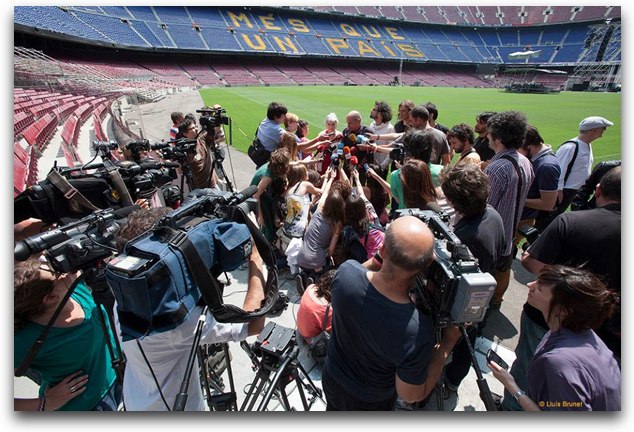
Photo art by Lluís Brunet
Tonight, in FC Barcelona's massive stadium in Barcelona, more than 60 groups (comprised of more than 450 artists!) will sing in a concert called “Concert per la Llibertat” or Concert for Freedom in support of Catalonia's desire to hold a referendum on independence from Spain. It sold out faster than Bruce Springsteen, though more seats were opened up afterwards behind the stage. Almost 100,000 will be in attendance.
Music has a long history of political action, both within and outside Catalonia. @MoltDeleros tells me that "for many years, lyrics with hidden meaning were the only way to defend our country and our way of being". The songs in the concert, he says, mostly come from poetry, some Catalan, some not."
@KatdeCanFanga tells me that there will be artists of all ages, some like Lluís Llach, himself a symbol of the pro-independence movement, have come out of retirement to sing. Here is a rough translation of Llach’s “Tossudament alçats” which the crowd is encouraged to sing along to:
Firmly on our feet
We are here, firmly on our feet
proclaiming the name, the time, and the place
that we grieve and that is ours,
if you want, with our fists open,
if necessary, with our fists closed,
so that the dream we share can come true.
From the very beginning and free of the past
people from all over allow ourselves the right to write the future
thinking that this old country
maybe holds the key
that can help us go farther, toward learning the art of life.
The Concert per la Llibertat was organized by Omnium Cultural and the Catalan National Assembly. Many news outlets have published the complete list of the participants and the songs they'll sing.
TV3 will retransmit the concert live on huge screens all over Catalonia as well as via Internet. It will also be broadcast via radio. Groups in Québec, London, Brussels, Santo Domingo, Paris, Mexico City, Buenos Aires, Edinburgh, Lausanne, and Cologne will gather to watch it together.
Yesterday, on El Món a RAC1, the presenter and guests talked about who would be there and who would not. Indeed, representatives from all of the major political parties except PP will be there and the Catalan government is sending a delegation (minus the president who is at his daughter's wedding).
The leader of the Catalan branch of Spain's ruling Partido Popular, Alícia Sánchez-Camacho, however, said, “Today's concert is a concert about rupture, exclusion, and division of all Catalans, and the Partido Popular will not allow it.” She then likened the concert to a witch's coven (!).
Some of the musicians have complained about receiving pressure not to perform at the concert. Dyango, a well known crooner famous for singing “Suspiros de España (Sighs of Spain)” said “he had received threats of all kinds”. When question about that song in particular, he said that he had sung many love songs in his day, and hadn't meant all of them literally.
Concert-goers who bring a non-perishable food item for the Food Bank will receive a commemorative bracelet.
Concert-goers who bring a non-perishable food item for the Food Bank will receive a commemorative bracelet.
In the end, as @KatdeCanFanga says “People are really happy because they/we want to shout again for #independence, like we did on September 11, 2012.”
Thursday, June 20, 2013
Hand in Hand for Catalan independence over 250 miles and 86 towns
The human chain will link municipalities in Catalonia between Pertús and Alcanar. The organizers have invited Valencians and Northern Catalans to continue the chain.
The Catalan National Assembly and Omnium Cultural announced yesterday the path of the human chain for independence that they are organizing for next September 11th. It will begin at 17:14 (commemorating the year the Catalans lost to the Spanish and French) and the chain will join Pertús in the Pyrenees with Alcanar at the southern tip of Catalonia, and will go mostly through towns near the coast and a few county seats: Figueres, Girona, Matarò, Sant Feliu de Llobregat, Vilafranca del Penedès, el Vendrell, Tarragona, Reus, and Amposta, and will also pass through the city of Barcelona, along many of its principal avenues, including the Diagonal, and through the Gothic Quarter (including Sant Jaume square, where both the Catalan and city government are situated) and the Eixample, among other neighborhoods.
These are the towns through which the human chain will pass: El Pertús, la Jonquera, Pont de Molins, Figueres, Santa Llogaia d'Àlguema, Bàscara, Orriols, Bàscara, Sarrià de Ter, Sant Julià de Ramis, Girona, Fornells de la Selva, Riudellots de la Selva, Tordera, Pineda de Mar, Calella, Sant Pol de Mar, Canet de Mar, Arenys de Mar, Caldes d'Estrac, Sant Andreu de Llavaneres, Mataró, Vilassar de Mar, Premià de Mar, El Masnou, Montgat, Badalona, Sant Adrià de Besòs, Barcelona, l'Hospitalet de Llobregat, Esplugues de Llobregat, Sant Just Desvern, Sant Feliu de Llobregat, Molins de Rei, Sant Vicenç dels Horts, Cervelló, Vallirana, Ordal, Cantallops, Sant Cugat Sesgarrigues, Olèrdola, Vilafranca del Penedès, Santa Margarida i els Monjos, la Ràpita, Castellet i la Gornal, Bellvei, l'Arboç, Coma-ruga, Creixell, Clarà, Torredembarra, Altafulla, Tarragona, Reus, Riudoms, Montbrió del Camp, Mont-roig del Camp, L'Hospitalet de l'Infant, l'Ametlla de Mar, El Perelló, l'Ampolla, Camarles, l'Aldea, Amposta, Sant Carles de la Ràpita and Alcanar.
The ANC has opened via.assembla.cat, with information about the "Catalan Way" which is identified with the #viacatalana hashtag on Twitter. Next week, people will be able to sign up to participate in a specific section of the path.
How did they choose the route?
The ANC explained why they chose the route, which mostly goes through coastal counties, and skips the interior, mountain ones, and Eastern ones, and also does not go into Valencia or North Catalonia. “It is the backbone of the Catalan Countries, and the ancient ‘Augustan Road’. That way the people of Valencia and North Catalonia, even though it's a work day, can continue the path in their territories. The Balearic Islands will also be able to have concurrent celebrations,” explained the group.
They also said, “The route we have chosen is easily accessible by a majority of the population and is basically flat and straight, with access for people of reduced mobility. It is close to most of the people, and especially the places where most people are and can join the process.” In addition, the ANC says that the path ensures that vehicles from Europe will be able to come and go without interference. Finally, it also “outlines a clear stretch of clear examples of lack of investment on the part of the Spanish government in Catalan infrastructure, like the N-340, N-II, and the Mediterranean train corridor.”
250 miles, 86 cities and towns
The ANC president, Carme Forcadell, explained yesterday that the September 11th demonstration last year had gone perfectly and that this year the idea was to go further still. “The Catalan Way is a political and logistical challenge,” she added. Forcadell pointed out that the Catalan Way represents the unity of the Catalan people in favor of the independence of Catalonia and that it demands that Catalans be able to “vote for independence in a referendum as soon as possible”.
Other speakers at the press conference, held in the Museum of Catalan History, included Rita Marzoa, spokesperson for Omnium Cultural, Ferran Civit and Ignasi Termes, members of the Secretariat Nacional, and two organizers of the Baltic Way of 1989, the Estonians Ülo Laanoja and Henn Karits. Marzoa, representing Omnium, pointed out the unity of the civil society in the process toward independence.
Civit and Termes, for their parts, explained the logistical details and the content of the chain. Civit pointed out how important it was that all of the lengths of the chain be connected and explained that if they were able to do that, then the chain would be a logistical success, and also a political one. Civit also explained that the path, which will go along the coast of Catalonia, from Alcanar to Pertús, will also allow the rest of the Catalan Countries to participate symbolically, even though outside of Catalonia it's not a holiday. For his part, Termes said that the process could not be delayed any longer, and that the path of the human chain would be over 250 miles long and would go through 86 different cities and towns in Catalonia.
Latest polls shows 70% would vote in favor of Catalan independence
The Catalan Government's Opinion Studies Center poll published today (Catalan English) confirms the trend of the El Periódico poll from a few weeks ago with increased support for pro-independence parties and for independence itself.
2000 people, distributed amongst Catalonia's four major metropolitan areas, were interviewed by phone between May 31 and June 13, 2013.
72.5% believe Catalonia has achieved an “insufficient level of autonomy”. Only 19.1% believe it has a “sufficient level” and less than 5% think it has too much.
47% believe that Catalonia should be an independent state. 21.2% that it should be a state in a federal Spain, 22.8% that it should be an autonomous region of Spain and 4.6% that it should be a region in Spain.
When asked how they would vote in a referendum to decide the independence of Catalonia, 55.6% said they would vote yes, and 23.4% said they would vote no, with 15.3% abstaining. In other words, if the abstainers stay home, the end results would be 70% in favor of independence (55.6/79) and 29.6% against.
There has been some question as to whether the CiU federation would be split by the independence vote, but the poll says 78% of CiU voters would vote in favor of independence, while only 7.9% would vote against, with 13% abstaining. That seems to indicate that Unió, led by Josep Anton Duran i Lleida, who has repeatedly stated that he is against independence, has little following, at least with respect to independence.
If elections to the Catalan Parliament were held tomorrow, the pro-independence and pro-referendum parties would win huge margins: 22% for ERC, 18.2% for CiU. The shift from CiU to ERC is hard to gauge. Is it frustration with economic crisis? Or frustration with distracting message from Unió/Duran? Continued support for independence would seem to indicate that the problem is not the referendum. If that were the issue, we'd see more voters fleeing to non-indyref parties like PP and C's, but that is not the case.
The Catalan Government has helpfully made available an English version (albeit shortened) of the poll.
The full report (in Catalan) has some additional interesting bits.
87.3% think that the current economic situation is 'bad' or 'very bad'. And 33.9% think it'll be worse next year, 38% say it'll be the same and only 21.9% say it will get better. That's not a lot of hope. When asked about their personal situation, 42.7% said it was the same as a year ago, and 52.2% say it was worse. I'd love to see that statistic over a longer timeframe.
Here's a question that I find hard to interpret: “How would you rate the political situation in Catalonia/Spain?” 70% said 'bad' or 'very bad' (in Catalonia), and 95.1% said it was 'bad' or 'very bad' in Spain, including a full 60% who said 'very bad'. It's such a general question. It could mean “Do you think the political system works?” or “Do you think politicians are corrupt (or self-interested)?” or “Are you worried about political situation?” or a slew of other things. Meanwhile, 59% are interested or very interested in politics. So, at the very least, they're not disengaging. Further, 63% say they talk about politics very frequently or frequently. And 69% consider themselves very well or well informed. Only 1% is very satisfied with “how our democracy works”, compared with 15.2% who are pretty satisfied and 56% who are hardly satisfied and 26.7% who are not satisfied at all.
People still rely heavily on television (82%) for political news, as compared with radio (40.3%), newspapers (60.8%), internet (39.5%), and friends/family (38.5%). And 50.6% say they watch TV news in Catalan (on TV3), as compared with less than 9% for all of the other channels (individually, not combined).
And the perennial question of how Catalan do you feel: 31% only Catalan, 25.7% more Catalan than Spanish, 35.6% as Catalan as Spanish, 2.6% more Spanish than Catalan, 3.6% only Spanish.
Sunday, June 2, 2013
Brussels think tank proposes mediation for Catalonia and Spain
Originally published in VilaWeb on June 2, 2013
Researcher at Brussels' principal think tank believes that either the EU or the UN could play this role
Brussels' principal think tank, the Centre for European Policy Studies (CEPS) has proposed that Catalonia and Spain name an “external mediator or counselor”. In an interview with the Catalan News Agency, Steven Blockmans, a Senior Research Fellow and Head of the EU Foreign Policy Unit, defended that “the EU or UN could play this role”, but warns that beforehand “both parties—Barcelona, but also Madrid—would have to voluntarily agree.” Blockmans said that both the referendum and the possibility of Catalonia and Scotland becoming independent are debated and “come up quite often” in Brussels, “although the European Commission won't official recognize that it's preparing for such an event”.
Blockmans recommended that if the Catalan government finds it impossible to negotiate with the Spanish government either about holding a referendum or what should happen after secession, that it should “at least try to convince it to invite the EU to serve as a mediator” and in this way get through the “political wall”. The senior research fellow and professor of both the University of Amsterdam and that of Lovania said that if Madrid agreed, “the exit and re-entry” of an independent Catalonia in the EU could “be fast-tracked” and “all that would be necessary would be a summit meeting” in Brussels, “with a simple meeting” in order to make the “political decisions”.
“Logically, Catalonia already fulfills all of the requirements for forming part of the EU, with respect to human rights, fundamental liberties, and the rule of law, and all of the EU legislation," reminded Blockmans. But at the same time, he points out that without an agreement, the Spanish government could veto the entry of the Catalan State into the EU. European legislation “says nothing about the secession of a member state,” but “in international law, the basic rule is that independence is illegal if there is no agreement between the affected parties," says Blockmans. "Obviously, a veto would have a high cost for Catalans and for businesses: borders would be reinstalled and the free circulation of people, goods, and capital would be restricted," says the Belgian researcher.
In declarations to ACN, Blockmans admits that that would be unacceptable and foresees that Catalonia and Spain will have to negotiate an agreement on the transition so that Catalans don't lose the rights and obligations that they currently have as EU citizens. “But if there is political blockage from a single member state, since unanimity is required, this transitional agreement wouldn't work,” he warns.
The head of the EU Foreign Policy Unit at CEPS recognizes that “the EU has motives for avoiding this situation,” but believes that the most interested party is Catalonia. Therefore, he encourages the Generalitat to start thinking about proposing an external mediator or counselor.
Friday, May 24, 2013
Three major Catalan political parties and ANC join forces in rally for independence
The ANC [Catalan National Assembly], Convergència, ERC, and the CUP joined forces in a rally in favor of independence in Sabadell
Josep Rull (CDC), Oriol Junqueras (ERC) and Quim Arrufat (CUP) defended independence with explanatory speeches aimed at convincing the undecided
by Oriol March in Sabadell, originally published on 23 May 2013 in Ara.cat
The Catalan National Assembly (ANC), CDC, ERC, and the CUP displayed pro-independence unity on Tuesday in a rally in Sabadell that was centered on explaining the reasons for an independent state to an audience of believers and from whom the speakers explicitly asked for support in broadening the majority in favor of independence. With the slogan, “2014: Let's make it possible”, the president of the ANC, Carme Forcadell, encouraged a joining of forces and criticized the oppressive attitude of the Spanish state.
Josep Rull, Organizational Secretary of the CDC, called for “asking for the moon”, using a phrase from poet Joan Maragall, and asked the pro-independence listeners to “appeal to people’s hearts” in order to convince them of the advantages of an independent state.
The president of ERC, Oriol Junqueras, called for “loving each other” as a way of achieving independence through the votes of the undecided. He specifically called on people who had been members of the PSUC, CCOO, and PSC in order to increase the numbers in favor of a “Yes” vote. “There is one thing that is more important than being pro-independence, and that is loving people,” stated Junqueras in his speech.
The member of parliament from the CUP, Quim Arrufat stated that Spain “builds walls and steals all that it can” and at the same time demanded that Catalonia “get rid of” the wall of “bankers, insults, and prejudices”. He also asked that people spread pro-independence feeling with “smiles”.
Dolors Camats, the national coordinator for ICV was slated to appear as well, but declined at the last minute because it was a purely pro-independence rally. Teresa Mira, also an eco-socialist, assured the crowd that ICV “is walking this path very slowly” but that it will serve as the “sweeper car” gathering stragglers in favor of a “Yes” vote.
Before Rull, Junqueras, Arrufat, and Forcadell took the stage, there were presentations by Montserrat Chacón (the ANC representative in Sabadell), Patrícia Gabancho (journalist and writer), Isona Passola (film producer), and Mercè Conesa, mayor of Sant Cugat and representative of the Association of Municipalities for Independence (AMI). That organization's president, Josep Maria Vila d'Abadal was not able to appear because of scheduling issues.
One of the most applauded speeches of the night came from actress Montserrat Carulla who opened with her traditional “I am Catalan, I am an actress, and I am in favor of independence” and who accused Franco of trying to dilute Catalonia with Spanish immigration during the years of his dictatorship.
Wednesday, May 22, 2013
The Catalan National Assembly's Plan B
(originally published in VilaWeb on May 22, 2013
The idea is that Catalans ask the Parliament to declare independence via the right of petition.
The Catalan National Assembly [Assemblea Nacional Catalana (ANC)] has launched a campaign to have Catalans ask their Parliament to exhaust all possible ways for holding a referendum on independence and—in the event that such a referendum is not authorized, or if the State does not accept the result—to unilaterally declare Catalonia’s independence. The initiative is based on the right of petition that is recognized by Catalan, Spanish, and international law and that permits citizens to ask any administration to act on matters that affect their interests or the interests of the the society as a whole for which they have established laws.
According to the President of the ANC, Carme Forcadell, the campaign’s goal is for the civil society to stand by the government and the Parliament and to force them to commit to the process of self-determination.
At the same time this morning as the Catalan Parliament was beginning to debate the Law of Referendums, the Catalan National Assembly introduced and launched a new tool that it designed to “help” and contribute so that the referendum can be carried out. The tool is the “Sign a vote for independence” campaign [Signa un vot per la independència], through which they hope to encourage Catalans to exercise their right to petition the Parliament. The petition in question is none other than to urge the Catalan Parliament to exhaust all the possible methods of holding a referendum up until May 31, 2014. In addition, it urges Catalan elected representatives—in the event this effort fails, either because the Spanish government refuses to authorize a referendum or because it will not accept the results of one—to unilaterally declare Catalonia's independence.
This last petition is addressed not only to the members of the Catalan Parliament, but also to the members and Senators of the Spanish Congress, and to mayors and selectpeople of Catalan municipalities. According to Agustí Carles, a member of the judiciary committee of the ANC, it was set up in this manner because there is also the possibility that the State might suspend the Catalan autonomous government, and in this case, the Parliament would not have the relevant jurisdiction though the legal representatives of the Catalan people would continue to be such.
The collection of signatures began on this very Wednesday and it was Forcadell herself who inaugurated the system during the presentation. Anyone 16 and older can sign—in person only—whether they be Catalan, Spanish, or some other nationality. The role of the ANC is only to serve as the collector of the signatures and to deliver all the petitions on the same day to the Parliament. According to those in charge of the campaign, they have not yet chosen the date to present the signatures because the tool would only be used in the event that the Law of Referendums does not move forward, or if the Spanish government refuses to accept the results of the referendum.
Carles explained that the right to petition is recognized by Catalan, Spanish, and international law. In the Catalan case, the Parliament has to process the petition through the petition committee and then give a response within three months of the receipt of same.
Forcadell remarked that, with this campaign, the ANC's goal is for the civil society to participate in the process of self-determination. The objective, according to what she explained, is that Catalans give support to the Government and the Parliament “who are already doing their job”, she declared. In addition, the tool can also be used to force the executive and legislative branches to commit to the celebration of a referendum since it specifies a particular date.
The campaign will be financed with the donations of the signers themselves, who will pay a symbolic fee of 1 euro upon signing. With those funds, a more international aspect of the campaign will be financed. Called “From Catalonia to the World” the initiative's goal is to develop a list of arguments that can be delivered to influential people all over the world who will help with the process. The people in charge of the campaign have explained that their goal is to spread knowledge about Catalonia “and its will to be independent” throughout the world, to give information about the demands for self-determination, and to "denounce the state of siege under which the State has Catalonia.”
What is the Plan B and how does one exercise the "right to petition"
The idea is that Catalans ask the Parliament to declare independence via the right of petition.
The Catalan National Assembly [Assemblea Nacional Catalana (ANC)] has launched a campaign to have Catalans ask their Parliament to exhaust all possible ways for holding a referendum on independence and—in the event that such a referendum is not authorized, or if the State does not accept the result—to unilaterally declare Catalonia’s independence. The initiative is based on the right of petition that is recognized by Catalan, Spanish, and international law and that permits citizens to ask any administration to act on matters that affect their interests or the interests of the the society as a whole for which they have established laws.
According to the President of the ANC, Carme Forcadell, the campaign’s goal is for the civil society to stand by the government and the Parliament and to force them to commit to the process of self-determination.
At the same time this morning as the Catalan Parliament was beginning to debate the Law of Referendums, the Catalan National Assembly introduced and launched a new tool that it designed to “help” and contribute so that the referendum can be carried out. The tool is the “Sign a vote for independence” campaign [Signa un vot per la independència], through which they hope to encourage Catalans to exercise their right to petition the Parliament. The petition in question is none other than to urge the Catalan Parliament to exhaust all the possible methods of holding a referendum up until May 31, 2014. In addition, it urges Catalan elected representatives—in the event this effort fails, either because the Spanish government refuses to authorize a referendum or because it will not accept the results of one—to unilaterally declare Catalonia's independence.
This last petition is addressed not only to the members of the Catalan Parliament, but also to the members and Senators of the Spanish Congress, and to mayors and selectpeople of Catalan municipalities. According to Agustí Carles, a member of the judiciary committee of the ANC, it was set up in this manner because there is also the possibility that the State might suspend the Catalan autonomous government, and in this case, the Parliament would not have the relevant jurisdiction though the legal representatives of the Catalan people would continue to be such.
The collection of signatures began on this very Wednesday and it was Forcadell herself who inaugurated the system during the presentation. Anyone 16 and older can sign—in person only—whether they be Catalan, Spanish, or some other nationality. The role of the ANC is only to serve as the collector of the signatures and to deliver all the petitions on the same day to the Parliament. According to those in charge of the campaign, they have not yet chosen the date to present the signatures because the tool would only be used in the event that the Law of Referendums does not move forward, or if the Spanish government refuses to accept the results of the referendum.
Carles explained that the right to petition is recognized by Catalan, Spanish, and international law. In the Catalan case, the Parliament has to process the petition through the petition committee and then give a response within three months of the receipt of same.
Forcadell remarked that, with this campaign, the ANC's goal is for the civil society to participate in the process of self-determination. The objective, according to what she explained, is that Catalans give support to the Government and the Parliament “who are already doing their job”, she declared. In addition, the tool can also be used to force the executive and legislative branches to commit to the celebration of a referendum since it specifies a particular date.
The campaign will be financed with the donations of the signers themselves, who will pay a symbolic fee of 1 euro upon signing. With those funds, a more international aspect of the campaign will be financed. Called “From Catalonia to the World” the initiative's goal is to develop a list of arguments that can be delivered to influential people all over the world who will help with the process. The people in charge of the campaign have explained that their goal is to spread knowledge about Catalonia “and its will to be independent” throughout the world, to give information about the demands for self-determination, and to "denounce the state of siege under which the State has Catalonia.”
Thursday, May 16, 2013
19 steps to Independence, according to Catalonia's National Transition Advisory Council
Originally published in VilaWeb, 16 May 2013
The Catalan government will receive the first report from the National Transition Advisory Council at the end of July with recommendations on how and when to hold the referendum on independence, and what question or questions should be formulated. This was the announcement made today by the president of the group, Carles Viver Pi-Sunyer, as he explained the task that the council will carry out over the next few months: they will write 19 reports, most of which outline the steps that need to be taken to move toward an independent Catalan State.
The first report will deal with how and when to convoke the referendum. Pi-Sunyer left open the possibility that there might be more than one question, that is, there might be two or even three, "in the form of a tree". "We will also the guarantees that the referendum should afford and the possible results and consequences that it will have. And what the reaction from the state may be," he explained. And in addition to the judicial analysis for holding a referendum, he also made it clear that they will examine "alternate, more political routes in order to be able to hold such a referendum".
The other 18 reports will be written, mostly by the end of the year, between October and December, while the remaining ones will be finished in the first trimester of 2014. They will be reports that analyze the fundamental decisions that will have to be taken assuming that the referendum will lead to the constitution of a new state. "We will help analyze the structures necessary in the event of a favorable result on the question of creating an independent state," said Pi-Sunyer, who did not close the door to the Council analyzing federal or confederal systems.
These are the 19 reports that the Council foresees creating:
1. The convocation of the referendum
2. The relationship of the new state with the EU. Will it be a member or not? If it si not, how will it be able to become one? What will happen with the Schengen Area and European Economic Space?
3. The relationship with the international community, from the United Nations to UNESCO, as well as all the other international organizations, including an analysis of what will happen with the treaties that Spain is a signer of.
4. The future relationship with the Spanish state. "The new state should have a very close relationship with the Spanish state," said Pi-Sunyer.
5. The succession of judicial regulations. "On Day 1 in the new state, we don't want to find ourselves with holes in the judicial system," observed Pi-Sunyer.
6. How to carry out the constituent process. A constitution will be necessary. "Perhaps one idea is that there would be a provisional constitution, and not try to create a Catalan Constitution from the start, the first week," says the Council president, who thinks such a document would have to cover fundamental rights, with references to the Statute of 2005, and that important decisions would have to be incorporated therein, like the question of dual nationality, or the status of the different languages.
7. Catalonia's judicial system. Pi-Sunyer says, "How many judges will we have, and how many secretaries of justice? We must ensure that we can administer justice right away. What will we do with the cases that are in process in the Spanish judicial system? What will we do with decisions from those courts? We will need a governmental body with judicial power."
8. Report on internal and international security.
9. Sectorial administration, for example electoral administration.
10. Economic topics, like the tributary agency in the new state, tax collection, etc.
11. Definition of the Catalan Tributary Agency
12. The financial institutions, like the Central Bank, and the maintenance of the euro.
13. The agencies and regulatory organizations that we should have, some of which are required by the EU.
14. The distribution of assets and debts between the Catalan and Spanish Governments, including the public debt.
15. The effects of an independent state on the business relationship between Spain and Catalonia.
16. How the Catalan Social Security system will work.
17. How to ensure access to energy and hydraulic resources starting on Day 1 after independence.
18. How telecommunications resources will be defined and distributed.
19. The internationalization of the process.
Wednesday, May 8, 2013
Spain's Constitutional Court suspends Catalonia's Declaration of Sovereignty
Originally published in VilaWeb on May 8, 2013
The State's Attorney General appealed the Declaration considering it an “open challenge to the constitution with political and judicial ramifications”
The Spanish Constitutional Court has suspended the Declaration of Sovereignty approved by the Parliament of Catalonia last January 23, and has agreed to hear the appeal of the Spanish Government. It’s the first time in the history of the democracy of the Spanish State that it has suspended a parliamentary declaration.
The consequences of the decision are not yet clear, since it might also effect legislation based on the declaration, like for example, the creation of the National Transition Advisory Council.
Now the Constitutional Court has five months—beginning from March 8, when the appeal was presented—to completely analyze the matter and decide if it will declare the declaration unconstitutional.
The appeal of the attorney general emphasizes the fact that the Catalan people cannot be a sovereign political or judicial subject and that, in any case, the sovereignty to decide on a hypothetical secession resides in the whole of the Spanish people. According to the attorney general's appeal, the Declaration of Sovereignty approved by the Parliament is an “open challenge to the constitution” which “has political and judicial ramifications”. For the attorney general, that the Catalan people be defined as a “sovereign political and judicial subject” is “neither more nor less than an act of constituent power” which attributes the right to secession to the Catalan people.
The Parliament is preparing its defense
The president of the Parliament, Núria de Gispert, announced that she has already ordered the legal services of the Catalan chamber to prepare the brief of the pleadings, which must be presented within twenty days. De Gispert qualified the decision as unusual, and noted that it doesn't make any “judicial sense” bringing a political declaration to the Constitutional Court. “We have never before had a proposed resolution, that has the meaning that it has, that comes from a political initiative, that is a political declaration; we have never before had a proposed resolution appealed before,” the president said. She has called for a meeting of the Board of Speakers on Thursday morning.
Monday, April 29, 2013
A Catalan State could benefit Spain
by Núria Bosch, originally published in Ara on 29 April 2013
I have heard it said that the independence of Catalonia would devastate the Spanish economy, and that this might be a reason for the European Union to be less than interested in the progress and success of the sovereignty process begun in our country of late.
But in light of this statement, it would be wise to take a look at the recently published paper titled "Where Spain is headed", from the Cercle Català de Negocis (CCN), a business association in favor of the Catalan State. The paper, among other things, talks about the benefits that the independence of Catalonia might bring to Spain. I found the reasons interesting, and thought I would comment on them here.
The first point is that independence could be just the catalyst for changing the economic and political model that the Spanish State needs. The idea is that, in order to get beyond the financial crisis, Spain needs to change its productive model, shrink its administrative structure, and replace its political and business elites.
That's all true. It has cost Spain dearly having an economic model based on construction and tourism, which both have a low added value, instead of promoting industry, research, and innovation. The Spanish government has failed to implement an economic policy in order to increase productivity or competitiveness both in the Zapatero era and now in Rajoy's administration. It has performed badly, on the fly, late, and with contradictions. You only have to look at the results of the economic policy that has been implemented, which generates a vicious circle of low growth and high unemployment and debt. And it doesn't look like the latest reforms make any attempt to change the economic model either. Therefore, Catalonia's independence may be the detonator that pushes Spain to change its productive model.
A second point is that a Catalan State would allow Spain to fully develop its own economic strategies. Catalonia and Spain have distinct business and economic strategies. The Catalan strategy is based on small and medium-sized, innovative, flexible, niche and export market-oriented businesses with a strong technology and industrial component. In contrast, the Spanish strategy is based on large businesses which operate in regulated sectors (banking, electricity, hydrocarbons, telecommunications, etc.) with a very important international presence, especially in Latin America.
In order to be successful, these two strategies require distinct (mercantile, labor, and financial) legislation and policies (especially with regard to infrastructures). So, the independence of Catalonia will allow the Spanish government to establish policies that are adequate for its own business model and to concentrate all its resources on Spanish companies, which will reinforce its competitiveness and job creation.
A third point is that the competition between the Catalan and Spanish economies on equal terms, each with their own state structures, would help Spain to progress. Well supported competition from an economic point of view always generates more efficiency and might push Spain to construct basic infrastructures according to their profitability and to abandon pharaonic white elephants. At the same time, the competition might encourage Spain to develop the tools it needs to compete with Catalonia to attract foreign investment. All of which would end up improving the competitiveness of Spanish businesses, which would increase the country's wealth.
In that same way, a Catalan State would have to dedicate resources to investments in infrastructures in order to strengthen the Catalan economy. This fact, which not only would facilitate the import of Spanish products and the export of products to Spain, would also reinforce the competitiveness of Spanish businesses, since it would make it easier for them to send their products to Europe.
A fourth and final argument would be that the economic strength of a Catalan State would be beneficial to the Spanish economy. A Catalonia with a strong economy would increase its imports of Spanish products and Catalan businesses would be able to make investments in Spain that would have a positive effect on its economy, at the same time that Catalonia could offer direct economic support to Spain.
In conclusion, all signs point to the recovery of Spain not having a V shaped curve (of improvement) but rather one shaped like an L (no recovery). Faced with this situation, in the medium and long germ, the independence of Catalonia could benefit the economy of the Spanish state and increase the well being of its citizens.
Núria Bosch holds a Bachelor Degree and a PhD. in Economics from the University of Barcelona. Bosch is Professor of Public Economics at the same university, director of the UB’s Chair in Fiscal Federalism at the Barcelona Institute of Economics (IEB) and one of the directors of the Fiscal Federalism Research Program at the same institute. The Barcelona Economics Institute is UB’s research center that carries out work in Applied Economics. She specializes in fiscal federalism, local and regional public finance, fiscal flows and public sector efficiency analysis. Her work has been published in specialized national and international journals and books, and she is a contributor to What's up with Catalonia?
Friday, April 12, 2013
Catalonia's National Transition Advisory Council will issue report on referendum before summer
Originally published in Vilaweb on April 11, 2013
They will write between 15-20 reports • Homs says the group’s work will benefit both those in favor of and against the creation of a sovereign state.
The National Transition Advisory Council was constituted this evening with the intention of preparing between 15 and 20 reports during 2013 and plans to have a report on the referendum itself ready before summer. The objective is to develop materials and sufficient arguments for debate among both those in favor and against the creation of a sovereign state.
The Councilor of the Executive, Francesc Homs, remarked that the council's work will benefit everyone, because there will be materials and documents that facilitate contrasting ideas, beyond the positions expressed in an electoral campaign, “when things were said that were not clarified or contrasted, because no one had delved very deeply into them”.
The President of the Council, Carles Viver Pi-Sunyer, made an initial proposal for a working plan but hoped to get consensus from the rest of the group’s members. In principle, it foresees developing between 15-20 reports during 2013 divided among four categories. The first is state structures, in which would be included a revenue agency, a central bank, other agencies and regulatory bodies, the judiciary, electoral administration and foreign service, for example.
In the second category are the processes. The most notable is the referendum, the report on which would have to be ready before the summer, but there will also be one on the transition of ordinances and norms (penal and mercantile codes), another on how the relationship will be forged with the EU, the relationship with international organizations, and how the relationship with the Spanish state will be articulated.
The third area is economics, and will contain a study of which resources the Catalan public administration will dispose of and which funding resources it will have to have, how assets and liabilities that are currently shared with Spain will be divvied up, and how contracts regarding goods and services will be dealt with that are controlled by the Spanish state.
The fourth area is reserved for specific topics, like social security, energy matters, security and defense, dual nationality, language and official status of languages.
Homs remarked that the council has a huge task before it and asked that it not be judged until after it files its reports, knowing that there is an “undeniable commitment to doing the job well, since the reports will be examined very closely”. He ensured that the reports would not be based on feelings, but rather on documentation, information, and data, and developed by a completely professional council. “We could have made it more partisan, but we opted not ” he noted.
The Councilor of the Executive recognized that the government's objective was to hold a referendum and with the winning option being the establishment of a sovereign state, but he said that the work of this council would serve those in favor as well as those against, because it would provide material for everyone to debate.
He added that “today, knowing what belonging to Spain means doesn't require a lot of study” because there are everyday examples all around, but that there much less available information about what it what it means to have a sovereign state.
The National Transition Advisory Council is presided by Carles Viver i Pi-Sunyer, director of the Institut d'Estudis Autonòmics (Institute for Studies on Autonomy). Its other members are:
Enoch Albertí i Rovira, professor of Constitutional Law at the University of Barcelona
Germà Bel i Queralt, professor of Economics at the University of Barcelona (Twitter)
Carles Boix i Serra, professor of Political Science at Princeton University (USA) (Twitter)
Núria Bosch i Roca, professor of Public Economics at the University of Barcelona (Twitter)
Salvador Cardús i Ros, professor of Sociology at the Autonomous University of Barcelona, and journalist (Twitter)
Àngel Castiñeira i Fernández, director of ESADE-URL's Leadership and Democratic Governing Chair and Department of Social Sciences.
Francina Esteve i Garcia, professor of International Law at the University of Girona
Joan Font i Fabregó, business leader, CEO of Grup Bon Preu.
Rafel Grasa, director of the Catalan International Institute for Peace
Pilar Rahola i Martínez, journalist and writer (Twitter)
Josep Maria Reniu i Vilamala, professor of Political Science at the University of Barcelona (Twitter)
Ferran Requjo i Coll, professor of Political Science at the Pompeu Fabra University (in Barcelona).
Joan Vintró i Castells, professor of Constitutional Law of the University of Barcelona
The National Transition Advisory Council will focus on identifying and analyzing all of the possible legal options for the national transition process, advising the government on strategic structures for the future government and Catalan institutions, optimizing available resources, proposing events and fomenting the distribution of information abut the national transition process throughout the international community and identifying sources of support, and advising the government on deploying institutional relationshiops in Catalonia so as to guarantee the process as a whole.
The Council is part of the Department of the Presidency (Executive), which offers administrative and logistical support, and is coordinated by the head of this department, in agreement with the vice president of the Government. As with other advisory councils of principle aspects of political action in Catalonia, the seats on the National Transition Advisory Council are unpaid positions.
They will write between 15-20 reports • Homs says the group’s work will benefit both those in favor of and against the creation of a sovereign state.
The National Transition Advisory Council was constituted this evening with the intention of preparing between 15 and 20 reports during 2013 and plans to have a report on the referendum itself ready before summer. The objective is to develop materials and sufficient arguments for debate among both those in favor and against the creation of a sovereign state.
The Councilor of the Executive, Francesc Homs, remarked that the council's work will benefit everyone, because there will be materials and documents that facilitate contrasting ideas, beyond the positions expressed in an electoral campaign, “when things were said that were not clarified or contrasted, because no one had delved very deeply into them”.
The President of the Council, Carles Viver Pi-Sunyer, made an initial proposal for a working plan but hoped to get consensus from the rest of the group’s members. In principle, it foresees developing between 15-20 reports during 2013 divided among four categories. The first is state structures, in which would be included a revenue agency, a central bank, other agencies and regulatory bodies, the judiciary, electoral administration and foreign service, for example.
In the second category are the processes. The most notable is the referendum, the report on which would have to be ready before the summer, but there will also be one on the transition of ordinances and norms (penal and mercantile codes), another on how the relationship will be forged with the EU, the relationship with international organizations, and how the relationship with the Spanish state will be articulated.
The third area is economics, and will contain a study of which resources the Catalan public administration will dispose of and which funding resources it will have to have, how assets and liabilities that are currently shared with Spain will be divvied up, and how contracts regarding goods and services will be dealt with that are controlled by the Spanish state.
The fourth area is reserved for specific topics, like social security, energy matters, security and defense, dual nationality, language and official status of languages.
Homs remarked that the council has a huge task before it and asked that it not be judged until after it files its reports, knowing that there is an “undeniable commitment to doing the job well, since the reports will be examined very closely”. He ensured that the reports would not be based on feelings, but rather on documentation, information, and data, and developed by a completely professional council. “We could have made it more partisan, but we opted not ” he noted.
The Councilor of the Executive recognized that the government's objective was to hold a referendum and with the winning option being the establishment of a sovereign state, but he said that the work of this council would serve those in favor as well as those against, because it would provide material for everyone to debate.
He added that “today, knowing what belonging to Spain means doesn't require a lot of study” because there are everyday examples all around, but that there much less available information about what it what it means to have a sovereign state.
New Members and a vice president
The Council president nominated a vice-president, Dr. Núria Bosch. In addition, a new member was added, Rafel Grasa, director of the Catalan International Institute for Peace. In total, there are now 14 members, with one seat that is temporarily vacant.The National Transition Advisory Council is presided by Carles Viver i Pi-Sunyer, director of the Institut d'Estudis Autonòmics (Institute for Studies on Autonomy). Its other members are:
Enoch Albertí i Rovira, professor of Constitutional Law at the University of Barcelona
Germà Bel i Queralt, professor of Economics at the University of Barcelona (Twitter)
Carles Boix i Serra, professor of Political Science at Princeton University (USA) (Twitter)
Núria Bosch i Roca, professor of Public Economics at the University of Barcelona (Twitter)
Salvador Cardús i Ros, professor of Sociology at the Autonomous University of Barcelona, and journalist (Twitter)
Àngel Castiñeira i Fernández, director of ESADE-URL's Leadership and Democratic Governing Chair and Department of Social Sciences.
Francina Esteve i Garcia, professor of International Law at the University of Girona
Joan Font i Fabregó, business leader, CEO of Grup Bon Preu.
Rafel Grasa, director of the Catalan International Institute for Peace
Pilar Rahola i Martínez, journalist and writer (Twitter)
Josep Maria Reniu i Vilamala, professor of Political Science at the University of Barcelona (Twitter)
Ferran Requjo i Coll, professor of Political Science at the Pompeu Fabra University (in Barcelona).
Joan Vintró i Castells, professor of Constitutional Law of the University of Barcelona
The National Transition Advisory Council will focus on identifying and analyzing all of the possible legal options for the national transition process, advising the government on strategic structures for the future government and Catalan institutions, optimizing available resources, proposing events and fomenting the distribution of information abut the national transition process throughout the international community and identifying sources of support, and advising the government on deploying institutional relationshiops in Catalonia so as to guarantee the process as a whole.
The Council is part of the Department of the Presidency (Executive), which offers administrative and logistical support, and is coordinated by the head of this department, in agreement with the vice president of the Government. As with other advisory councils of principle aspects of political action in Catalonia, the seats on the National Transition Advisory Council are unpaid positions.
Wednesday, April 3, 2013
100 days of the government, a half of a year for the country, by Vicent Partal
by Vicent Partal. Originally published in VilaWeb on 3 April 2013
Artur Mas' second government is 100 days old. It's a government that has systematically fulfilled that which it promised for what it calls the “national transition”, even as it still seems shell-shocked from electoral results that it did not expect and as it finds itself trapped in a frightening daily routine of financial hardships and endless budget cuts. It is an unpleasant situation that encourages those who don't want Catalonia to move forward in the independence process, and who are convinced that by stopping the government they can stop everything. They get ahead of themselves.
Because it's essential to note that the approval of the budget or an imagined financial pact with Madrid is not a big enough obstacle compared with the ambition, volume, and consistency of the Catalan sovereignty process. They are real difficulties that those who were voted in at the polls must simply get through. But they're nothing more than that. Whoever believes that the process towards independence will be stopped if the budget is not approved or because of a squabble between two factions has not understood anything about what has been going on in this country in the last few years.
What we are experiencing, above all, is a democratic revolt clearly directed by the citizenry. From below. Fomented by a mature and rigorous citizenry that knows perfectly well that in the Europe of the 21st century it is the politicians’ job to find the paths that make collective projects possible. By a citizenry that, cognizant of this fact, does not get skittish at the first difficulty. By a citizenry that has learned a lot about its own strength, its own empowerment, and its own demonstrated capacity to move the debate toward terrains where no one had placed it before.
And I don't have a single reason to believe that this citizenry, that this country, will not hold course to where it was six months ago. What there was on September 11th has neither disinflated nor is there any prevision on the horizon that anyone could disinflate it. How the Parliament of Catalonia and the Government will find an adequate path is a worry, that's clear. And how long this terrible situation is dragged out, agonizingly dragged out, and which we all suffer and that no one deserves, is also a source of worry. And that's it: the worry is nothing more than worry. Momentary, circumstantial, concrete. It doesn't invalidate the project.
I'll say it another way: when they write the chapter on the whole process, the budget talks and the money from Moncloa won't make it out of the the footnotes. Let's not be confused about that now either...
Tuesday, April 2, 2013
Statement of UN Secretary General Ban Ki-Moon on Self-determination processes in Europe
This is what United Nations Secretary General Ban Ki-Moon had to say today in Andorra in response to a question about the UN's attitudes toward processes of self-determination in Europe:
You can hear the original recording on the report at Vilaweb, in the middle of the right-hand column. The initial question is in Catalan, but the Secretary General's statement is in English.
The United Nations has a firm and principled position that human rights and human dignity should be firmly upheld and protected every year, and all the pending issues between the countries and among the countries should be resolved through peaceful means, through dialog, respecting the genuine aspirations of the people concerned. This is what I can tell you as the Secretary Genereal.
And I really urge the leaders around the world to exercise their political will, political leadership, and wisdom to resolve all the issues through dialog and peaceful means.
You can hear the original recording on the report at Vilaweb, in the middle of the right-hand column. The initial question is in Catalan, but the Secretary General's statement is in English.
Thursday, March 28, 2013
Google Mapping to focus independence efforts
Marc Belzunces published a cool mapping of Catalonia's Parliamentary election results on Tuesday, and it has generated enormous interest. It uses color to gauge pro-independence feeling by illustrating how people voted with respect to independence in the last elections.
The most exciting part to me is how he explains how to use the map to focus independence efforts in areas with current support between 30 and 50%. It is a monumental and brilliant way of using technology.
First, if you download Marc's KMZ files, and then open them into Google Earth, here's what you'll see as an overview of feeling on independence, based on how people voted in the Parliamentary elections on November 25, 2012:

In this map, dark blue means super-majority (>50%) in favor of independence, light blue shows a majority in favor of independence, orange means majority in favor of union, and red means super-majority in favor of union. Also note that “in favor of independence” is a rough shorthand for votes for the parties with independence in their platforms, namely CiU, ERC, and CUP, while "in favor of union" is a rough shorthand for votes parties opposed to independence, that is, PSC, PP, and Cs. Of course, there is not a 100% correspondence between an individual's stand on independence and their support for any political party. Also, since ICV (eco-greens) are not clearly pro independence or union, their votes are not reflected here.
It's good to remember, seeing that sea of blue, that the vast majority of Catalonia's population of 7.5 million is concentrated in (1.6M) and around (3.2M) Barcelona and the other metropolitan areas, where the situation is more complex, as you can see by zooming in. The areas surrounding Barcelona, often referred to as the "red belt", have high concentrations of Spanish-speaking, working class people from Andalusia, Extremadura, and other parts of Spain, that, historically, have tended to vote unionist. However, as Marc points out, it's not nearly as monochromatic as people like to think:

Marc found that pro-independence sentiment is greater in the historic center of metropolitan areas, like Terrassa, shown here:

Perhaps most interesting from a political and technological point of view is the map that Marc has made to "prioritize efforts for the pro-independence campaign". The map is a gradation of colors showing support for pro-independence parties (CiU, ERC, CUP, and SI), in which:
Dark green indicates 40-50% in favor of independence
Light green indicates 30-40% in favor of independence
Yellow: 20-30%
Orange: 10%-20%
Red: below 10%
The uncolored, transparent areas, which is most of the country, is where independence garners more than 50% support.

Marc recommends focusing effort in those areas in which support for independence is between 30-50%, that is the green areas.
Indeed, I think the most remarkable part of this whole effort is that it is yet another example of someone using publicly-available information to make a tool that others can take advantage of in order effect political change. Anyone can download Marc's KMZ map overlays and then, as he recommends, "spend a few hours playing around with them, analyzing the data and its distribution. And then making decisions about where to act."
Indeed, another person I follow on Twitter, Catalina Ionescu, did just that, and discovered that a few of the most unionist areas of otherwise blue, metropolitan Barcelona correspond to areas with strong Spanish military presence. For example, the area around the Bruc Military Barracks:

It will be interesting to see what else people come up with.
Some additional notes:
Marc commented to me shortly after I originally published this article, the pro-independence areas (dark and light blue) include 70% of Catalonia's electorate. The unionist areas are 30%. He also said that the "areas with simple majorities (light blue and orange) make up 56% of the data. These are the "battle zones".
The most exciting part to me is how he explains how to use the map to focus independence efforts in areas with current support between 30 and 50%. It is a monumental and brilliant way of using technology.
First, if you download Marc's KMZ files, and then open them into Google Earth, here's what you'll see as an overview of feeling on independence, based on how people voted in the Parliamentary elections on November 25, 2012:
In this map, dark blue means super-majority (>50%) in favor of independence, light blue shows a majority in favor of independence, orange means majority in favor of union, and red means super-majority in favor of union. Also note that “in favor of independence” is a rough shorthand for votes for the parties with independence in their platforms, namely CiU, ERC, and CUP, while "in favor of union" is a rough shorthand for votes parties opposed to independence, that is, PSC, PP, and Cs. Of course, there is not a 100% correspondence between an individual's stand on independence and their support for any political party. Also, since ICV (eco-greens) are not clearly pro independence or union, their votes are not reflected here.
It's good to remember, seeing that sea of blue, that the vast majority of Catalonia's population of 7.5 million is concentrated in (1.6M) and around (3.2M) Barcelona and the other metropolitan areas, where the situation is more complex, as you can see by zooming in. The areas surrounding Barcelona, often referred to as the "red belt", have high concentrations of Spanish-speaking, working class people from Andalusia, Extremadura, and other parts of Spain, that, historically, have tended to vote unionist. However, as Marc points out, it's not nearly as monochromatic as people like to think:
Marc found that pro-independence sentiment is greater in the historic center of metropolitan areas, like Terrassa, shown here:
Perhaps most interesting from a political and technological point of view is the map that Marc has made to "prioritize efforts for the pro-independence campaign". The map is a gradation of colors showing support for pro-independence parties (CiU, ERC, CUP, and SI), in which:
Dark green indicates 40-50% in favor of independence
Light green indicates 30-40% in favor of independence
Yellow: 20-30%
Orange: 10%-20%
Red: below 10%
The uncolored, transparent areas, which is most of the country, is where independence garners more than 50% support.
Marc recommends focusing effort in those areas in which support for independence is between 30-50%, that is the green areas.
Indeed, I think the most remarkable part of this whole effort is that it is yet another example of someone using publicly-available information to make a tool that others can take advantage of in order effect political change. Anyone can download Marc's KMZ map overlays and then, as he recommends, "spend a few hours playing around with them, analyzing the data and its distribution. And then making decisions about where to act."
Indeed, another person I follow on Twitter, Catalina Ionescu, did just that, and discovered that a few of the most unionist areas of otherwise blue, metropolitan Barcelona correspond to areas with strong Spanish military presence. For example, the area around the Bruc Military Barracks:
It will be interesting to see what else people come up with.
Some additional notes:
Marc commented to me shortly after I originally published this article, the pro-independence areas (dark and light blue) include 70% of Catalonia's electorate. The unionist areas are 30%. He also said that the "areas with simple majorities (light blue and orange) make up 56% of the data. These are the "battle zones".
Subscribe to:
Posts (Atom)